
In Netflix’s new documentary, BTS: The Return, initial studio sessions for Arirang aren’t music to the ears of all the group’s members.
Photo: Courtesy of Netflix
When director Bao Nguyen set out to document BTS’s long-awaited comeback as a group, he had Greek mythology on his mind. Nguyen told press in Seoul that when he saw Jin, Suga, J-Hope, RM, Jimin, V, and Jung Kook speaking to the crowd at one of their last U.S. concerts before their mandatory military service, BTS reminded him of Odysseus, while their Army wives fans were like the Homeric hero’s waiting wife, Penelope. But the documentary ended up telling more than just a story of yearning for a return. Following the March 20 release of BTS’s latest album, Arirang, people have debated whether a project named for a Korean folk song needs more Korean lyrics, whether the track list feels cohesive enough, and whether it is sonically the right next step for BTS’s discography to take. BTS: The Return demonstrates that the group anticipated and debated some of those same concerns in songwriting sessions and meetings with company execs at Big Hit Music and HYBE. They weren’t necessarily confident in how fans would feel about their final choices. “In the end, it’s good as long as people like it,” Suga suggests at one point. “We never know what’s going to take off. That’s just how it is.”
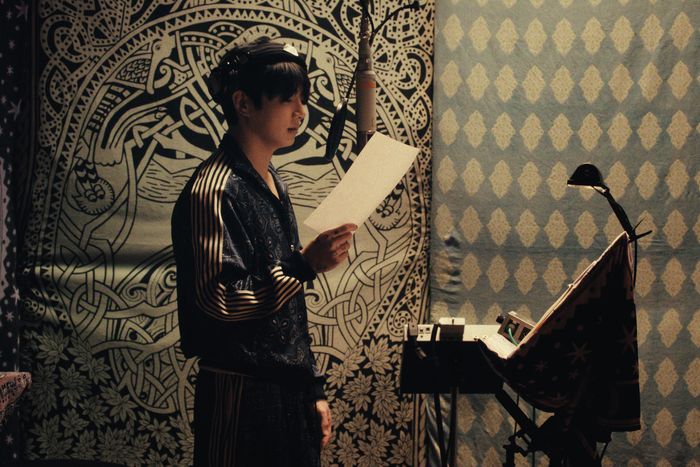
Along with home-video-style footage shot by the members on camcorders, Netflix’s cameras follow the K-pop stars in the L.A. home they stayed in during the album-creation process, the studio where they worked with producers like Diplo and Pdogg, and the cars that brought them back and forth between both places. Nguyen still regrets that the weather and timing didn’t work out for him to get a shot of one undisclosed member riding a motorcycle through Seoul, but we do get several scenes of the members’ lives outside of the group.
Below are the seven biggest takeaways from BTS: The Return, in which the septet reacts to its past — gold-chain–and–guyliner era included — and tries to figure out its future as “BTS 2.0.”
The scheduled March release date for Arirang put BTS in a time crunch, essentially giving them only a summer to work on the album in L.A. before heading back to Korea to mix it. That meant the group started working on songs while Jin was still on his solo world tour. When the eldest member joins the rest of the group a day after finishing said tour, J-Hope welcomes him with a bouquet of flowers and Suga explains that “most of” the album is already done. The group now just needs a lead single and a main performance piece but is in somewhat of a creative rut in these final sessions. At one point in the studio, Jin laughs and says, “I don’t know why I’m here.” (V chuckles and responds, “Hyung, we all feel the same way.”)
Although Jin notes, back at their shared home, that he wants the group to really enjoy this process, it seems difficult to do with the pressure of the looming deadline. As Jimin puts it, BTS are “hauling ass” because they’ve been gone for so long that they don’t want to extend the break any further. J-Hope at one point describes the making of Arirang as “systematic, like working in a factory.” Jin later acknowledges that he was initially a little unsure of his role given that he was clocking in a little later than everyone else but that he ultimately “knew exactly what to do.” Still, BTS is once again one worker short by the end of the summer; Jin has to leave the L.A. sessions before the other members due because of his solo schedule.
With just a couple of weeks left in L.A., some of the members still feel lost about the overall message or theme of this project. Big Hit executive creative director Boyoung Lee proposes that the album reference the history of the first known recording of the Korean folk song “Arirang,” which was made by seven Koreans who came to the U.S. and studied at Howard University in 1896. Lee also notes that the meaning of the word arirang has been connected to a deep longing for loved ones, which she suggests could be connected to BTS’s passion for their fans and music.
In that vein, “Arirang” is sampled in the album’s opening track, “Body to Body.” On the last day in L.A., RM is worried that the song contains too many disparate elements and compares the listening experience to eating a mixture of bread, pork cutlets, and kimchee. “Wait, why does that sound fucking delicious?” Jimin counters. While J-Hope asserts that the sample gives him goosebumps, V and RM worry that incorporating too much of “Arirang” will feel overly heavy-handed to Korean listeners. Even J-Hope isn’t thrilled with a later version of the track that extends the “Arirang” part.
HYBE chairman Bang Si-hyuk eventually makes the case personally for the longer version, asking the members to consider how it would feel to see tens of thousands of foreigners singing along to that much of the iconic folk song. Again, the company reminds them that their target audience is more global now. “I believe you will gain much more without losing too much musically,” Bang says. “For me, it’s not a matter of choosing a ‘good’ or ‘bad’ song.”
The members consistently acknowledge that this lead single is a mellower departure from their usual style; when RM reflects in a meeting that the song feels a bit low in energy, Jung Kook says the entire track feels that way. “I’d hesitate a bit before playing this for someone,” J-Hope adds. But Suga points out that the group was similarly unsure before releasing “Dynamite,” making the case that it will be cool to come back with a different vibe.
It’s a conversation the members are having outside the group, too. When V has dinner with a group of friends that includes actors Park Hyung-sik, Park Seo-joon, and Choi Woo-shik. He tells them they chose the “mildest” of the more in-your-face songs to be the lead single, characterizing it as a song you can play on repeat without getting tired of. Meanwhile, Jimin says one of his friends can’t accept that “Swim” is the lead single, noting that people expect powerful, high-energy dance songs from BTS. Jimin says he shares a sentiment previously expressed by RM — that if BTS is going to change or take a risk, now is the time to do it — but is admittedly still a little nervous because of a lack of “conviction” among the members.
In one meeting, Suga and RM express a desire to add more Korean lyrics, particularly in the rap verses. “Authenticity matters,” RM says. But Big Hit Music vice-president Nicole Kim pushes back, suggesting they need to try if they want the album to go global. The members are worried about having enough time to get the pronunciations right. “No matter how hard we try, what sucks will suck,” Jimin says. Even RM — who acknowledges on the album track “Aliens” that he’s the group’s most fluent English speaker — questions whether his lyrics sounds awkward because he’s not a native speaker during a session with songwriter A.Chic.
“Lyrics that only speak to us won’t be heard by anyone else,” V suggests in one meeting. And there’s bad news for fans whose favorite BTS songs are “On” or “Black Swan”: Kim, the VP of Big Hit, specifically identifies them as examples of songs that aren’t very “relatable.” J-Hope suggests the lyrics of “Swim” should be “more accessible and inclusive.”
Throughout the documentary, we see several boards with references and inspirations for BTS 2.0 that are plastered with photos and sticky notes laying out inspirations. One such board includes the covers of Charli XCX’s Brat and Travis Scott’s Astroworld. In a later meeting, we see some boards in the background that are covered with photos of BTS members from past album cycles.
Perhaps the most surprising moment of the entire documentary is that all of BTS is able to spend an afternoon hanging out on a beach in Santa Monica without getting mobbed by the public. Nguyen told the press that he had actually been hoping for a Beatles-esque moment in which they were recognized, but the members ended up being able to kick around a ball, sit, chat … and, yes, go for a swim.