
The battle over the Carrière de la Corderie, the 2,600-year-old Greek limestone quarry in Marseille, has reached a definitive—albeit controversial—conclusion. What began as a desperate grassroots movement in 2017 to save the birthplace of France’s oldest city from luxury real estate development has evolved into a landmark case study in the tension between urban modernization and archaeological preservation.
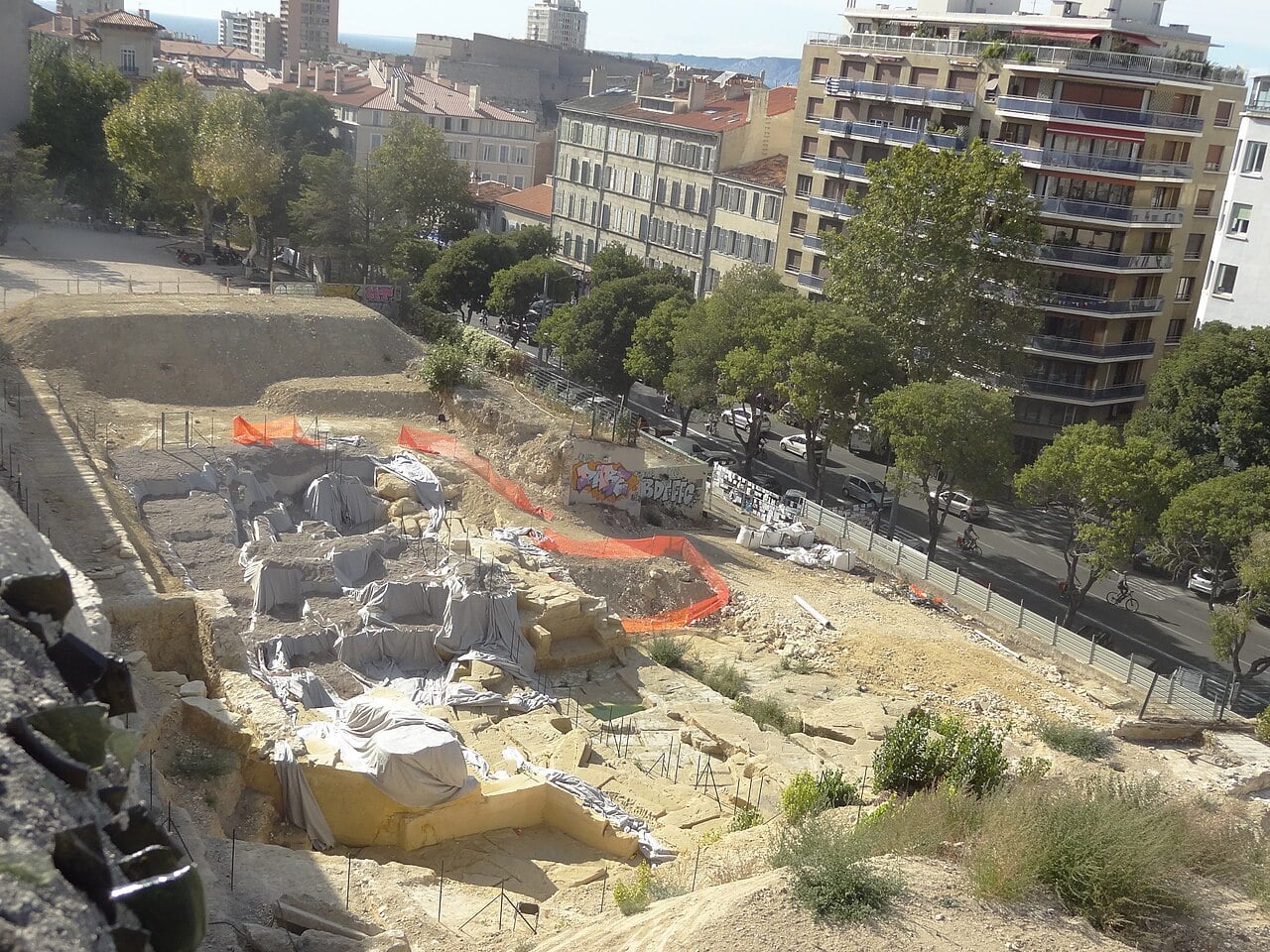
Discovered during preventive excavations for a residential project, the quarry dates back to the 5th century BC. It was the primary source of the limestone used by the Phocaean Greeks to build the ancient city of Massalia. Despite its immense historical value, the site’s survival was not guaranteed.
10% protection for Marseille’s Ancient Greek quarry
Following years of legal battles and protests that saw thousands of Marseille residents take to the streets, the French Ministry of Culture reached a compromise. Only 635 square meters of the site—roughly 10% of the total archaeological find—were officially classified as a Historic Monument. This protected “island of antiquity” features the most well-preserved extraction basins and tool marks left by Ancient Greek masons.
However, for many activists, the victory was bittersweet. The remaining 90% of the ancient site was handed back to developers. Today, a luxury apartment complex towers over the ruins, with the preserved section of the quarry effectively “caged” within the private development’s footprint.
Public access and modern discoveries
As of 2026, the site remains a point of contention regarding public access. While the city promised a “window into the past,” the ruins are mostly visible through glass barriers from the Boulevard de la Corderie. Physical access is generally restricted to special occasions, such as the European Heritage Days, leaving local associations to continue their fight for a more integrated, open-air museum experience.
Despite these frustrations, the Corderie site has sparked a renaissance in Marseille’s Greek history. Recent excavations in late 2025 have uncovered Ancient Greek vineyards on the city’s outskirts, providing a fuller picture of the colony’s economic life. Furthermore, chemical “fingerprinting” of the Corderie stone has allowed researchers to identify exactly which ancient structures across the Mediterranean were built using Marseille’s limestone.
The Corderie quarry stands today as a permanent reminder of Marseille’s Hellenic soul. While the concrete of the 21st century now surrounds it, the Ancient Greek spirit remains carved into the white stone beneath, stubbornly refusing to be forgotten.
Related: The Greek Origins of Marseille, France’s Oldest City