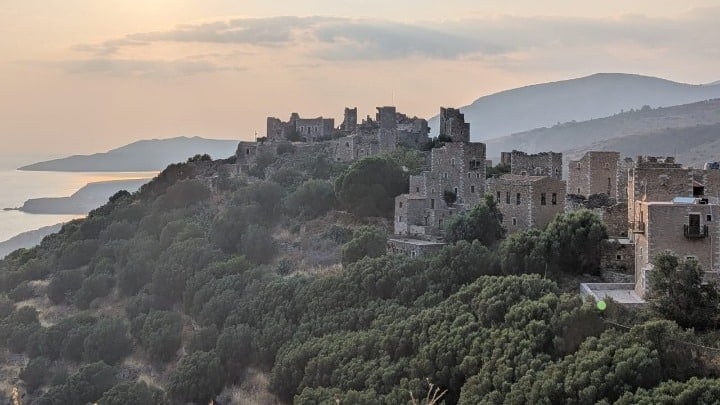
The Mani Peninsula, a land where pagan traditions survived long after most of Greece had embraced Christianity, rises dramatically from cliffs and jagged mountains, its secluded coves carved by wind and sea.
Covering roughly 1,800 square kilometers (695 sq mi), Mani forms the middle of the region’s three southern prongs, stretching from the Taygetus Mountains to Cape Tainaro, where the Ionian and Aegean seas meet in the southern Peloponnese. Administratively, the peninsula falls under the prefectures of Laconia and Messenia. The Messenian section is known as Exo Mani, the central stretch from Oitylo to Gerolimenas is Meso Mani, and the southernmost reach—from Gytheio to Cape Tainaro—is Kato Mani.
Pagan roots and the origins of the name Mani
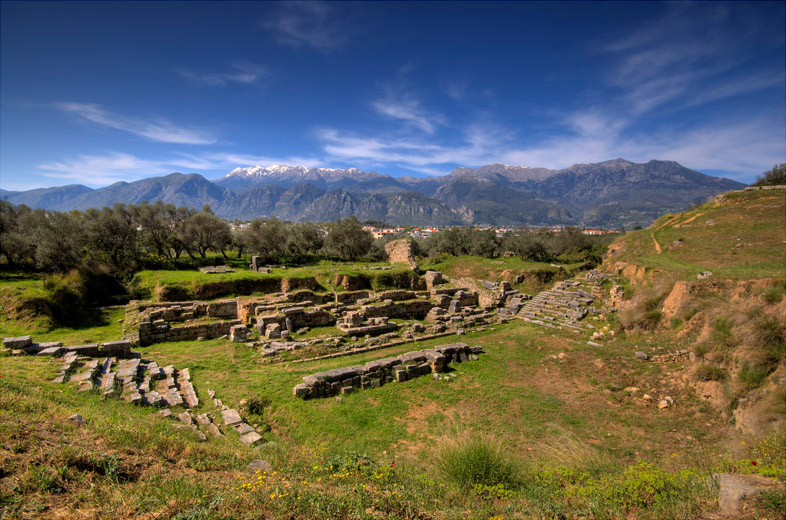
Mani has been inhabited continuously since the Paleolithic era. Archaeological sites, including Areopoli and the Alepotrypa Cave of Dirou, attest to some of the region’s earliest settlements. Homer himself refers to several cities in the area, including Messe, Voitylon, and Kardamyli. In later centuries, Mani’s history became closely intertwined with that of Sparta, though it maintained a degree of separation under the Koinon of the Lacedaemonians, a federal political organization, until the third century AD. Thereafter, control of the peninsula passed to the Eastern Roman Empire and, subsequently, to Byzantium.
The origin of the name “Mani” has long been a subject of debate. The most widely accepted theory traces it to a fortress known as Maini, constructed during the reign of Emperor Justinian in the 6th century AD near Cape Tiganis, close to the harbor of Mezapo. According to historian Apostolos V. Daskalakis, the surrounding region gradually adopted the fortress’s name, which eventually evolved into “Mani.” Sources from the 10th century, including Constantine VII Porphyrogenitus, confirm that the name was already in local use, suggesting that the fortress played a decisive role in shaping the peninsula’s identity.
Other explanations have been proposed, though they are generally considered less persuasive. One theory derives the name from the Latin word “Manus,” meaning “hand,” based on the peninsula’s resemblance to an outstretched arm; historical documents refer to it as “Brazzo di Maina,” and Maniot flags often depict a hand gripping a sword.
Another theory connects the name to “Manes,” the spirits of the dead, reflecting Cape Tainaro’s ancient association with the Underworld. Some scholars link it to “Maina,” a term associated with lowering sails in safe harbors during storms. Still others argue that the name reflects the fierce and unyielding character traditionally attributed to the Maniots.
Pagan survival and sacred landscapes
Mani’s strong sense of identity enabled it to preserve Greek culture and customs far longer than most of the Peloponnese. Even into the 10th century, Maniots referred to themselves as “Hellenes” and remained largely unmixed with Slavic settlers elsewhere. Scholars such as Gustav Friedrich Hertzberg regarded them as the true descendants of the ancient Lacedaemonians, the inhabitants of the Ancient Greek city-state of Sparta.
Christianization reached Mani slowly, impeded by its rugged terrain and tightly bound clan society. Archaeological evidence indicates that churches began appearing in the 5th and 6th centuries, yet older pagan practices continued for generations, observed in private or semi-public spaces. In several instances, Christian sites were constructed directly atop earlier pagan temples, resulting in a layered sacred landscape that reflects the region’s complex religious history.
The Monastery of Panagia Yiatrissa (“Mary the Healer”) in Kastania, on the slopes of Taygetus, is traditionally believed to stand on the ruins of an ancient temple dedicated to Athena. In villages around Areopoli, Kitries, and other Maniot settlements, Roman-era architectural elements from nearby sanctuaries were incorporated into local churches.
The Church of Agios Theodoros in Vamvaka, a typical cross-in-square Byzantine church, contains reused epistyle beams, inscriptions, and fragments from earlier structures. Similarly, the 13th-century Church of St. John (Agios Ioannis) in Keria features an unusually large number of embedded ancient and medieval carved reliefs, columns, capitals, and dressed stones embedded in both its exterior and interior walls. Together, these sites preserve a tangible “material memory” of Mani’s pre-Christian past, weaving pagan heritage directly into the Christian landscape.
Conversion, resistance, and enduring identity
Despite prolonged resistance, Byzantine sources report that Mani’s conversion eventually took place—and not peacefully. Constantine VII Porphyrogenitus credits Emperor Basil I with bringing Christianity to Mani, implying that imperial pressure and coercion played a decisive role. Even so, Maniots preserved their customs and sense of identity long after most Greeks had converted. Under Basil’s rule, pagan rites became increasingly difficult to sustain. The emperor employed both military force and clerical authority, reflecting a broader Roman Empire pattern in which conversion often unfolded alongside violence and compulsion.
Mani’s cultural endurance was also rooted in its social and martial organization. Villages revolved around powerful clans in which loyalty to family and community outweighed allegiance to distant rulers. Geographic isolation, combined with strong internal cohesion, allowed traditions to persist. Pagan rituals continued at weddings, funerals, and harvest festivals, while oral storytelling safeguarded history, mythology, and customary law. Even as trade and limited travel introduced outside influences, Maniots adopted only what they chose, carefully preserving their distinct identity.
This resilience enabled Mani to remain a Hellenic stronghold even as Byzantium imposed cultural conformity elsewhere. It is no coincidence that Pletho Gemistus, the last pagan Neoplatonist philosopher, was born in Laconia near Mani. His life embodies the intellectual and cultural legacy of the region—a final echo of Greek pagan tradition that endured deep into the Byzantine era.
Mani stands as the last bastion of pagan Greece within the Byzantine Empire. Its geography, social cohesion, and fierce independence allowed Maniots to safeguard Greek traditions, rituals, and identity longer than most of the Peloponnese. In doing so, Mani offers a rare window into pre-Christian Greek life, demonstrating how landscape, society, and cultural memory can preserve traditions across centuries.