
From 31 January to 17 February 2026, the Venice Carnival celebrates the year of the Milan-Cortina 2026 Olympic and Paralympic Winter Games with a special edition dedicated to the theme ‘Olympus – At the Origins of the Game’, a great collective tale that interweaves myth, history, art and sport, bringing the game back to the centre as the origin of celebration, competition and community.
The calendar
The calendar of events was presented at Ca’ Farsetti by the Mayor of Venice Luigi Brugnaro, the councillor delegated to the Protection of Traditions Giovanni Giusto, Carnival artistic director Massimo Checchetto, and Vela spa’s general manager Fabrizio D’Oria.
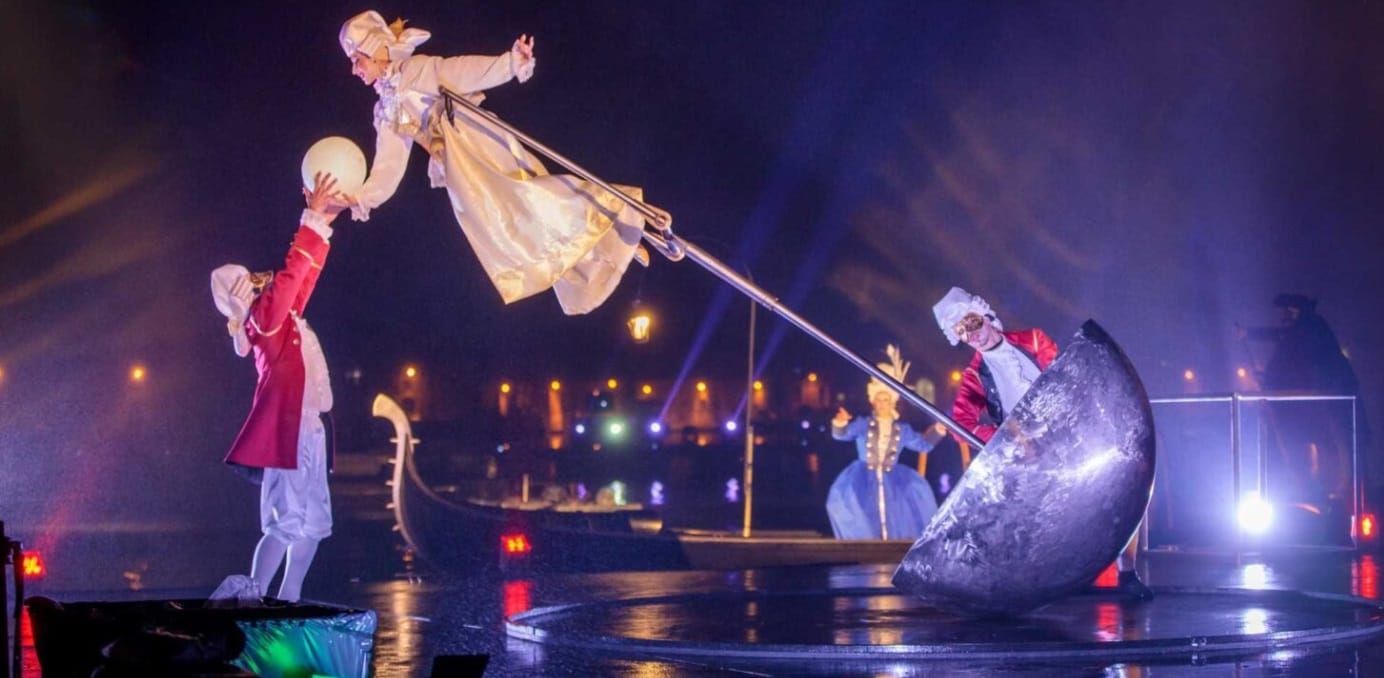
It begins on Saturday 31 January, starting at 5 pm in St Mark’s Square, with The Grand Carnival Ball with Bridgerton, the first major event introducing the public to the atmosphere of the 2026 edition. The following day, Sunday 1 February, the tradition gets into full swing with the Festa Veneziana, the evocative procession on the water along the Grand Canal, which officially opens the historical and traditional programme of the kermesse. The culminating moment will be the bursting of the Pantegana under the Rialto Bridge, the unfailing symbol of the start of Carnival. The same day will also see the start of the programme on the stage in St. Mark’s Square, the beating heart of the event: the city will begin to beat to the rhythm of the parades of the most beautiful masks, capable of attracting hundreds of visitors, together with a preview of the widespread shows that will animate Venice and Mestre throughout the carnival period. Also on Sunday 1 February, the parade of allegorical floats begins in Dese, bringing the party to the mainland districts. Meanwhile, the selection of the Maries, one of the most eagerly awaited moments in Venetian tradition, begins.
The message
“The Venice Carnival 2026 is a message that starts from our history and speaks to the world,” said Mayor Brugnaro. “In the year of the Olympic and Paralympic Winter Games in Milan-Cortina 2026, we have chosen to tell the game as a deep cultural and social value, as a space for meeting, respect, participation and collective growth, as in the spirit of Olympia. The game, which can also be declined as sport, is a universal language, capable of uniting different generations, cultures and communities, and is an integral part of the identity of this city. Here, for centuries, competition has not divided but united: it becomes spectacle, creativity, a collective ritual, an occasion for confrontation and celebration. Venice,’ continued the mayor, ‘has always known how to transform challenge into beauty and participation into wonder, anticipating that Olympic spirit that puts man, talent, commitment and mutual respect at the centre. With Olympus – At the Origins of the Game we celebrate a city that knows how to get involved, that welcomes and involves, that opens its squares, its canals and its sestieri to the world, transforming them into places of shared emotions. It is a widespread Carnival that speaks to families, young people, and children, that values tradition and at the same time looks to the future, reaffirming Venice as an international capital of culture, creativity, and civil coexistence’.
The Partnership
The title of this edition recalls Greek mythology and the harmony between body and mind, but also the Venice of centuries past, when the Carnival was a great stage for popular competitions, acrobatics, regattas and tests of collective skill. From the Forces of Hercules to ritual battles on the Bridge of Fists, from tournaments in the calli to festivals on the water, Venice has always known how to transform competition into spectacle and challenge into a shared rite, anticipating the spirit of the modern Olympics.