The interview takes place at Soho House on London’s Greek Street, in the middle of London Fashion Week. O’Connor’s agent has called ahead warning that she’s pulled her lower back and to please make sure there is a supportive chair. I arrive early and begin awkwardly scouting the room for something suitably orthopaedic. When she finally sweeps in, in a long black coat, Levi’s and fluffy flats, she ignores the hardback chair and drops on to the sofa beside me. ‘I need to do a fitting at 3,’ she says, already mid-thought. ‘But we can get snackaroos.’
The brace around her waist is tight, but she greets me with a huge hug and a milewide smile – all warmth, velocity, nervous energy – as if we’ve known each other for years. Which, in a way, we have.
Fashion people often exist in each other’s peripheral vision: a nod backstage, a hello across a room. I’ve watched O’Connor stride down catwalks for three decades, but until now we’ve never actually sat and talked.
As the quintessential catwalk queen, she has an aristocratic air I’d assumed translated into supreme confidence – even the waiter bows when he brings her tea –and a kind of cool composure. But her thoughts tumble out in breathless bursts. She wants this conversation, she says, to be raw.
‘I’m so sick of not telling the truth.’
That same evening, I meet a second Erin O’Connor – the one the industry knows: statuesque, luminous, entirely composed. We are in Claridge’s grand ballroom at a dinner hosted by Roksanda Ilinčić and the British Fashion Council, in a room heaving with fashion royalty. O’Connor appears in a sweeping peacock-blue silk gown, intercepts me and introduces me to the actor Joely Richardson, before announcing – with mock authority – that she appears to have appointed herself unofficial hostess. ‘I’m basically doing the door for Roksanda tonight,’ she laughs.
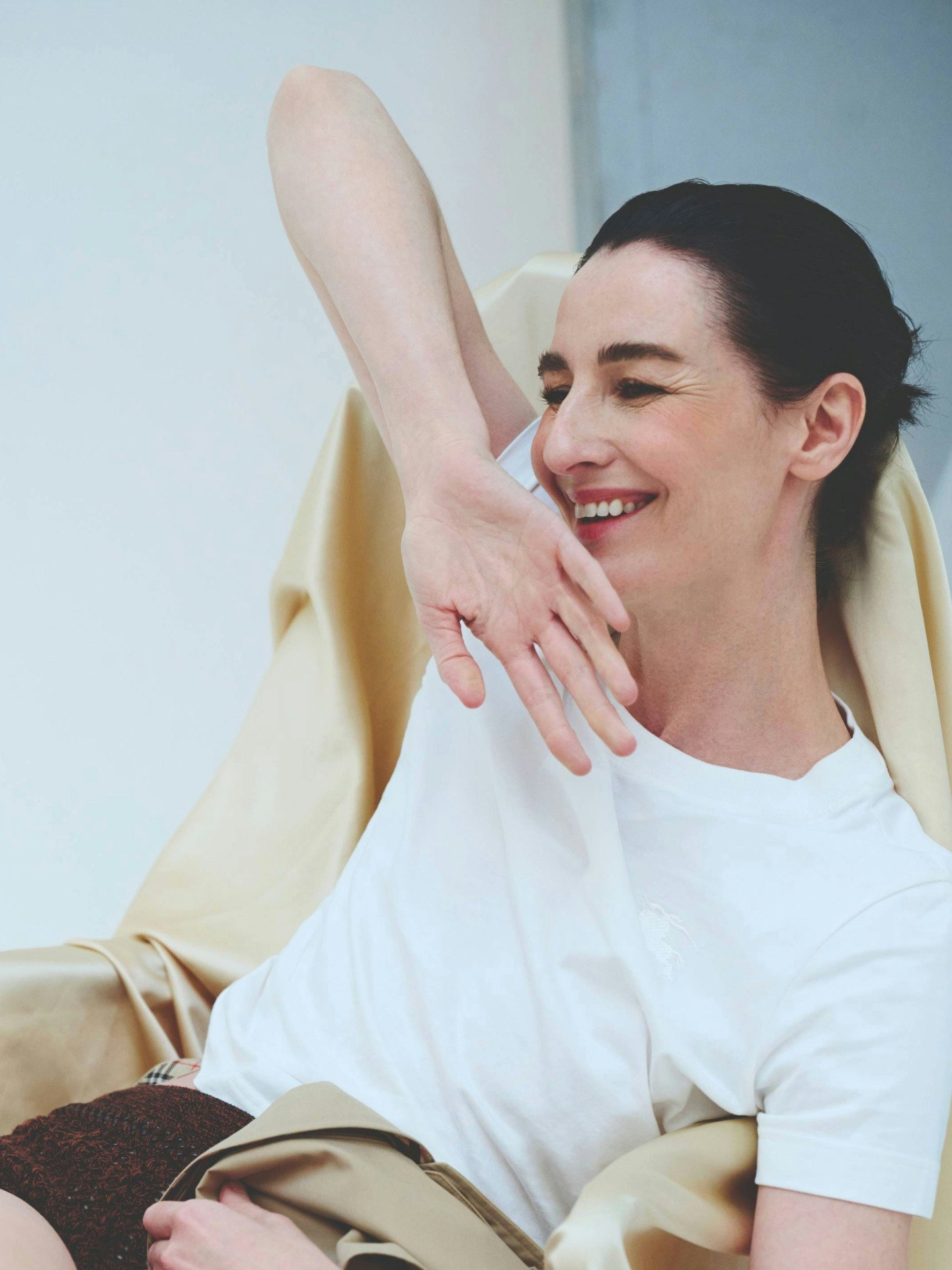
Photo: Nick Knight. T-shirt, shorts and coat, all Burberry

O’Connor is very funny – quick, selfdeprecating, physically comedic when she wants to be, all long limbs and angles. She jokes she’s ‘basically a right angle’. Then adds, ‘I’m addicted to making people laugh. It’s my greatest joy.’
But even sparkling O’Connor has a time limit. As soon as dessert is served, she leans over and quietly announces she’s leaving. No fuss, no lingering goodbyes. Minutes later, I glimpse the back of that extraordi nary blue dress flying up the staircase while the party continues below. ‘I didn’t go to the after-parties,’ she had told me earlier. ‘I was always thoroughly spent.’ It would take her decades to understand why. ‘I am thoroughly neurodivergent,’ she says, cheerfully. ‘It took perimenopause, an ADHD diagnosis and a divorce to put things into perspective.’ The diagno sis reframed the sensitivity, the intensity,
the sense of being slightly out of sync with the world. ‘For a very long time,’ she says, ‘I had the best time masquerading, in every sense of the word.’ Fashion, after all, rewards transformation. Wigs, latex,
corsets, characters. ‘If there was a wig or a corset or a challenge,’ she says, ‘I was your woman. Give me the tough stuff – I wanted to make it work.’
What looked like confidence was… something else. ‘It allowed me to conceal… the person that is here now.’ She pauses. ‘I think it was… elegant concealment.’ The industry read it differently, only too happy to believe she was someone else entirely. ‘People would say, “You’re so confident.” And I’d think – no. It’s manufactured poise.’ For years, she moved from role to role, never quite landing. ‘I got used to living like that,’ she says. ‘Moving from one version of myself to the next.’
By the late 1990s, she was walking for everyone who mattered – her silhouette unmistakable, her walk a long, fluid swish. Designers projected entire worlds on to her. For Alexander McQueen this was once a mirrored asylum in which she wore a dress constructed entirely from razor clam shells, which cut her. Valentino once suggested they continue the advertising campaign shoot at home with her family at her ‘coun try estate’. ‘If only,’ she says, scoffing at the thought. The assumption – persistent, unwavering – was that she must belong to a certain kind of lineage. ‘People refused to believe I wasn’t aristocratic,’ she says. Fashion had made her exactly what it needed her to be.
In reality, O’Connor grew up in Walsall, in the West Midlands, the middle child of three girls in a lively Irish Catholic house hold. Her father, Cahal, built furnaces in a factory. Her mother, Veronica, worked in a nursery school. She was born in a high-rise flat before the family moved to a modest house with a garden on an estate. ‘Behind us were rolling fields,’ she says of the Staffordshire countryside. ‘You could see the tip of Lichfield Cathedral in the distance.’
On Sundays, the whole extended family gathered – church, then the pub, generations of relatives in suits and ties. ‘That’s where I get my love of tailoring,’ she says. But school was harder. ‘I cried a lot and found it genuinely tough.’ She was labelled early. ‘They called me “Little Miss Worry”. I was always anxious. A constant low level anxiety.’
Modelling, in contrast, offered structure. She was famously ‘discovered’ aged 17 at The Clothes Show Live in Birmingham, when renowned talent scout Fiona Ellis swooped. Within a year she’d moved to London, but it wasn’t overnight success. ‘I bombed for about 18 months, as editors didn’t know quite what to do with me.’ It was only when photographer David Sims cast her on a shoot, Linda Cantello ordered her to grow back her eyebrows and hair stylist Guido Paulo chopped off her hair and dyed it black that editors got her. ‘Suddenly I was high fashion,’ she recalls.
‘Going on stage, I could do,’ she explains. ‘There’s a beginning and an end.’ Socialising was another matter entirely. ‘Maintaining that in close proximity… I found it utterly exhausting.’ What she understands now is that she had been coping – constantly – in ways that went unseen.
Working with John Galliano required an entirely different level of endurance. ‘It was like The Krypton Factor,’ she says. First you had to understand the character. Then came the physical challenge: Perspex platforms on polished floors, corsets that restricted breathing, headpieces that shifted your centre of gravity. ‘You’d have 20lbs added to your body, something on your head, some thing restricting your lungs,’ she says. ‘And you’d think – how am I going to get down that runway without falling over?’
She thrived on it. ‘If there was a challenge,’ she says, ‘I was your woman.’ But there were limits. ‘It was a really important moment for me,’ she says. ‘Where I suddenly thought – I have reached my limit. I cannot do this. I won’t do this.’ It wasn’t just the physical strain, but the atmosphere around it – the lack of dignity. She recalls standing nearly naked before a designer and being criticised for being too thin while simultaneously being made to try on their clothes. ‘It was enough.’
By the mid-2000s, she had begun to see the industry differently – not just as something to navigate, but something to change. She became vice-chair of the British Fashion Council, working to improve conditions for models, and founded Model Sanctuary, a backstage refuge offering support, medical care or simply somewhere to sit. All of which earned her an MBE in 2017 for ‘services to fashion and charity’. But speaking up came at a cost. ‘Models were very easy targets. With no voice,’ she says. Public scrutiny turned personal. ‘I was accused of not menstruating, having a furry back, having halitosis…’ What had begun as advocacy became something far more punishing. For someone who had spent years mastering concealment, it was a brutal inversion; suddenly, there was nowhere to hide. And for a time, it took a profound toll on her health.
It was, in part, through her sons that everything began to make sense. ‘As they started to grow – talking, walking, going into school – I could feel their experience so deeply,’ she says. ‘Their sensitivity, their frustration.’ Albert, now 11, is already towering (‘5ft 9in, bigger feet than me’) and has found his sport in rugby. Eddie, seven, by contrast, is ‘a slink, a wafter’. ‘He wakes up and has to put pen to paper immediately, drawing, writing, painting.’ She smiles. ‘They’re total opposites. Which is perfect.’ Watching them, she recognised something. ‘I thought, I know that feeling.’
‘IT TOOK
PERIMENOPAUSE,
AN ADHD
DIAGNOSIS AND A
DIVORCE TO PUT
THINGS INTO
PERSPECTIVE’Erin O’Connor
She now co-parents with her former partner, Stephen Gibson. ‘We have a unique situation,’ she says. ‘And it works for us.’ Her older sister, Kelly (Auntie Kelz) has moved in, creating what she describes as a ‘gaggle’ of family life – siblings, children, overlapping households. ‘They’re still my favourite people,’ she says. ‘For scandal, joy, moans, everything.’
A few days later, we meet again at Nick Knight’s London studio. He greets her like an old accomplice. ‘Last time Erin was here, she was hanging off the scaffolding outside,’ he says cheerily.
She smiles. ‘You’re never quite done with Nick. It’s always that moment where you’ve just slightly exhaled – that’s when you get the picture. That bit in the middle. Always.’
Between takes she studies the images on the monitor, in front of us all, every shot, good and bad. ‘This is a test of self-love,’ she says. ‘Ooh… she’s a mood.’ We all laugh.
‘I masked a lot,’ she later tells me. ‘Modelling made that easier. You’re allowed to become someone else.’ Now, she is learning something harder. After her separation, she didn’t rush into anything. ‘I knew I needed time to get to grips with myself,’ she says. ‘And that’s quite scary because you don’t know how long that’s going to take.’ It took years. ‘I wasn’t even flirting,’ she laughs. ‘I didn’t know how to date any more.’ When she finally did, it didn’t go entirely smoothly. ‘I shook his hand,’ she says. ‘That’s how out of practice I was.’ But something shifted. ‘I’ve met someone kind,’ she says simply. Alexander Chappell is a brand designer and artist, slightly younger and, crucially, emotionally fluent. ‘It’s so lovely to be with someone who understands,’ she says. ‘It’s the best feeling in the world.’ After everything – the masking, the pressure, the years of holding it all together – there is a sense not just of recovery, but of renewal. ‘It feels positive,’ she says. ‘Really positive.’
Life now looks rather different. She returned to modelling full-time last year, enthusiastically, but it is no longer the whole story. She has become, unmistakably, a presence beyond the clothes: speaking, hosting conversations, stepping into culture in a broader way. Recently, Bella Freud invited her on to her podcast, Fashion Neurosis, introducing her as a ‘fashion icon’. The National Gallery has asked her to take part in its Picture This series, where she will speak about a painting – an idea she approaches with the same thoughtful intensity she still brings to the runway. There is also, she hints, a major television project in the pipeline, though details remain firmly under wraps until later this year. And then, a fashion milestone that still surprises her: she has just landed her first campaign for Burberry. She laughs at the thought of it – after three decades at the top of the industry, a first. ‘I’m so happy about that.’ She
pauses, briefly taking stock. Busy, certainly. But, for the first time in a long time, some thing else too. Happy.
She glances at the monitor again. ‘There we go,’ she says quietly. ‘That’s me.’
See the full shoot in Grazia’s new issue, on sale 31 March
Photographs: Nick Knight
Styling: Molly Haylor. Model: Erin O’Connor at Supa Model Management. Hair: Bjorn Krischket at The Wall Group using Amika. Make-up: Adam de Cruz at One Represents using Lisa Eldridge. Nails: Adam Slee at Streeters using Pleasing. Set design: Andrew Tomlinson at Streeters. Shoot producers: Kate Davey at Liberte Productions, Gabriela Velasco. Photographer’s assistants: Laura Hughes, Gil Warner, Oldnightkid Wang. Digital: James Bryant. Fashion assistants: Amber Backhouse, Sheraz Zingraff. Retouching: Epilogue Imaging.
Lead image, Erin wears: Blazer, £1,790, trousers, £895, and scarf, £375, all Burberry