
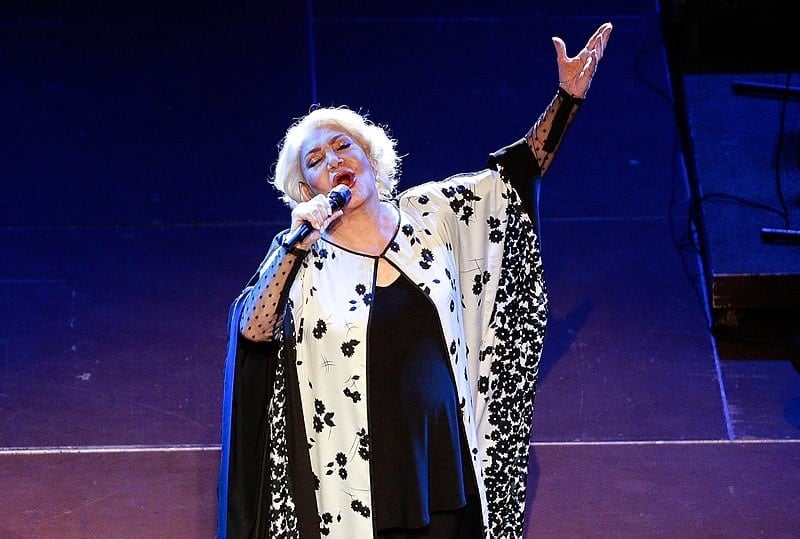
Marinella, one of the greatest Greek singers with an unparalleled voice, passed away at the age of 87, a year and a half after suffering a stroke on stage during her performance at the Odeon of Herodes Atticus in September 2024.
The retrospective show had been designed to celebrate her enviable career that spanned seven decades, but eventually marked a sorrowful goodbye to her fans.
Her dramatic collapse happened during her third song of the night —the well-known “Words Are Unnecessary,” one of her biggest hits- and as she voiced the verse, “My God, you taught us how much to love.”
After a long hospitalisation period, she returned to her home, where she died peacefully on Saturday, March 28, 2026, her family announced.
A star is born, in a refugee family
Marinella was born Kyriaki Papadopoulou in Thessaloniki on May 19, 1938, the last of four children. The Papadopoulos family were refugees from Pontus and arrived in Greece after a long stay in Constantinople. They lived in a humble semi-basement in the center of the city.
As a young child, Marinella had a difficult life growing up during the German Occupation and the Greek Civil War. Like most children of her generation, she matured quickly, as her life was full of hardships and deprivation. Hunger and cold were the order of the day for her family in those years.
In her biography Marinella: Nights That Turned to Afternoons, by Giannis Xanthoulis, the Greek singer praised her father for his morals and good heart. She said her father imparted values and principles such as diligence, independence, and honesty to her. More importantly, he never stopped her from following her dream, as her father knew that she had an artistic streak.
Early on, Kyriaki knew that she was born to become an actress or a singer. When she was a child, her father would put her on the family table to sing for him. She has revealed that her father was her first fan ever.
Indeed, Marinella was born an artist. At the age of five, she appeared on the radio show “Children’s Hour.” It was a show all children were glued to in the time prior to the advent of television. A few years later, her voice advertised Thessaloniki clothing stores, and at seventeen, she appeared as an actress in one of the most famous troupes of the time: groups of actors and singers who were touring Greece performing songs and theatrical sketches.
One evening, luck (or fate) showed her the way to the microphone. The singer of the troupe fell ill, and the seventeen-year-old Kyriaki was asked to replace her. From then on, her role was that of a singer of the troupe, and she soon began singing in night clubs.
Young Kyriaki becomes Marinella
Kyriaki, also known as Kiki, was eighteen years old when she was “baptized” Marinella. It was 1956, and she was singing at Panorama night club in Thessaloniki when the singer Tolis Harmas, who was also performing at the club, gave her the stage name Marinella after a song he was singing. He told her she wouldn’t have any luck going on stage as Kiki Papadopoulou.
Ιt turned out that 1956 was a pivotal year for the young singer. Along with her new stage name, she met the legendary Greek singer Stelios Kazantzidis, who helped her advance her career. Soon, the two became the most famous couple in Greece. They also became the greatest male-female duet in the history of Greek popular music, unsurpassed to this day.
In 1957, she released her first song on record, “Elenitsa, Nitsa” (Little Helen). By that time, the couple had moved to Athens. They sang unparalleled duets on stage and on records. Marinella and Kazantzidis toured together in the United States and Germany, also performing in movies together, singing songs of the most prestigious Greek composers, such as Mikis Theodorakis, Manos Hadjidakis, Vassilis Tsitsanis, Giorgos Zambetas, Apostolos Kaldaras, Stavros Xarchakos, and Christos Leontis.
Marinella-Kazantzidis became the most talked-about couple in Greece. They were known as a singing duet and for their torrid love affair. According to people who knew the couple, Kazantzidis was incredibly jealous of her, as Marinella later also admitted. The two got married in 1964 but divorced two years later. Their personalities were too volatile to continue living together.
Marinella has said she owes a lot to her first husband, as he taught her much about how to use her voice, as well as about clarity in phrasing and orthophony.
A new career begins
After Marinella parted ways with Stelios Kazantzidis, her new mentor became composer Giorgos Katsaros. He suggested going on a tour in the Soviet Union, something she agreed to for financial reasons.
Katsaros and lyricist Pythagoras wrote two new songs for her, and that was the beginning of her solo career without Kazantzidis. She began singing at a Plaka night club known as Old Athens along with Dimitris Mitropanos, Cleio Denardou, and Sofi Zanninou.
In 1968, Greece’s top director of the 1960s and 1970s, Giannis Dalianidis, invited Marinella to sing in his blockbuster movie Gorgones kai Magges (Mermaids and Tough Guys). Composer Mimis Plessas and lyricist Lefteris Papadopoulos wrote “Anoixe Petra” (“Open Up, Stone”) for her, and her performance in the movie was so touching that the song became one of the most iconic folk songs in Greece. It is a song people have requested in each of her live performances since.
In the late 1960s and the 1970s, Marinella sang in several films and even had small roles in some. In October 1970, Marinella participated in the V Festival Internacional da Cançao Popular – Parte Internacion (FIC) in Rio de Janeiro, Brazil, representing Greece with the song “Kyra Giorgena” (Wife of George), finishing 4th among 38 countries.
Marinella was the first Greek singer to participate in the International MIDEM Festival in Cannes in 1973 with three new songs written by Stavros Xarchakos. She also participated in the 1974 Eurovision Song Contest, finishing in 11th place with the song “Krasi, thalassa kai t’ agori mou” (“Wine, sea and my boyfriend”).
In November 1973 in the days of the Athens Polytechnic uprising, she got married to the second love of her life, the popular singer Tolis Voskopoulos. They recorded several albums and performed together for several years, making the most popular duet of the 1970s.
In 1976, Marinella and Kostas Hatzis, a Greek songwriter of Romani origin, recorded a live duet at Plaka. It was a triple record album called Recital that became a platinum, selling over 500,000 copies, one of the best selling albums in Greek music history.
Unforgettable encounters
Throughout her illustrious career, Marinella had some unforgettable encounters that she spoke of in her biography, as well. In the late 1960s, when she was performing at the emblematic Stork seaside night club, one night, Frank Sinatra was dining there. The celebrated singer was so fascinated by Marinella’s voice that he said, “If this woman were in America, in two months she would be at the very top.”
Later on, on another night, Ingrid Bergman was at the club to watch Marinella perform. The Greek singer described their meeting as an unexpected joy, but what was truly unforgettable for her was the invitation of the Shah of Iran to sing at a New Year’s Eve reception at his resort on the island of Kish in the Persian Gulf.
Marinella’s voice was unparalleled compared to other Greek female performers. It was instantly recognizable for its uniquely sharp quality combined with emotion, as well as for its wide range.
The Greek singer was the type to avoid committing to arrangements if these did not fit into her personal schedule. She had famously refused to sing at the wedding reception of Aristotle Onassis and Jackie Kennedy because the event would take place on her day off. She never compromised regardless of the price she would pay.
Marinella in the 1990s and beyond
In the 1990s, Marinella had already established herself as a symbol of Greek popular music, and every concert of hers was a major event. She has appeared at the small Olympic Stadium, the Odeon of Herodes Atticus, and the Athens Concert Hall, all sold-out concerts followed by raving reviews. In November 2002, she performed with George Dalaras on a tour of Greece and abroad. The live album from the performances went platinum the following year.
On April 10, 2003, Jon Pareles wrote in The New York Times: “Her voice was earthy and strong, and she had the presence of an actress as she danced a few teasing steps or brought dignity to longing.”
On August 29, 2004, the great Greek singer performed at the closing ceremony of the 2004 Summer Olympics among roaring applause.
Her musical theatre performance in the role of Sophia Vembo in Athens and Thessaloniki in 2014 gained great critical acclaim.
Two years after Vembo’s death in 1978, Marinella recorded an album with twelve songs originally performed by the “Singer of Victory”, and in 1999 she sang a song along Vembo’s voice recording on stage at a packed Odeon of Herodes Atticus, reviving the Greek legend in a most unexpected duet that brought tears to the eyes of the audience.
In recent years, Marinella gave few, rare shows, often in support of Greek charities.
Her last performance on September 26, 2024, unto her unfortunate public collapse mid-show under the Acropolis of Athens, sealed an artist’s life full of great hits, success, and adoration by an audience who loved, and will continue to love her voice, wherever Hellenism exists.