
From the third century BC, Alexandria in Egypt was the intellectual hub of the Greek world, as the literature of classical antiquity was collected, edited and canonised at the Mouseion (Shrine of the Muses) and the Library of Alexandria.
To the ancient Greeks, myths were more than just stories, and to the scholars working at the library, mythical tales presented an opportunity to understand the inhabited world. We are able to uncover how scholars attempted to bridge the gap between myths and the real world through a particular type of source material, one that is preserved in the margins of manuscripts.
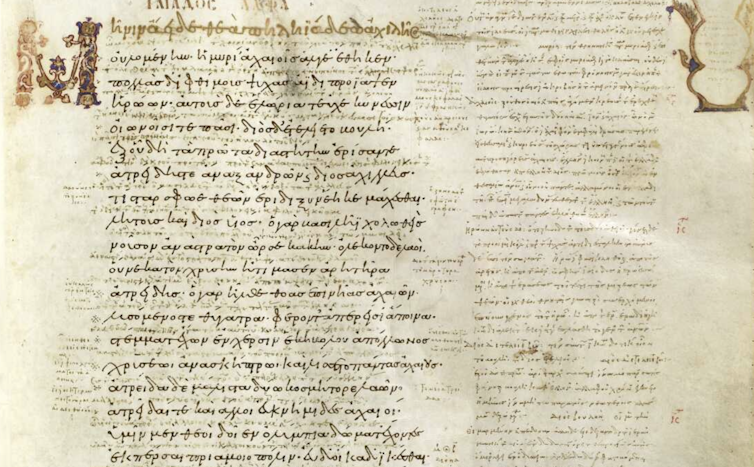
We are fortunate that the commentaries and scholarly works of Alexandrian critics have been passed down to us – copied and transmitted across the centuries as comments, notes and annotations in the margins of papyri and manuscripts.
These comments are known as scholia, and they are a window into the workings of ancient scholars. Scholia reveal a range of concerns and ideas, from analysis of poetic techniques to criticisms of grammar. They are also testament to the endeavour of ancient scholars to map the mythical places traversed on heroic voyages onto locations in the known world.
Neel Smith and Christopher Blackwell.
Mapping myths and monsters
One of the most significant scholarly disputes in antiquity, even predating the establishment of the Alexandrian library, was the route taken by the hero Odysseus on his perilous homeward journey after the Trojan War. The final stages of the Greco-Trojan conflict and the subsequent homecoming of Odysseus were the subjects of the ancient epic poems attributed to Homer: the Iliad and the Odyssey.
Homer’s epics were the focal point of scholarly activity in Alexandria. Indeed, one of the chief librarians there, Apollonius of Rhodes, composed his own epic, the Argonautica, which recounts the quest of Jason and the Argonauts to obtain the golden fleece and was modelled on the Homeric poems of a few centuries before.
Like Odysseus, the route taken by Jason was disputed, and Apollonius, as a scholar-poet, was familiar with debates on the exact routes taken by these heroes. Across several annotations, the scholia tell us about the versions of the Argo’s journey that differ from Apollonius’, including that of his contemporary, the poet Callimachus.
The attempt to map mythical locations is most notably characterised by the wanderings of Odysseus (as recounted in Books 9-12 of the Odyssey), which were located in Sicily and Italy. Significantly, the sea monsters Scylla and Charybdis were thought to dwell in the treacherous strait of Messina, the strip of water between the north-east of Sicily and the toe of Italy’s boot.
A strict opponent of this approach, however, was Eratosthenes – the Alexandrian scholar who calculated the circumference of the earth, to a remarkable degree of accuracy. He preferred to locate the wanderings of Odysseus and the travels of the Argo at a remove from the Mediterranean, dispelling them to the remote regions of the ocean.
How to spot a myth
While the route of Apollonius’ Argonauts contained fantastical elements (like the Sirens and the Clashing Rocks), scholars were also interested in mapping known locations along the route.
As the Argonauts navigate places like the Black Sea in Book II of the Argonautica, the evidence in the scholia demonstrates that scholars had a desire to record the geographical landmarks visited by the heroes, as well as any myths associated with those locations.
In his own epic, Apollonius ensures that the Argonauts leave markers of their journey, often in the form of an altar that is still visible in the landscape. The scholia show us scholars discussing the exact location of these markers – whether the altar to the 12 gods on the Bosporus strait was found on the European side or Asian side, for instance.
In addition to the markers mentioned by Apollonius, the scholia document a vast array of location-based stories which explain the origin of a place’s name – the aition. By using the mythical past to explain a phenomenon in the present, aetiology is a way for the contemporary reader to orient themselves in a text.
Andrew Hasson / Alamy
It is clear that critics had a “checklist” of sorts for talking about physical landmarks such as rivers or mountains: they note their location, the origin of their name and any connected myths or mythical markers. A standard entry in the scholia reads like this:
The Callichorus is a river sacred to Dionysus in the region of Heraclea. The river is called this because Dionysus organised a chorus there.
The consistency with which these physical landmarks are documented resembles the catalogues which we also find on papyri from the Hellenistic period – the era after the death of Alexander the Great which saw the expansion and transformation of Greek language and culture. Papyri of this type list the names of rivers and associate them with renowned peoples and places (such as those on the Argonautic voyage).
This shows us that these locations, even if they are known from poetry or a fictional voyage, could be situated in the landscape and understood through an origin myth. The cataloguing of mythical landmarks ensures they become enshrined in cultural memory and, through the process of copying them in the margins, ingrained in Greek identity.