
Getting your audio player ready…
A newly examined Greek inscription uncovered inside Homs’ Great Mosque of al-Nuri is reopening an old argument with big implications: does the mosque sit directly over the long-lost Elagabalus Temple, the famed Roman-era “Temple of the Sun” at ancient Emesa? The text, carved into the granite base of a column, is being presented as a rare physical clue in a city where centuries of rebuilding have blurred the lines between pagan, Christian, and Islamic sacred space explains a release by the University of Sharjah.
The discussion is being driven by research from Prof. Maamoun Saleh Abdulkarim (University of Sharjah), published in the journal Shedet and summarized in a university news release, which argues the inscription strengthens the case for continuity at the city-center site rather than at the citadel mound. “This inscription… provides new evidence in a long-standing debate,” he said, comparing two rival locations proposed for the Elagabalus Temple.
A Column Base That Won’t Stay Silent
The inscription was found beneath the mosque’s floor during restoration work, cut directly into a column base roughly 1×1 meter. According to the reporting, the lettering appears formal and carefully spaced in multiple horizontal lines, consistent with official commemorative styles, even if the Greek itself shows irregularities associated with a region where Aramaic dominated everyday speech.
One early public translation (shared online by historian Abdulhadi Al‑Najjar, according to the same report) describes a dramatic, martial tone, comparing a ruler to wind, storm, and a leopard while depicting victory and tribute-taking. That kind of language is not a neat “this was a sun temple” label, but it does resemble the grand, performative voice of imperial-era monumental texts meant to be seen and remembered.
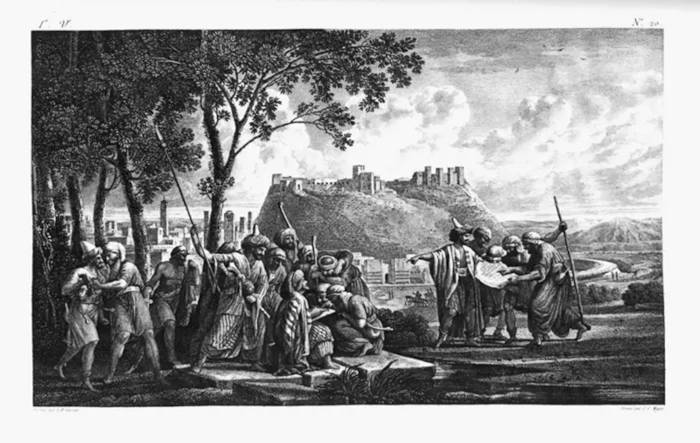
Illustration of the state of the Emesa Castle in Homs in the late 18th century. By L. F. Cassas, 1799-1800. (Shedet,2026)
Temple, Church, Mosque: Emesa’s Layered Sacred Landscape
Homs (Roman Emesa) has long been associated with a powerful local sun cult centered on the deity Elagabal (Elah‑Gabal). The Great Mosque of al‑Nuri is widely described as standing on (or reusing materials from) earlier religious structures, with traditions that the site passed from a pagan sanctuary to a church and later to a mosque explains Archnet.
The historic sequence of the location is first a Roman sun-god temple, then converted into a church dedicated to St John the Baptist, and then partially transformed into a Friday mosque after the Muslim conquest, with later major rebuilding associated with Nur ad‑Din in the 12th century. Those claims are not a substitute for excavation, but they show why any new inscription found under the building is of great value to investigations.
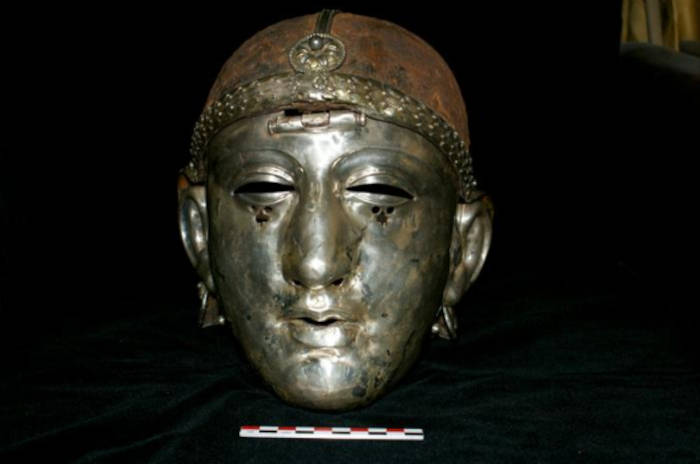
A mask of a person believed to be from the royal family, discovered in the Abu Saboun cemetery in Homs (Emesa). (Shedet,2026)
Why the Elagabalus Temple Still Matters
Elagabalus himself remains one of Rome’s most controversial teenage emperors, but his origin story is rooted in Emesa’s priesthood. Encyclopaedia Britannica notes that his mother’s family were hereditary high priests at Emesa and that his public identity as emperor became tied to the local god Elah‑Gabal, hence the name by which history remembers him.
That is why the SEO-friendly question “where was the Elagabalus Temple?” is more than trivia. If the Great Mosque truly overlays the sanctuary, it would be a traceable example of urban sacred continuity, where power and worship are repeatedly reinterpreted rather than erased, a theme also highlighted by Abdulkarim:
“If its association with solar cult symbolism is confirmed, it may indicate a spatial continuity… through architectural layering and reinterpretation rather than a complete break,” noted the release.
What the New Evidence Can (and Can’t) Settle
Even proponents of the “mosque-over-temple” theory face a practical limit: large-scale excavation under an active major mosque is not feasible, so arguments rely on inscriptions, reused architectural elements, and comparative urban history. That helps explain why a single carved text, especially one physically embedded into a column base, can carry outsized weight in the scholarly back-and-forth.
It’s also a reminder that inscriptions can be as politically charged as they are informative. Whether it’s a Greek text in Homs, a funerary stele elsewhere in Roman Syria, or a coin image that preserves a cult’s symbolism, small survivals can redirect big stories. (Related reading: a Roman-era stele with Greek inscriptions recently reported from Manbij.)
Top image: The inscription (right) was discovered at the base of a large column (left). Source: Teriz Lyoun/Shedet
By Gary Manners
References
Archnet Staff. 2026. Jami’ al-Umawi al-Kabir Hims, Syria (Great Mosque of Hims / al-Nuri). Available at: https://www.archnet.org/sites/14952
Barkho, L. 2026. A mysterious Greek inscription reignites debate on whether a Syrian mosque stands atop Roman Emperor Elagabalus’ Temple of the Sun. Available at: https://www.eurekalert.org/news-releases/1117377
Barkho, L. 2026. Religious Transformation in the City of Emesa, Syria: From Paganism to Christianity During the Roman and Early-Byzantine Periods. Shedet Journal. Available at: http://dx.doi.org/10.21608/shedet.2025.392640.1307
Encyclopaedia Britannica Editors. 2026. Elagabalus. Available at: https://www.britannica.com/biography/Elagabalus
Zahid, N. 2026. Greek Inscription Found in Syrian Mosque Points to Lost Temple of the Sun. Greek Reporter. Available at: https://greekreporter.com/2026/02/24/greek-inscription-mosque-ancient-temple-sun-syria/