
Greece is entering a new phase in the study of the Kasta Tomb at Amphipolis, one of the country’s most debated archaeological landmarks.
A recent programmatic agreement signed by Greece’s Ministry of Culture, the National Hellenic Research Foundation, and the National Center for Scientific Research Demokritos marks the beginning of a large-scale scientific effort to digitally reconstruct the monument’s original painted surfaces.
With a budget of 660,000 euros ($773,355), funded exclusively by the Greek Ministry of Culture, the project introduces a research plan that combines archaeology, advanced imaging, and artificial intelligence to recover details that erosion has long concealed.
The AmphiPoly Project
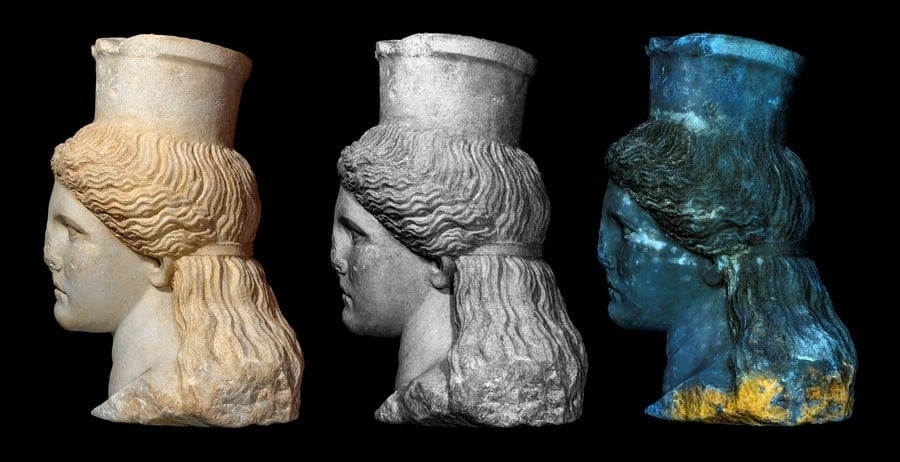
Under the new agreement, the two research institutions will carry out the AmphiPoly Project, a comprehensive program focused on revealing the initial face of the tomb. The project’s primary objective is to construct an evidence-based reconstruction of its polychromy and decorative scheme across all historical phases. Using archaeometric measurements, advanced digital tools, and historical and archaeological research, the team will produce three dimensional visualizations and aesthetic restorations of the tomb’s decor.
The ultimate goal is to better understand the monument’s construction, symbolism, chronology, and use. Many of its decorative features are now difficult to interpret due to centuries of damage, erosion, and loss. By digitally restoring what once existed, the project will provide scholars and the public with a clearer view of the tomb’s original artistic program.

Cutting edge technologies power Kasta Tomb research
Significant parts of the research will be conducted through specialized laboratories at Demokritos in collaboration with leading international centers. The scientific teams will analyze pigments, surfaces, and materials using high precision archaeometric techniques. The project will also incorporate high-resolution, three-dimensional scanning and digital visualization platforms to reconstruct both physical and missing elements.
The initiative includes the creation of physical replicas of key components of the tomb’s architecture and decoration, such as the sphinx flanked facade, the mosaic, and the lion pedestal. Virtual reality material will be produced for museum use, offering visitors a fully immersive way to explore the monument and the scientific data behind its reconstruction.
AI re-imagines lost imagery at Kasta Tomb in Amphipolis, Greece
A team of visual artists will contribute to the project by completing digital reconstructions through artificial intelligence systems trained on archaeometric evidence. These tools will support the re-creation of damaged or lost imagery in the mosaic and painted marble friezes.
Comparative data from spectral analyses of Macedonian funerary artworks, including the abduction of the Persephone fresco from Tomb I at Aigai, believed to have influenced the Kasta Tomb mosaic, will inform the reconstructions. Additional dating analyses of mortar and osteological samples from the tomb’s interior will further refine the understanding of its phases.

Archaeological significance of Kasta Tomb in Greece
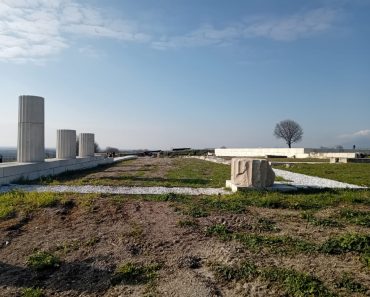
Greek Minister of Culture Lina Mendoni underscored that the Kasta Tomb, along with its tumulus and circular enclosure, must be approached as a unified archaeological complex.
Ongoing restoration works funded through the EU Regional Program of Central Macedonia for 2021–2027, the National Development Program, and the regular state budget total over 11 million euros (about $12.9 million). These works represent the final stage of a multi year effort, scheduled for completion in 2027.
The restoration plan includes the reconstruction and presentation of the enclosure wall, landscape design around the tumulus pathway, and stabilization of the burial chamber’s excavation area. The original two-leaf marble door of the final chamber, which had been broken and violated since antiquity, will be reinstalled in a demanding technical operation intended to restore the monument’s historical coherence.
A new museum and exhibition facility will also be built to host digital applications, multimedia content, and finds from the site, allowing visitors to understand the monument without burdening its sensitive interior spaces.
Linking science, technology, and cultural heritage at Amphipolis
Through AmphiPoly, the Ministry of Culture is commissioning two of Greece’s most prominent research institutions to undertake a project that complements its ongoing restoration work at Amphipolis. The initiative brings together archaeology, materials science, digital humanities, and high technology to recreate the tomb’s visual language with scientific precision.
The president of the National Hellenic Research Foundation, Demosthenes Sarigiannis, emphasized that the project reflects modern approaches to heritage research, combining advanced imaging, non-invasive analytical methods, and high accuracy digital tools to reconstruct the monument’s chromatic complexity and shed new light on Macedonian funerary architecture.
Evangelos Karkaletsis, president and director of Demokritos (National Center for Scientific Research), noted that the institution’s long-standing expertise in archaeometry and micro-analytical techniques will contribute to a deeper understanding of the tomb’s artistic and historical significance. By integrating laboratory analysis, material studies, and international research partnerships, the project aims to illuminate aspects of the monument that have remained obscure for centuries.