

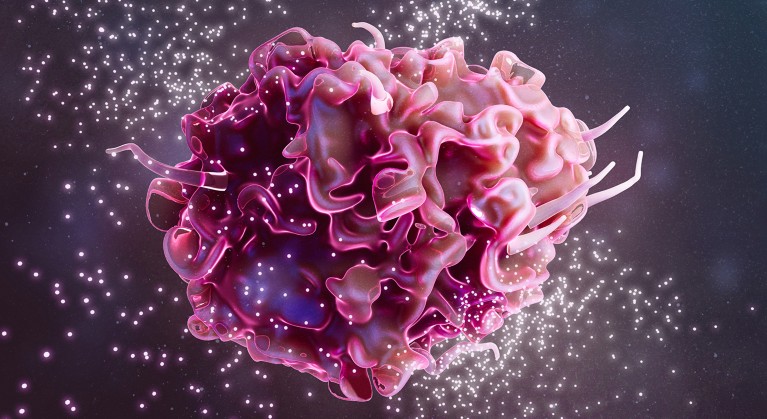
Immune macrophage cells (pictured in this illustration) release cytokines to mediate cellular processes.Credit: Nanoclustering/Science Photo Library/Getty
Japan is one of the world’s most rapidly ageing countries, with the highest number of centenarians and nearly a third of its population aged 65 and above. It is also home to Okinawa, one of six ‘Blue Zones’ — regions around the world where people enjoy exceptionally long lives.
“In Japan, there are an unusual number of people who live for more than 80 years,” says Toshio Inui, an Osaka-based clinician, who credits this longevity to a diet rich in fish, soy and vegetables. “Historically, nutrition has been associated with longevity. Clinically, it is very important too — not only for people with cancer, but for those with other diseases.”
Inui, who trained as an oncologist, is the co-founder of Saisei Pharma, a biotech and nutritional supplement company headquartered in Osaka, Japan.
The research-led firm — whose name means rejuvenation or regeneration — is focused on studying the interplay between nutrition and health, particularly for age-related conditions such as cognitive decline and muscle loss. Specifically, Saisei Pharma researchers are investigating whether adding an immune-boosting protein called macrophage activating factor (MAF) to the diet might help slow the rate at which people age.
To do this, Saisei Pharma is collaborating with scientists from numerous research institutions including the National Hospital Organization (NHO) Kyoto Medical Center, and Tokushima, Konan, Tottori and Hiroshima universities. They are conducting preclinical and clinical studies on conditions such as sarcopenia, and examining the effects of MAF on proteins and genes related to the ageing process.
More muscle
MAF plays an important role in the immune system. When produced by the body in response to infections or tumours, MAF helps activate and boosts the defensive power of macrophages — white blood cells that clear out dead, damaged, or cancerous cells, alongside harmful pathogens such as bacteria and viruses.
Inui and his team are exploring whether dietary MAF might have an impact on sarcopenia, an ageing-related condition characterized by a progressive decline of muscle mass and strength. Sarcopenia is associated with frailty, and can increase the risk of falls, fractures, and physical disabilities, which in turn may hamper an older person’s mobility and independence.
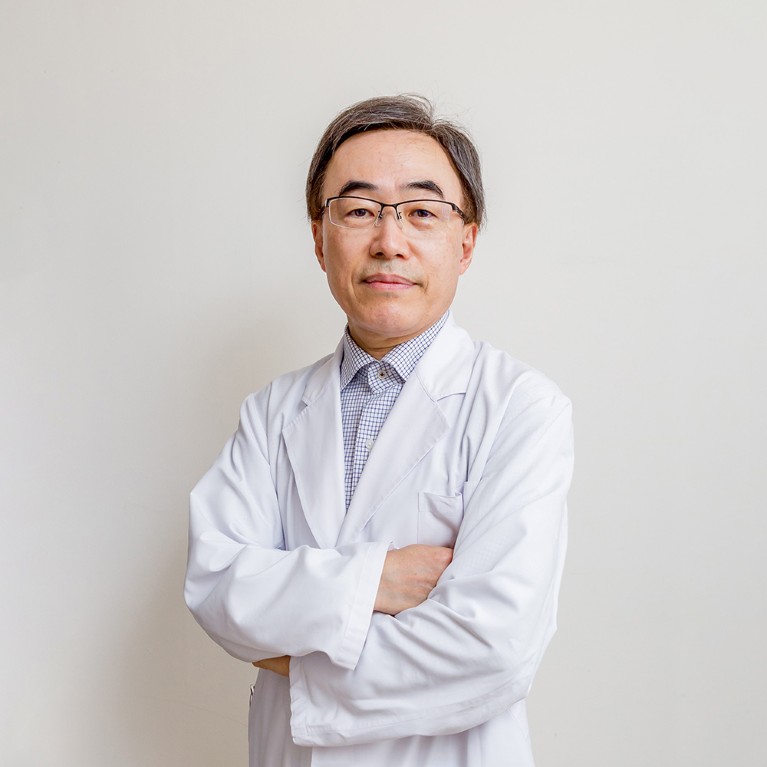
Toshio Inui is the co-founder of Saisei Pharma, based in Osaka, Japan.Credit: Saisei Pharma
“I’ve been treating patients with sarcopenia and other diseases for many years now. When we look at aged people, we see that the amount of muscle they have is very low,” says Inui.
Nutrition is closely linked to the condition. Goro Katsuura, a neuroscientist at NHO Kyoto Medical Centre who has worked with Saisei Pharma for 13 years, is collaborating with Saisei scientists on preclinical mouse studies of sarcopenia. They are examining the effect of MAF supplementation on muscle atrophy factors, muscle growth factors, and motor coordination.
Saisei is also interested in whether MAF might impact sarcopenia in humans.
They are conducting a new clinical trial in Osaka to measure whether its MAF supplement alters the levels of IGF-1, or insulin-like growth factor1, circulating in the blood.
IGF-1 is a key hormone for muscle growth and repair, and controls a molecular pathway involved in the ageing process. With ageing IGF-1 levels fall, slowing the rate at which the body repairs damaged muscle cells and builds new muscle, as well as reducing its ability to inhibit muscle wasting. “IGF-1 has a very strong, protective action against sarcopenia,” says Inui.
He wants to know if dietary MAF could impact blood serum IGF-1 levels, and if consumed in high doses, might help increase muscle mass.
“We don’t have any clinical trial data yet on sarcopenia,” says Katsuura. “So, we are looking to see if MAF has an effect on sarcopenia, particularly on muscle therapy and motor dysfunction.”
Slowing ageing
Another molecule that Saisei Pharma researchers are keen to find out more about is PPAR-γ, short for Peroxisome Proliferator-Activated Receptor-gamma. The protein acts as a master regulator for numerous genes, switching them on and off in cells. Its activity is closely linked to the ageing process and age-related diseases.
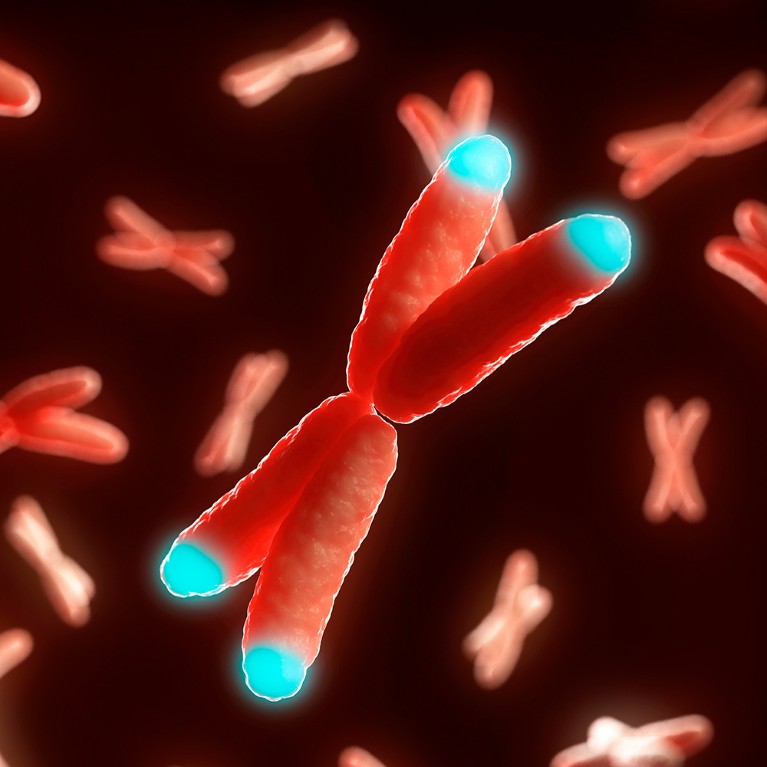
Telomeres (blue) are the caps on the ends of chromosomes that help prevent them from fraying.Credit: Sciepro/Science Photo Library/Getty
Inui and his team, with collaborators from NHO Kyoto Medical Center and Kyushu University, have run a series of experiments to explore the effect of MAF on PPAR-γ levels in the kidneys of mice.
They hope the findings will build on knowledge about the effect of MAF on ageing-related conditions. Already, Saisei researchers — alongside collaborators from Kyushu University, Osaka Medical and Pharmaceutical University, and NHO Kyoto Medical Center — have demonstrated that oral administration of MAF to mice slightly lengthened telomeres1.
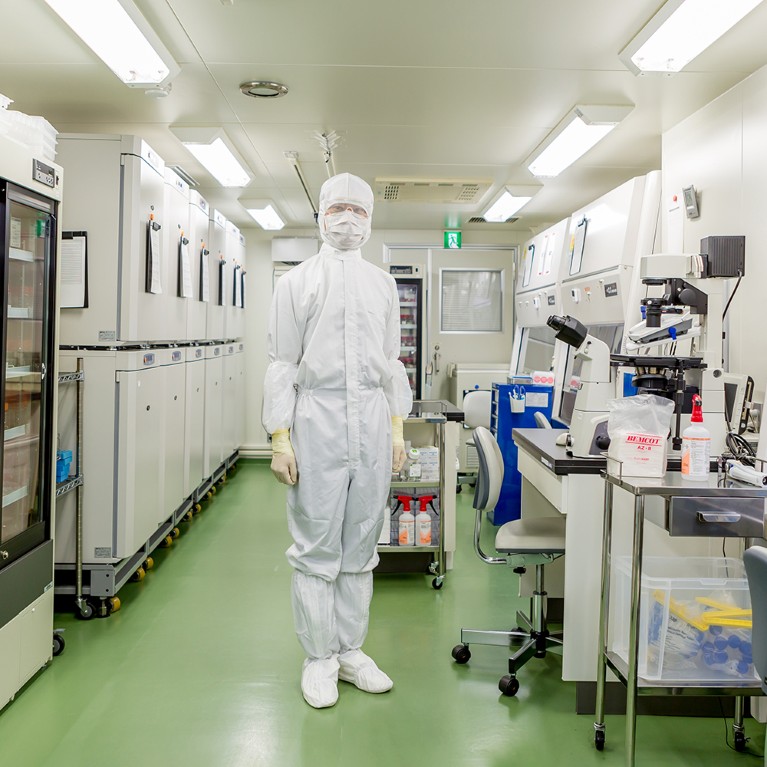
A scientist in Saisei’s laboratories in Osaka.Credit: Saisei Pharma
Cells have a molecular clock that determines how long they live. The clock comes in the form of telomeres — caps on the ends of chromosomes, often likened to the protective plastic tips on the ends of a shoelace. Telomeres — short, repeated segments of DNA — help protect chromosomes from fraying or sticking together during DNA replication, preventing genetic information from getting lost.
Telomeres get a little shorter every time a cell divides, and beyond a certain threshold, the truncated caps lead to genomic instability, a decline in tissue function, and heightened susceptibility to age-related diseases such as cancer, diabetes, and osteoarthritis. Eventually, telomeres get so short that the cell dies, explains Inui.
But in a series of experiments, the team found that dietary MAF, when consumed for four weeks or more, lengthened telomeres in both young and old mice1. This was accompanied by an increase in the expression of both telomerase reverse transcriptase and telomerase RNA component — which together form an enzyme that helps to rebuild and lengthen telomeres.
In a clinical trial, the Saisei team are now studying 161 human participants aged 40 and above in Japan to explore whether MAF taken orally for three or six months might affect telomere length.
Additionally, they have undertaken studies to look for any effects of MAF in a real-world setting — for instance, in patients with dementia at a daycare rehabilitation center in Okayama, Japan2; and in more than 300 people with COVID-19 in Italy3 and Ukraine4 during the pandemic.
Ramping up Klotho
Another gene that has sparked the Saisei team’s interest is Klotho. Named after the goddess in Greek mythology who spins the thread of life, Klotho codes for a ‘longevity’ hormone of the same name — so called because it regulates numerous physiological processes related to ageing5.
In humans and other mammals, Klotho levels decline naturally with age. This can accelerate muscle wasting, cognitive decline, and inflammation, while slowing down tissue regeneration, among other effects.

Saisei Pharma scientists have conducted mouse studies on telomere lengthening, Klotho expression and sarcopenia.Credit: JacobStudio/iStock/Getty
In earlier experiments conducted by other research groups, mice with Klotho gene deficiencies exhibited age-related symptoms such as osteoporosis, artery hardening, skin thinning, and reduced lifespans5. Conversely, when Klotho was over-expressed, mice lived between 20% to 30% longer than control mice6 and performed better at memory and learning tasks, indicating the protein protected them from cognitive decline7.
Saisei Pharma’s research in mice hints that MAF works partly by triggering an overexpression of Klotho in the blood, brain, and kidneys, according to Inui. Its researchers are now looking for any similar possible effects of MAF in humans.
Inui’s team will soon commence a clinical trial involving more than 100 patients, aged between 40 and 80. “We want to know whether dietary MAF can significantly increase plasma Klotho levels after twice-daily administration,” says Katsuura.
The researchers at Saisei and the universities hope that their studies will clarify how immune-related proteins and ageing pathways interact, and lay the groundwork for future strategies to support healthier, longer lives.