When the architects Kleanthes and Schaubert set out in 1833 to design “new Athens,” envisioning a city with an urban identity worthy of Europe’s modern capitals, they could never have imagined that one of its very first streets—Ermou Street—would, only a few decades later, rank among the most expensive retail streets in the world. From the moment it was built until today, Ermou has remained the beating heart of Athens.
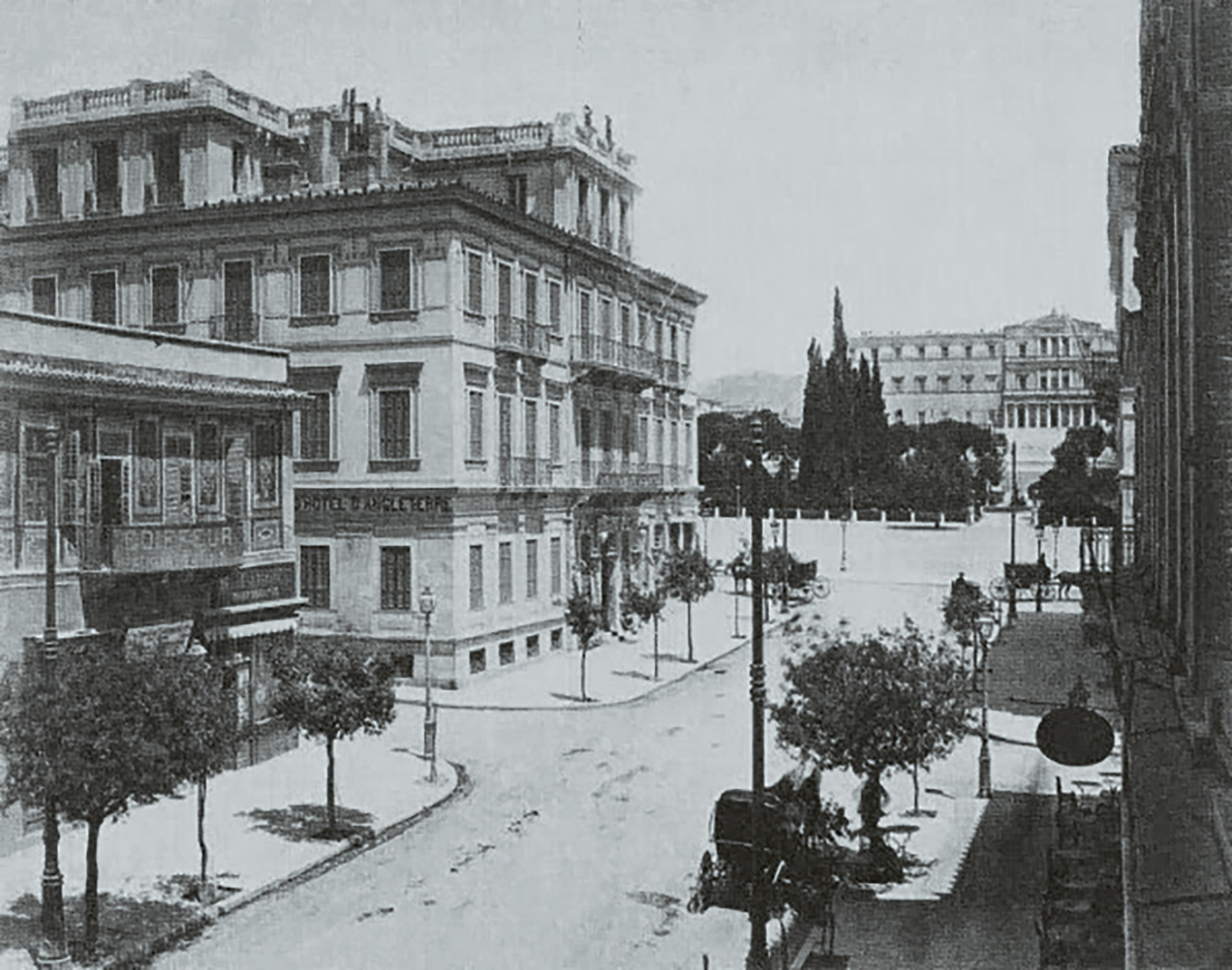
A defining landmark and a powerful symbol of the city’s modern social and historical evolution, Ermou captures Athens’ commercial pulse through every season. For nearly two centuries, its pedestrianized stretch—now the largest in the Greek capital—has drawn major international brands, iconic storefronts, and an endless stream of visitors. A magnet for both locals and tourists, it forms a constantly flowing river of people and commerce.

1885-2025
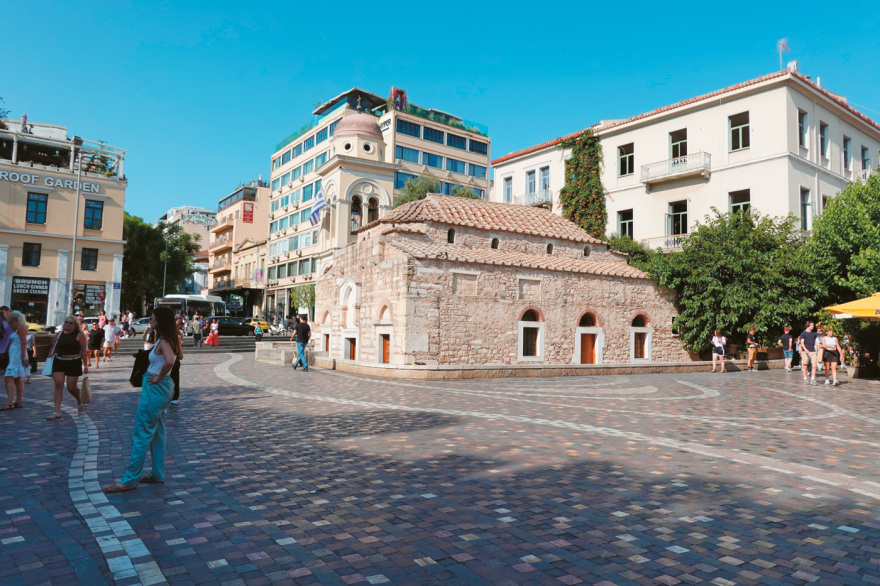
Lined with noble façades and rare townhouses—small architectural jewels that still survive—Ermou recalls a glorious past. Once home to grand hotels and legendary cafés whose stories have become folklore, it is also the only street in Athens with three Byzantine churches.
A street synonymous with nostalgia and aspiration, a living marketplace, and a crossroads for generations, social classes, and cultures, Ermou has come a long way from its beginnings as a rough dirt road strewn with stones. Today it ranks 15th among the most expensive retail streets on the planet.
The “Great Street”
In the original urban plan of Athens, Ermou was envisioned as the capital’s central commercial artery—hence its name, honoring Hermes, god of commerce. It began at Piraeus Street and stretched all the way to Syntagma Square.
The transformation happened quickly. Ermou became known as the “great road,” distinguished not by true width but by comparison to the narrow lanes of Plaka, Psyrri, and Monastiraki that still survive today.
Its first segment—up to Kapnikarea—bustled with activity, with Queen Amalia herself setting the trend for high-society promenades. The second segment, extending to Monastiraki, was also lined with shops and cafés. At its intersection with Miaouli once stood a towering date palm, admired by Hans Christian Andersen during his travels to Greece; it was uprooted in 1857. The third segment remained for years a dusty dirt road of humble homes, workshops, taverns, stables, and inns—a character that still echoes subtly today.

Ermou, nearly 1,600 meters long, was paved in 1838 using the macadam method, gained sidewalks later, and was asphalted by 1910. A royal decree in 1856 required all buildings to be two stories and form a continuous façade.
Changing with the times
Like all major streets, Ermou evolved with the city’s economic cycles, social needs, and technological advancements. Postwar Athens—heavily congested and polluted by the 1970s and 1980s—threatened the viability of its leading shopping street.
The turning point came with the decision to pedestrianize Ermou from Aiolou to Syntagma. Completed just before New Year’s Eve 1998, the project initially faced fierce opposition from merchants worried about declining traffic. But once opened, the pedestrian zone was instantly embraced.
Iconic Buildings
Ermou soon filled with neoclassical residences, especially between Aiolou and Syntagma. Among them:
The Kavakou House, formerly at the corner of Ermou 67 and Aiolou 15, a three-story eclectic masterpiece that once housed a pharmacy and later a hotel.
The Konari–Melas Arcade, built in 1883 on behalf of merchant Vasileios Melas, became Athens’ first glass-covered commercial passage, inspired by European galleries.
Next door, the Pyrrou Arcade (1885) was the second such passage in the city, connecting Ermou to Athenaidos Street.
Other notable neoclassicals include:
-
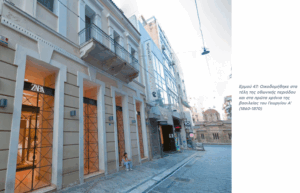
The building at Ermou 47 (1860–1870), once home to textile shops
-
The building at Ermou 62 & Aiolou 32 (c. 1870), later declared a listed monument
One building even housed the State Symposium, which issued the historic proclamation validating the 1843 revolution and demanding Greece’s first constitution.
Shops and Commerce
By 1837, Ermou was already gaining its commercial identity. Originally dominated by textile merchants, it later filled with ready-made clothing stores bringing fashions from London, Milan, and Paris. Over time, cafés, patisseries, tobacconists, bookmakers, photographers, and food shops created a vibrant mosaic, while further west, one still found blacksmiths and workshops.
Ermou also became home to notable foreign merchants:
-
Rodolphus Mayfarth, a Viennese bon vivant selling luxury goods
-
The Philippe Brothers, offering fine French fabrics
-
Lizier, the first European dressmaker to sell Parisian fashion to Athens’ elite
And, of course, the legendary Tzitzikas pastry shop, famed for its Copenhagen cream dessert.
Equally iconic was Alexandraki, Athens’ first ready-to-wear clothing store, serving figures such as Venizelos, Marika Kotopouli, the Zolotas family, Queen Sofia of Spain, and Amalia Karamanlis.
Hotels
From the mid-19th to mid-20th century, Ermou was known for its luxury hotels. Of the 24 hotels in Athens in the 1860–1880 period, 13 were on Ermou.
Foremost among them:
-
The Grand Hôtel d’Angleterre, rival of the “Grande Bretagne” and host to Ernest Hemingway, John Steinbeck, Yehudi Menuhin, and countless dignitaries
-
The Tourist’s Palace (opened in 1906), one of the finest hotels of its era
Cafés
Ermou was also a social and political hub. At the corner of Ermou and Aiolou, the café “Beautiful Hellas” opened in 1839, soon becoming a gathering place for writers, politicians, travelers, journalists, and intellectuals.
Nearby, the Café of the East (later “Zagoritis”) became one of the city’s most celebrated meeting points.
Ermou Today: A Global Retail Powerhouse
For 35 years, Cushman & Wakefield’s Main Streets Across the World report has consistently ranked Ermou among the planet’s top retail streets. After dipping to 31st place during the financial crisis, it now sits proudly at 15th, with rents rising to €3,720 per sq.m. per year.
Ermou’s exceptional ranking brings significant benefits to Athens, enhancing its global reputation and boosting tourism. Today it stands as the 7th most expensive shopping street in Europe and the 2nd most expensive in Southern Europe, above Rome, Madrid, and Barcelona.
What’s Next
Following the pedestrianization of the Syntagma–Aiolou section (1998) and the Asomaton–Piraeus section (2003), new urban upgrades are planned:
These changes will further increase commercial value, improve walkability, and elevate the street’s historic center environment.
Ask me anything
Explore related questions