
ATHENS – From the benches in Greece’s courtrooms…lawyers who are members of the ‘Dikigori en Choro’ dance group have embarked together on the colorful paths of the Greek musical and dance tradition. They are the dance group of the Athens Bar Association, and on the occasion of their recent visit and performance for the Greek communities of Alexandria and Cairo as part of the March 25 celebrations, the group’s founder and coordinator, Sevastianí Neonáki, spoke to The National Herald. She shared about their cultural journey alongside the practice of law, as well as its dynamic outward-looking character with particular emphasis on the Greek diaspora.
“Drawing from my personal experiences and my love for Greek music and dance tradition, in the autumn of 2023 I conceived the idea of creating the first traditional dance learning group within the Athens Bar Association. The Bar Association supported the initiative, colleagues responded, and thus on Monday, January 8, 2024, the ‘Dikigori en Choro’ held their first lesson with the participation of about 80 lawyers,” Neonáki recalled.

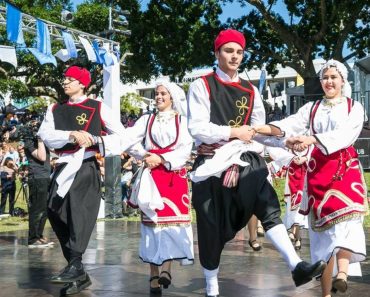
Theodora-Iliana Papacharalambous in traditional costume. (Photo courtesy of ‘Dikigori en Choro’)
The primary aim of the group, which today numbers around 200 lawyers, is to pass on their passion for Greek musical and dance tradition by organizing and participating in events both within and outside Greece, maintaining a special interest in the Greek diaspora. “In this way we feel that we become ambassadors of our cultural heritage as well as of the legal profession, which by its nature is multifaceted,” noted the Athens lawyer and founder/coordinator of the group.
Among the most important milestones of their journey are their participation in February 2025 in a celebratory festival marking the 131st anniversary of the Zographeion Lyceum in Constantinople, in July of the same year at the closing ceremony of the Ecumenical Conference of Greek Lawyers, and, recently this year, ‘Cities Palimpsest’, their performances in Alexandria and Cairo under the auspices of the Greek Embassy as part of the celebration of the anniversary of Greek independence.
“Our performances are not merely a display of dances from different regions of our homeland. On the contrary, they are enriched with narrative and dramaturgical elements, drawing on the timeless continuity of Hellenism from antiquity to modern times, as well as its cultural wealth. The organization, artistic direction, research, writing of texts, and ultimately our entire presentation are undertaken by us, the colleagues ourselves. We work intensively before each artistic event, and it is precisely this element of voluntary contribution and personal responsibility toward the group that we believe keeps the entire structure strong,” Neonáki explained.

Warmly welcomed by the Greek diaspora in Egypt were the ‘Dikigori en Choro’ during their recent performances in Alexandria and Cairo. In the photo: the founder and coordinator of the group, Sevastiani Neonáki. (Photo courtesy of ‘Dikigori en Choro’)
As she emphasized, “our travels to landmark cities of Hellenism, such as Constantinople, Alexandria, and Cairo, filled us with emotion and a deep sense of connection with the Greek communities that keep the flame alive beyond our borders. The heart of Hellenism beats strongly there, like the drum at the finale of our performance ‘Cities Palimpsest’, beating in rhythm with the heart for every Greek neighborhood in the world.”
“We hope that our next meeting will bring us to the other side of the Atlantic, to the modern ‘metropolis’ of the world, close to our compatriots, so that we may dance and sing together, as only Greeks know how.”
Theodora-Iliana Papacharalambous, lawyer, visiting researcher at the American College of Greece -Deree and former vice president of the Association of Trainee and Young Lawyers of Athens, who participates in the Athens Bar Association’s dance group, told TNH that “art, as a counterbalance to the strict structure of law, is a pillar of holistic development for professional identity and quality of life.”

Commemorative photo from the recent appearance of the ‘Dikigori en Choro’ in Egypt. (Photo courtesy of ‘Dikigori en Choro’)
“During our recent visit to Egypt, our fellow Greeks in Alexandria and Cairo welcomed us with enthusiasm and feelings of love. It was particularly moving to share the art of dance with people who recognize its cultural meaning,” she commented.
“In my personal experience, the dominant feeling during our performances was pride, as dance functions as a carrier of collective memory and cultural continuity, but also as a connecting link for people who are geographically far from their homeland. And when the dance ends, a sweet sense of fullness remains – as if something essential was expressed, without ever being spoken,” she added.