

Earlier this fall, visitors arriving at the summit of the Acropolis witnessed an exceptionally rare sight. After 20 long years, the Parthenon was entirely free of scaffolding, showing off its full facade in a way most travelers, and even many Athenians, have never seen in their lifetimes.
Considered the crowning glory of Doric architecture, the Parthenon briefly stood in its purest form, its proportions and marble surfaces fully visible without interference.
It was built in the mid-5th century B.C. to honor the city’s patron goddess, Athena, and today remains the centerpiece of Greece’s most visited historic site, which welcomed around 4.5 million visitors in 2024, according to national tourism data.
For the first time in two decades, and, according to Greek cultural officials, the first time in roughly 200 years without exterior supports at all, Athens’ most iconic temple stood unobstructed against the city’s skyline, revealing crisp architectural details that had long been hidden behind restoration scaffolding.
Although the window of full visibility was short-lived, it was symbolically important. The scaffolding returned after a month, so crews could complete the final phase of a nearly fifty-year conservation project, but authorities expect that by next summer, the removal will be permanent.
In other words, the rare view offered this fall was a preview of what travelers can expect when work officially wraps up in 2026.
A Glimpse Of A Rare, Open-Air Parthenon
When work to remove the western scaffolding was completed in October, it created what officials called a transformation in how the monument feels to visitors. Greece’s Culture Minister, Lina Mendoni, described during an interview on Skai radio that for visitors,
“It is like they are seeing a different, a completely different monument.”
The same sentiment was shared widely across social media as travelers posted once-in-a-lifetime images of the scaffolding-free facade, with many expressing genuine excitement at witnessing a moment they never expected to see in their lifetime.
Even from the pedestrian path below, sights once hidden for decades snapped into view, revealing clean angles of the Doric columns and frieze, and giving the monument an unexpectedly personal feel. For a UNESCO World Heritage Site that welcomes around 20,000 guests daily, the experience was historic.
The scaffolding was reinstalled after a brief departure, but this time with a reduced and less intrusive configuration designed to aid the final phase of the restoration effort while minimizing visual impact.
A Brief History Of The Restoration Project
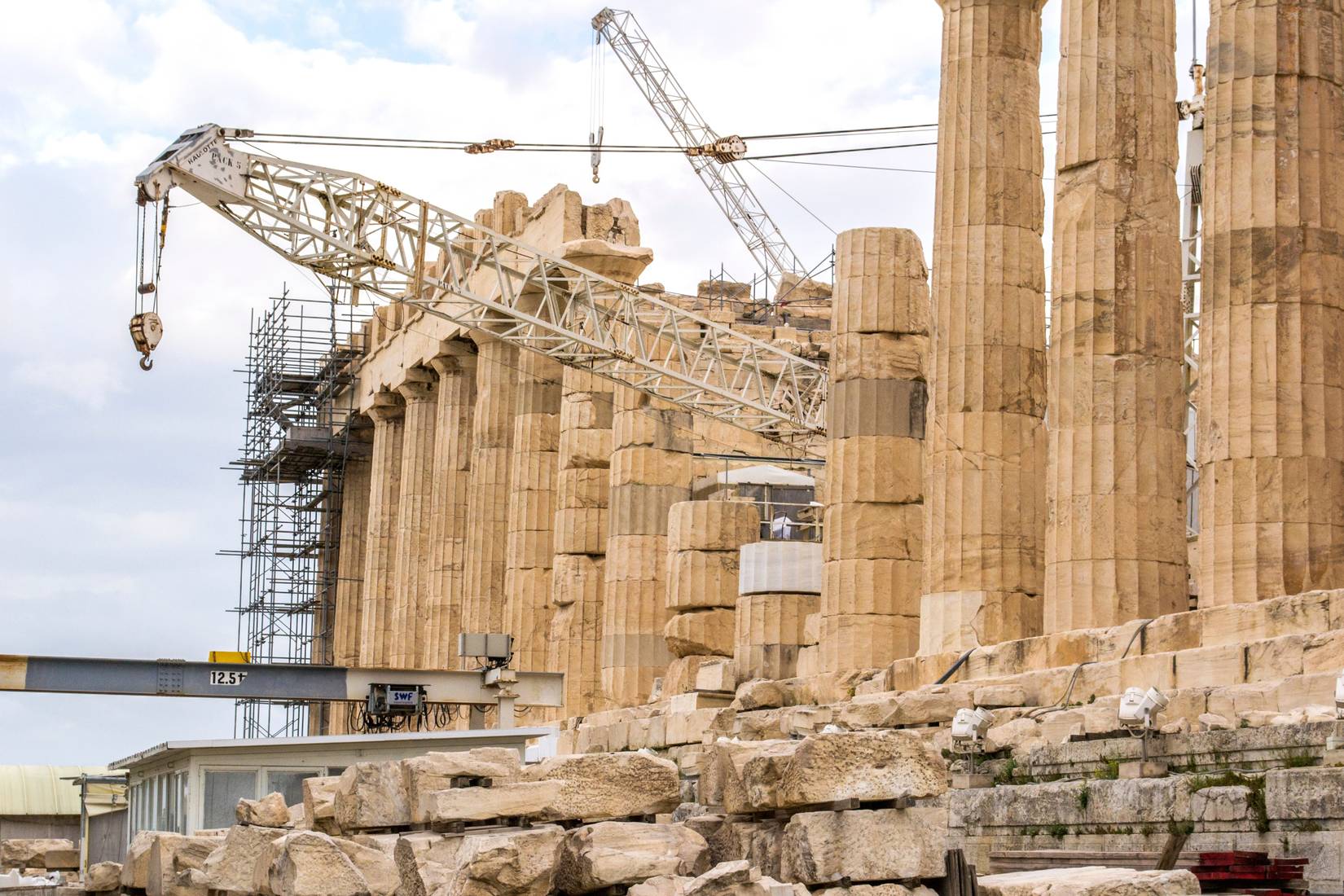
The current restoration campaign began in 1975, triggered by the need to correct earlier repairs that unintentionally weakened the monument. A 19th-century conservation overseen by engineer Nikolaos Balanos used iron clamps that later corroded, expanded, and fractured the stone they were meant to stabilize.
Since then, specialized teams have painstakingly disassembled and reassembled architectural sections, replacing failing metal supports with durable titanium and inserting new marble sourced from the same quarry the ancient Athenians used.
Sculptural fragments have been relocated to the Acropolis Museum for climate-controlled preservation while the structure’s stone puzzle continues to be realigned piece by piece.
This correction hasn’t just protected the Parthenon; it has reestablished the accuracy of its original engineering, one of the ancient world’s most precision-driven achievements.
Restoration Milestones
- 1975: Modern conservation efforts begin
- 2000s: Widespread titanium reinforcement replaced corroded iron
- 2025: Western facade temporarily cleared of scaffolding
- Summer 2026: Permanent scaffolding removal expected
What To Expect In The Coming Months

The brief period of full visibility ended, but travelers have a reason to stay optimistic. Scaffolding returned last month to complete the pediment work on the west facade, yet ministry officials emphasize that the new framework is lighter and visually restrained.
By summer 2026, crews expect to wrap up their major work. While conservators acknowledge that future discoveries could necessitate smaller projects later on, this marks the last large-scale phase currently planned. It’s as close to a “finished” Parthenon as the modern world has seen.
Next year could also invite a surge in photographic tourism. If October’s response was any indication, travelers are eager to see the Acropolis skyline as its original builders intended—clean, symmetrical, and free of steel supports.
Athens finally saw its crown jewel unveiled, and although scaffolding has already returned, the monumental project that has reshaped and stabilized the Parthenon is nearly complete.
By summer 2026, Greece’s most famous landmark is expected to stand permanently unobstructed and fully return to a form not seen in decades. The glimpse granted this fall wasn’t just a rarity; it was a promise of what is soon to come.