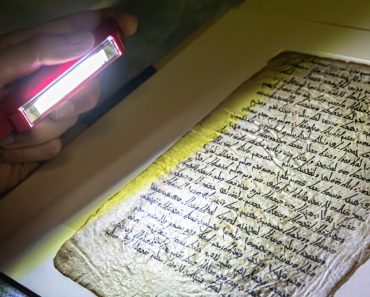

CNRS researcher Victor Gysembergh has located in the Museum of Fine Arts of Blois a folio that had been considered missing from the celebrated manuscript containing the works of the Syracusan mathematician Archimedes. The page, which corresponds to the treatise “On the Sphere and the Cylinder,” was removed from the codex at some point in the 20th century, and its whereabouts had been a mystery for decades.
The history of science and classical philology experienced this March 2026 a chapter worthy of an academic intrigue novel, although in this case the setting was not a remote archive in Istanbul nor a renowned university library, but rather a fine arts museum located in central France.
A page from the famous Archimedes Palimpsest, a 10th-century Greek manuscript that contains some of the fundamental treatises of the genius of Syracuse, has been identified in the collection of the Museum of Fine Arts of Blois by Victor Gysembergh, a researcher at the French National Center for Scientific Research (CNRS) affiliated with the Léon Robin Center for Research on Ancient Thought, a joint research unit of the CNRS and Sorbonne University.
The discovery, whose details were published in the March 6 issue of the prestigious German journal of papyrology and epigraphy Zeitschrift für Papyrologie und Epigraphik, is not the result of a systematic search through the museum’s holdings, but rather of the visual acuity and expertise of a specialist capable of recognizing, among the folds of a liturgical codex or the loose leaves of an art collection, a fragment of a manuscript that the scientific community had been searching for for decades.
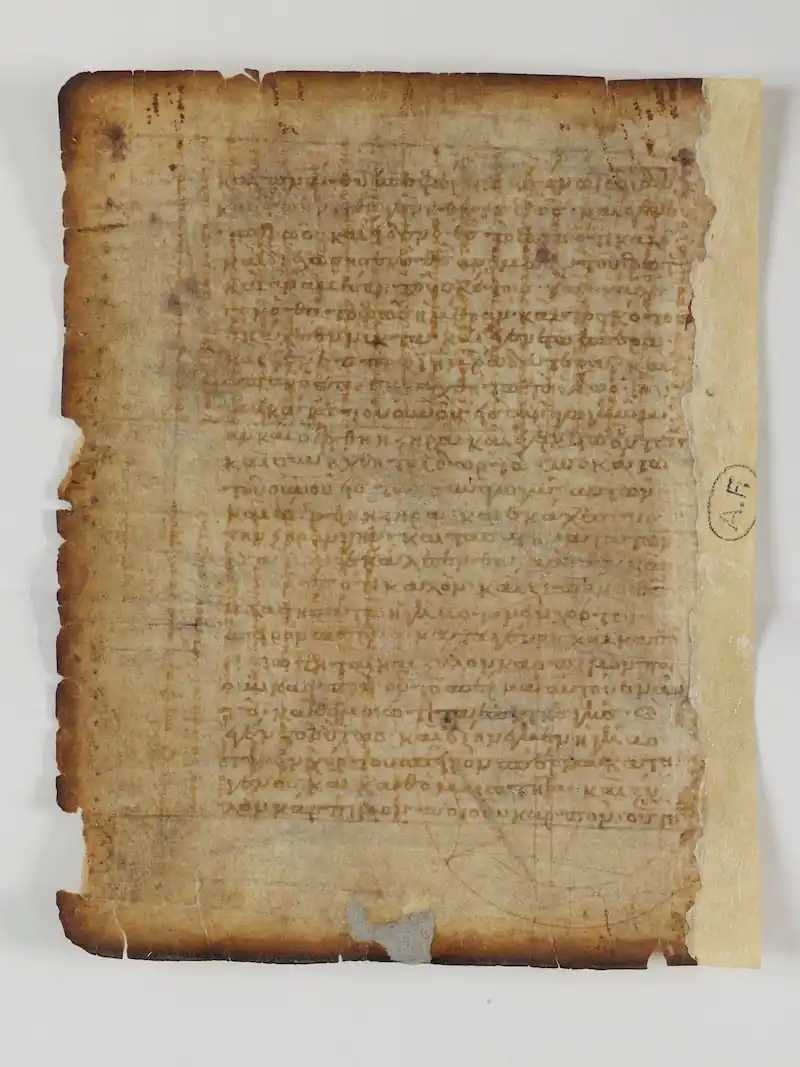
The page in question, which experts had cataloged as lost after comparing old photographs of the manuscript with its current state, is none other than folio number 123 of the Archimedes Palimpsest, an object that is currently preserved in the Walters Art Museum in Baltimore, in the United States, in the hands of a private owner, although the French government authorized its export from the country in 1996 after a long judicial and administrative process.
Confirmation of the authenticity of the discovery has been possible thanks to the existence of an exceptional photographic record. At the beginning of the 20th century, between 1906 and 1908, the classical philologist Johan Ludvig Heiberg produced a series of photographic plates of the manuscript when it was still in Constantinople, present-day Istanbul.
Those images, which are now preserved in the Royal Danish Library, constituted until a few years ago the only reliable window for studying the text of Archimedes, since the original manuscript had suffered serious damage and rewriting over the centuries.
It was precisely the direct comparison between one of those old plates and the folio located in Blois that allowed Gysembergh to establish an unequivocal correspondence: the page found in France is, without a doubt, the same one that Heiberg photographed one hundred and twenty years ago and that later disappeared from the main body of the codex at some point during the journey that took the manuscript from Constantinople to its current location in Baltimore, passing through private collections in Paris and other places.
The content of the recovered page is far from trivial. On one of its sides, despite the vicissitudes it has endured over the centuries, a passage from the treatise On the Sphere and the Cylinder can still largely be read, specifically propositions thirty-nine to forty-one of the first book of that work.

Subscribe to our newsletter
Receive our news and articles in your email for free. You can also support us with a monthly subscription and receive exclusive content.
On that same side, the text of Archimedes appears partially covered by a later religious text, a prayer written at some point during the Middle Ages, when the parchment—an extremely costly material—was scraped and reused to contain liturgical writings, a common practice at the time that gave rise to the palimpsest condition of the manuscript. Despite this superimposition, the geometric figures accompanying the treatise and much of the original Greek text remain discernible, which allowed its preliminary identification.
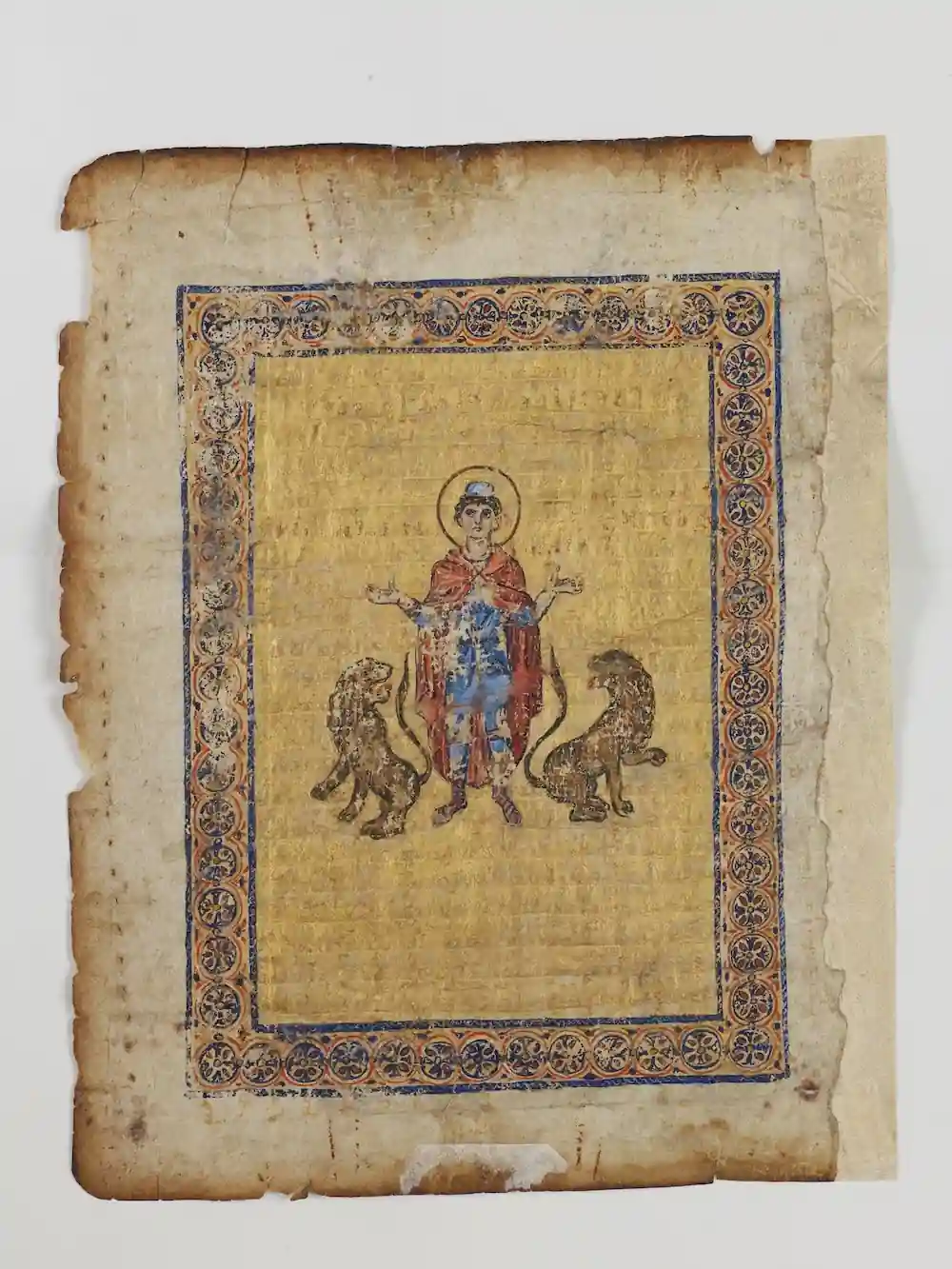
The mystery—and at the same time the greatest attraction for future research—lies on the other side of the folio. There, the text of Archimedes is not hidden by the medieval ink of an anonymous copyist, but by a much more recent illustration, added around the year 1942.
It is an enigmatic representation of the prophet Daniel accompanied by two lions, a devotional image that, according to the notes accompanying the piece and the research carried out by Gysembergh’s team, was painted directly onto the parchment at the initiative of the owner who possessed the manuscript at that time.
The hypothesis put forward by the experts is that the owner, with the intention of increasing the commercial value or the aesthetic appeal of the codex, decided to embellish it by adding this illumination, perhaps unaware that he was burying forever, at least to the naked eye, a portion of the text of the Greek mathematician. Beneath that layer of 20th-century paint, the content of folio 123 remains inaccessible today to conventional observation methods.
However, science now has tools that did not exist when the manuscript was the subject of an exhaustive study campaign in the early 2000s. On that occasion, a multidisciplinary team achieved spectacular advances using multispectral imaging techniques, which make it possible to illuminate documents with different wavelengths and reveal faded or scraped inks that the human eye cannot perceive.
That campaign brought to light texts by Archimedes that were believed to be lost and even fragments of other classical authors. Now, the discovery of this lost page, and especially the presence of the enigmatic modern illustration that hides one of its sides, raises the need to go one step further.
The CNRS researcher has already announced his intention to request the necessary authorizations to submit the folio, within approximately a year, to a new generation of analyses. The work plan includes the combination of advanced multispectral techniques with a method of X-ray fluorescence analysis, but not using conventional laboratory devices, rather by using the light generated by a synchrotron.
This technology, which allows the surface of the parchment to be bombarded with high-energy beams without damaging it, could be capable of penetrating the layers of paint added in 1942 and discriminating the chemical composition of the underlying inks—the ones belonging to the text of Archimedes and those of the medieval prayer—separating them from the pigments used in the illustration of the prophet Daniel. If successful, this intervention would make it possible to read for the first time in many decades the complete text contained on that side of the folio.
The discovery in Blois has reopened the debate about the need to undertake a new comprehensive examination of the Archimedes Palimpsest. Those responsible for the study believe that current technologies are considerably more powerful than those available twenty years ago, and that applying these new methods not only to this newly discovered page but to the entire manuscript could substantially improve the reading of passages that remained partially undeciphered during the previous campaign.
Science now has a unique opportunity to extract from the parchment the last word that the sage of Syracuse wrote about the relationships between the sphere and the cylinder, knowledge that remains latent beneath layers of ink, paint, and centuries of history—and which now, thanks to a sharp eye in a provincial museum, is once again within reach.
SOURCES
Victor Gysembergh, A leaf from the Archimedes palimpsest rediscovered in Blois. Zeitschrift für Papyrologie und Epigraphik, 6 mars 2026