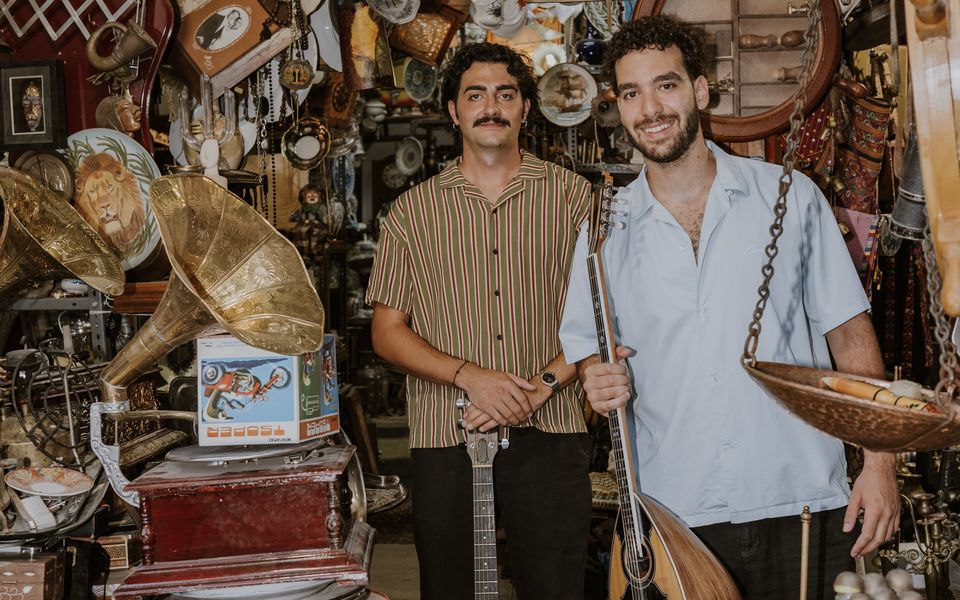
The weekends in Athens are a smorgasbord of music, ranging from techno parties and rock concerts to jazz and disco nights, pop revelry and traditional festivities. Amid the bustle, however, another, less prominent sound can be heard. In small tavernas and music venues, a new generation of musicians is picking up the three-string bouzouki and testing their vocal range as they breathe new life into traditional rebetiko music.
“What really stood out for us with rebetiko was the directness and simplicity of its lyrics, and its interesting melodies. There’s also something subversive about it. It challenged the established norms of the era in which it emerged, and that’s a characteristic that resonates with us,” says 26-year-old Panagiotis Siklafidis, a member of the now-famous duo Giagkinides.
Siklafidis and Spyros Zisis, also 26, started out as street musicians, performing in public squares and pedestrian streets in Thessaloniki, northern Greece. They helped popularize the sound of the bouzouki and classical guitar among Gen Z within a few years, through covers of well-known rebetiko songs and original releases such as “Katafertzou.”
“We believe the term ‘rebetiko’ has become too closely associated with older times, with the problems of that era, a particular slang and a certain style of dress. Replicating all of that today seems somewhat pointless. What we can hold onto, though, is the spirit of the genre, which is defined by sincerity,” he says.
Musician Konstantinos Papaioannou, AKA Koutsavakis, 29, agrees. He started building a following during the Covid pandemic with the very apt “M’apagorefsan, re manges,” inspired by the lockdowns; and has since released other hits like “Re matzore,” and “Ston Evosmo pou perpato.”
“At first, I took it up for much the same reason young people start smoking – because I thought it would make me look cool. But I eventually realized that only my bouzouki knows the emotional struggles I may be going through,” he tells Kathimerini. “Another reason is that rebetiko addresses a wide range of social issues.”
However, he says, rebetiko is often confined to a familiar formula that no longer resonates as deeply with audiences. “In the 1930s and 40s, the songs reflected the awful hardships and wars people had lived through. Many musicians today have held on to these darker elements, yet there are beautiful, melodic songs written in later years that could be incorporated into their repertoire, such as ‘Dina, Konstantina,’ ‘Thelo Sta Bouzoukia Apopse Na Me Pas’ and ‘Ta Kavourakia,’ among others.”
For 32-year-old singer Maria Vakali, who performs at music venues in central Athens, her upbringing played a decisive role in drawing her to the genre. “It was one of the main types of music we listened to at home. My father also sang, which I think had a considerable influence on me. I also feel that my voice is well suited to this musical style, and I love its romantic character,” she tells us.

Controversial themes
Rebetiko music has long been associated with the figure of the “mangas” – a streetwise tough guy – masculinity, a distinctive attitude toward life and themes of substance use and abuse, as exemplified by songs such as Panagiotis Toundas’ “Stou Thoma” and Markos Vamvakaris’ “O Harmanis.” But how do contemporary artists approach this aspect of the genre in an age of political correctness and evolving social sensitivities?
“The rebetiko musicians of the past expressed themselves through the experiences of their own times. Personally, I may not agree with all their views or their way of life, but I have tremendous admiration and gratitude for Markos Vamvakaris,” Koutsavakis says. “But having a deep appreciation for him doesn’t necessarily mean I have to embrace his views on life, everyday living or women.”
Maria Vakali points out that performers naturally have the right to critically assess what they hear and make a conscious decision not to sing certain songs. She also notes her particular fondness for female rebetiko artists such as Stella Haskil and Ioanna Georgakopoulou. “There are certainly songs that demean women, but there are just as many that celebrate them, such as ‘To Koritsaki Mou (Gia Koitaxe, Vre Kosme)’ and ‘To Deka to Kalo,’” she says.
She also comments on darker aspects of the older repertoire. “The older rebetiko contains frequent references to substance abuse, of course. But writing lyrics in the same way nowadays might be considered outdated. There are, of course, a few songwriters who maintain this style, but their audience is equally limited,” she says. “These themes are now being expressed by rap and trap. These are the genres that have become associated with that particular lifestyle and enjoy greater commercial appeal than a contemporary rebetiko song exploring similar themes would.”
For Panagiotis Siklafidis, it is unfair to judge people who lived all those years ago by today’s standards. “Especially given that they were among the most open-minded people of their time and contributed, in their own way, to musical and social progress. There are also numerous examples of female rebetiko artists, such as Sotiria Bellou and Marika Ninou, who, in an overwhelmingly male-dominated society, found in the genre an environment in which they could assert their independence and do great things.”

Mainstream or alternative?
We often hear about the relentless hunt for authenticity, a trend that has sent people flocking to village festivals and traditional kafeneios, turning them into tourist attractions. The new rebetiko generation, however, is resisting the pull of the mainstream.
“I think quite a few of my fellow musicians in the new generation of rebetiko fall back on a superficial kind of spontaneity, neglecting the deeper study and preparation that our music and live appearances require,” Koutsavakis says, adding that he is not opposed to a more professional and structured approach to presenting rebetiko in order to attract a wider audience.
Vakali voices a different concern. “When something becomes popular and commercialized, it risks losing its soul. If rebetiko, for example, suddenly becomes fashionable, everyone will start writing rebetiko songs to meet a new, commercially driven demand. Not all of these songs are likely to be of high quality,” she says. “Some songs are bound to be thrown together, perhaps even using AI, and the genre could end up losing what makes it authentic.”
Zisis, for his part, explains that Giagkinides is careful to avoid “staged authenticity” without compromising on the hard work and dedication their craft demands. Commenting on how audiences often react to success, he says: “A lot of people discover a song and love it, but as soon as everyone is listening to it, they suddenly ‘hate’ the artist. To us, that’s just pretentious. We want rebetiko to evolve, for young people to discover it and for it to carry on by adapting to the realities of today’s world.”
Story via the original publisher. Read the original article