For DARA, winning Eurovision was never just about bringing a trophy home. After securing Bulgaria’s first-ever Eurovision Song Contest victory in 2026, the pop artist found herself at the centre of an international conversation that extended far beyond music. For a generation of young creatives growing up in the Balkans, her victory represented something arguably more powerful than a career-defining achievement. The permission to dream bigger.
Several months later, she barely had a moment to process the magnitude of what had happened. Between performances, international opportunities, and the launch of her own record label after a decade of being signed, the Bulgarian star is already laying the foundations for the next chapter of her career.
Her latest single, “BAD IDEA,” marks her first release as an independent artist and offers an introduction to a new era ahead of her forthcoming album. Unapologetic, ambitious, and refreshingly outspoken, DARA is less interested in following the conventional rules of the music industry than she is in discovering what happens when she breaks them.
Yet, beneath her bold visual identity and seemingly fearless stage presence lies an artist whose relationship with perfectionism, vulnerability, and cultural identity is far more complex. From incorporating elements of Bulgarian tradition into her visual universe to envisioning a collaborative project celebrating Balkan artists, DARA is determined to explore what international pop stardom can look like without compromising where she comes from.
EUPHORIA. caught up with DARA to discuss life after Eurovision, challenging generational mindsets in the Balkans, embracing artistic independence, the relationship between fashion and cultural heritage, and why releasing music is ultimately an act of vulnerability.
 Photo: press
It’s been several months since your Eurovision victory. Have you actually had a moment to process everything that has happened?
No. Not at all! I think at the beginning of the year, I’m going to Mexico City, and then I hope I’ll finally have the time to be like, “Wow, god damn, what have I done?”
I’ve just been working from one thing to another, so it’s been hard for me to actually realise the full picture and the magnitude of the things that have been happening to me.
Today, I’ve been in my room almost all day. Can you imagine? That hasn’t happened to me since maybe the first week of July. It feels so good to be back home.
What has been the biggest change for you, both personally and professionally, since winning Eurovision?
I started my own label, so that’s been the biggest change. But, of course, meeting people from all over the world and having the platform of Eurovision and that big stage opened a lot of new opportunities for me, which is wonderful.
You made history by securing Bulgaria’s first-ever Eurovision victory. What does representing your country on an international stage mean to you, particularly when it comes to creating greater visibility for Bulgarian artists?
Well, you said a lot of the things that I wanted to say! [Laughs]
For me, representation has always been extremely important because I don’t see Bulgarian people anywhere. Nowhere. Or if I see some news, it’s probably not going to be very good.
I’ve been feeling like, “Wait, there are so many cool people here.” There are so many creatives, musicians, singers, people who I love and admire, and all of my friends that I create music with. The fact that it’s so hard to go outside Bulgaria just because we’re Bulgarians was not sitting well with me.
I wanted to be a good representation and somebody who people could look at and say, “Wow, you have those kinds of people in Bulgaria?”
I also wanted to inspire the younger generations who are trying to go outside and show their faces. Some of them are scared, some don’t believe enough in themselves, or they think their dreams are way too big and they can never accomplish them.
When you’re from a small city or a small country, there’s always that doubt in yourself before anything else. If you look at countries like Italy or France, you can immediately see that people believe in themselves. They’ve been taught from a young age, “You’re number one.” In our country, it’s more like, “You think you’re that good? Think again.” It’s hard to live in an environment like that and dream big.
But I always knew that everything was possible, and I kept that in my heart. Every time I’ve been depressed or felt less, I’ve reminded myself that everything is possible. I need to close my eyes and keep repeating that until I know there’s light and hope, and I can see my vision and pursue it.
That’s been my whole life, but it’s become even more relevant to my journey since the beginning of this year. From the start of Eurovision to moving to Greece, which was a main part of the journey because it helped me focus on what I wanted, and then actually winning Eurovision, which was insane.
The trophy is not the thing that made me proud of myself, but what made me proud is seeing hope in people’s eyes and seeing that I changed somebody’s mindset about what they can do and whether they have limits. People from outside the art scene, people with completely different jobs, came up to me and said, “You gave me hope that something is possible, that I might also achieve what I want.”
That’s the most important thing for me, the hope that I see in people’s eyes.
Growing up in the Balkans myself, I feel there’s often this deeply ingrained belief that there’s a limit to what we can achieve internationally. Do you feel your victory carries a responsibility to challenge that mentality beyond Bulgaria?
Yeah, it does. Everybody’s saying that it’s pretty hard, but I believe we are meant to evolve and to change.
That win is a lesson for a lot of people, not only for my country but for the whole Balkans and Slavic countries, too. I think this is a mindset that comes from the older generation, and we need to break those rules.
I don’t think I belong to the generation that made those rules. I don’t believe in them. There are things that are part of this generational trauma, and I don’t want them on my back. You can keep them, thank you so much! I will speak about something new, and whoever wants to come with me, welcome.
But I’ve been called delusional more than once because of the dreams that I have. There have been people around me who have said a lot of things that made me feel small. I decided who to be around, how to speak, and what energy to give out into the world and the universe. Even my prayers and my conversations with God have changed.
Your latest single, “BAD IDEA,” marks the beginning of a new chapter for you as an independent artist. What made you feel that this was the right song to introduce this era?
There is no right track. There’s no such thing. I don’t believe in that. It’s been marketed as, “What’s the right track?” No, just release the music! But it’s my first song as an independent artist, with my own label, and that was a big step.
I have a lot of songs that are done and ready to go, but I needed to transform. After winning Eurovision, with all of the shows, interviews, and everything that was happening around me, I also decided to start the label, which was extremely challenging.
I’d been with a label for 10 years, and moving my whole body of work from one place to another is hardcore. That’s hardcore! So maybe it’s a “BAD IDEA” to do that right after Eurovision and create all this chaos, but it’s worth it. [Laughs]
It’s a big song, and it’s catchy. When I heard it for the first time, those first notes hooked me immediately, and I was like, “Yeah, I want this. Let’s do this and then never stop releasing music until I’m 85!” No, I’m joking. But I think you just need to go, explore, and push boundaries.
You mentioned wanting to create opportunities for other artists from the Balkans. Is that something you actively want to pursue through this next chapter of your career?
I will try my best, and this is what I want to do. God knows if I can achieve it, but I will at least try. If it’s not me, it’s going to be somebody else, and they might be inspired by me winning Eurovision.
I know there are a lot of talented artists in every country in the Balkans. They’re my friends, and I believe in them. I know that if they have a chance to go and perform at Eurovision, they will smash it.
People like to divide us by countries, but we are artists. We are all the same. We’re the same tribe. We’re the artist tribe. We understand each other, we like to be around each other, and we support each other. We are the only people who know how hard it is to do what we do.
For example, I have a lot of friends in Greece from the Greek music scene. I came to Greece three years ago, and I was like, “I need to do a Balkan EP with all of the Balkan artists. They’re so dope, people should know about us.” They don’t know what’s going on here, and that’s interesting. Overall, I see a bright future.
 Photo: press
As you prepare to release your first fully English-language album, how are you approaching this next stage of your career and connecting with an even wider international audience?
Well, first of all, I already have an international audience, like you! [Laughs] So that’s not that hard.
What’s hard is actually keeping your message and making sure that message is heard. In 2026, it’s extremely hard because everything is so dynamic. You know how it goes with social media and AI, and how flooded everything is with news and content.
But my priority has always been to connect with people and with my audience first. If that can lead to new people finding me and my music and connecting with it, I’ll be extremely happy and thankful.
I’m doing what I’m doing, and I think people will like it. I personally love what I have.
I think if artists don’t like what they’re doing, they should quit doing it or give themselves a break. I personally believe that first you need to adore what you’re doing and then release it.
And it’s not so easy sometimes because it’s not a product. You’re not releasing a tomato on the market, you’re releasing your fucking soul. It’s hard, but you need to let it go and let the audience listen and be the judge of it. That’s it.
You have such a distinctive visual identity, and fashion seems to be an important part of your artistic expression. What can we expect from this next era aesthetically?
I like that you’re asking about fashion!
It keeps on being specific. Sometimes I wake up and I’m like, “Can I not be so specific?” Because what do you mean I want a turquoise leather jacket with pockets right here, fitted to my waist? [Laughs]
See also

Sometimes I wish I wasn’t so specific so things could be easier for me, but I cannot.
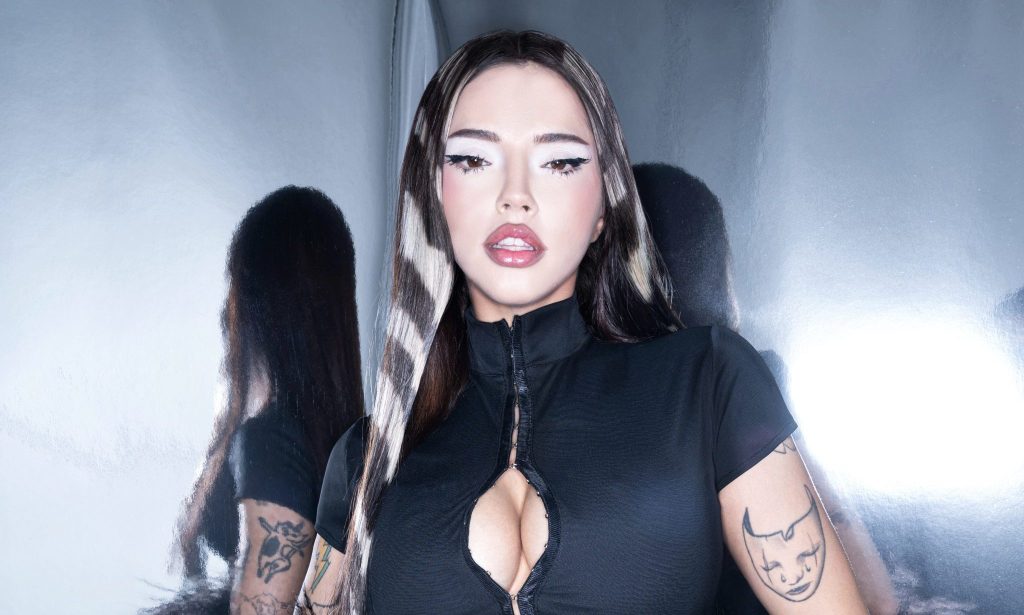
What I’m going to keep pushing is, first of all, my tiger-zebra hair, as you can see. And then there are small details everywhere. You can feel the animal inside of me.
I also love incorporating Bulgarian tradition, culture, and clothing, but through small details. Not full-on traditional clothing, but taking details from it and putting them in different places. You’ll see what I’m talking about.
You saw my dress with the turquoise carpet in Eurovision already. That comes from Kukeri, a tradition that we have in Bulgaria. In the “BAD IDEA” video, we also had a Kukeri, but we also have this brutalist monument. We have a lot of those in Bulgaria, and that’s something from my culture. Whatever I do, I would love to include those small details.
People might not know what they are, and they might be like, “Where is that?” And I’ll be like, “This is my country. This is Bulgaria.” It’s about representing in different ways and making it extremely fashionable, of course. Please!
Beyond the visual references, can we expect Bulgarian folklore or other Balkan influences to find their way into your music sonically?
That’s really hard. Someday. I promise you, someday this will come. But for me, it’s so, so special.
It’s so intimate to me that I have a fear of touching something that is so unique. I grew up with that music, and I studied folklore in music school my whole life, so this is my story, and it’s something that’s pretty personal to me.
It’s almost like showing you my deepest secret.
I don’t want to approach it like, “Let’s just do a pop song and put a little bit of folklore here,” just for fun or just to show it. I want to make it with taste, and that takes time.
It’s something that I need to explore more and have the time to really dive deep into, so I can show it to the audience exactly how I see it, hear it, and feel it.
Onstage, you come across as an incredibly fearless and confident performer. Are there parts of yourself that the public hasn’t had the opportunity to see yet?
Of course. You’ve never seen my mental breakdowns. You’ve never seen those!
You’ve never seen my anxiety, how I’m trying to warm up, or everything that I do backstage.
I’m a perfectionist, and almost every time, I’m in denial that I’m going to do great. In rehearsals, I’ll be like, “That was so bad. That was a three out of 10.”
And then I’ll see a video and be like, “Oh, not so bad.” [Laughs]
So it’s only afterwards that you’re able to acknowledge that you actually did a good job?
Yeah. Or maybe it’s not as bad as it was in my head, at least! But I’ve been trying to be better, and I think that’s part of being a good performer and artist. You’re trying to do better and always trying to do your best.
Finally, when can we expect the album, and what should we prepare ourselves for?
At the beginning of the new year. In the beginning, let’s say it like that.
But expect it to be iconic. I expect you to expect this album to be iconic, and I expect you to dance to it, okay?
Absolutely. I promise!
Story via the original publisher. Read the original article