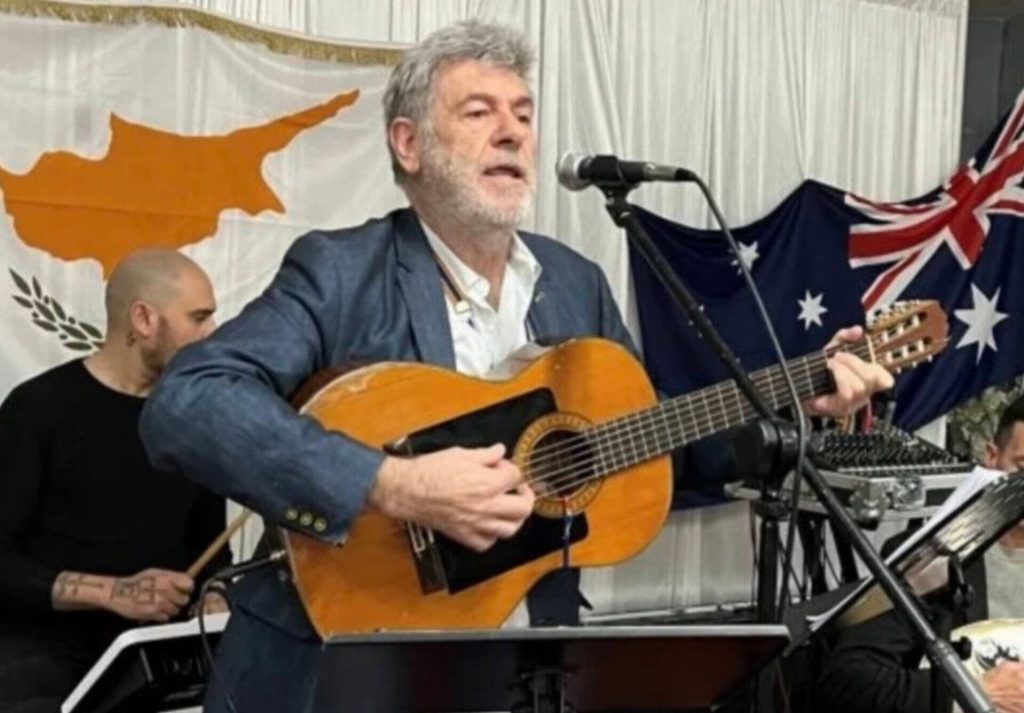
Three years after Stelios Tsiolas’ passing in November 2023, his music continues to speak to generations, homelands and memories.
As a composer, conductor and educator, Stelios combined his love for Cyprus, the experiences of the Greek diaspora and his belief in the power of music to preserve human history.
Born in Cyprus, he began composing at the age of twelve and, by the age of fifteen, was already performing his own works at local festivals.
The events of 1974 and his service in the Cypriot armed forces had a profound impact on his life.
After migrating to Australia in December 1976, he developed a distinctive musical voice, drawing inspiration from the Greek tradition and creating works of symphonic, choral, chamber, theatrical and educational music.
His work has been performed in concert halls, community venues and school classrooms.
He has composed for singers, choirs and instrumental ensembles, orchestrated music for Greek festivals in Australia, taught and mentored others.
His catalogue of works includes “Diabolus Musica”, “Freedom Tonight”, “Echocromata”, “The Greek Kangaroo” and the cycle of songs to poems by Doros Loizos.
His educational work also includes “Sakaraka”, which is listed in the 1988 ABC Sing! catalogue, as well as children’s songs through which language and cultural memory are transmitted to younger generations.

“At Dawn” – a voice of memory
Among his most important works is the oratorio “At Dawn”, which was performed at the Dallas Brooks Hall in Melbourne on 18 September 1986, conducted by Douglas Heywood, as recorded in the Camberwell Chorale concert calendar.
In 1989, Stelios himself conducted the work in his beloved homeland, Cyprus. The concert in Cyprus was held at the invitation of the President of the Republic of Cyprus – a distinction with deep personal meaning for Stelios.
Through “At Dawn”, he gave musical expression to the memories of displacement, the dignity of his people and their unwavering hope for peace and freedom.
Another highlight of his musical career was his participation as assistant conductor in the concert of Mikis Theodorakis’ “Axion Esti” at the Perth Festival in 1991 – an experience that his wife, Argyro, remembers with particular emotion.
His website also mentioned his international biographical recognition in The International Who’s Who in Music and Musicians’ Directory, 11th edition (1988).

“Because that is how it must be” – the unwavering faith in Kontea
For Stelios, Cyprus was never just the place where he was born. Its history, the sacrifices of his family and people, and the longing for a free Kontea lived on in his music.
His iconic song “Γιατί Έτσι Πρέπει” (Because That Is How It Must Be) expresses the unceasing hope and the conviction that the memory of the homeland must never fade.
The chorus of this song is engraved on a white marble plaque on his grave. These words remain there for people to see, remember and sing: a timeless expression of the longing that accompanied him throughout his life.
His family also acknowledges the place that his songs about Cyprus are in the Cypriot school curriculum, as well as his songs about migration in the Australian school curriculum – a legacy in which music becomes memory and the continuation of culture.

“Freedom tonight” – an album of nostalgia and hope
Among the recordings that Stelios’ family holds especially close to their hearts is the album “ΛΕΥΤΕΡΙΑ ΑΠΟΨΕ” (Freedom Tonight), which Argyro considers his greatest recording creation.
Throughout the album, his voice conveys a deep longing for freedom and, above all, for his beloved Kontea. In every song he performs, the pain of separation from his homeland, the memory of uprooting and a hope that never faded resonate. For those who knew and loved him, “Freedom Tonight” remains a timeless musical testimony to his identity, his devotion to Cyprus and his dream of seeing Kontea free again.
A tribute from his wife – the love behind the music
Our journey together began in 1986, at Evangelistria College, where we both taught.
It was there that our paths crossed and a life began, founded on love, mutual respect, shared values and our enduring appreciation for education, culture and music.
Among my most cherished memories is the unique experience of the concert with the legendary Mikis Theodorakis, at which Stelios served as assistant conductor.
It was then that I felt so keenly the depth of his passion, his unwavering dedication and, above all, his boundless respect for music and all that it represented.
I was not merely observing his musical talent. I experienced his passion first-hand, sharing in the emotion, the dedication and the sacrifices of his artistic journey.
During the years we spent together, I realised just how deeply Stelios loved Cyprus, and in particular Kontea, the village where he was born, in occupied northern Cyprus.
I could sense how deeply he carried its history, its struggles and the sacrifices of its people and his own family.
His songs gave voice to the pain of uprooting, to nostalgia for home and to the unshakeable hope for freedom.
The chorus of “Γιατί Έτσι Πρέπει”, now engraved on the white marble plaque of his grave, will remain visible to all who visit him – words to be read, remembered and sung.

“Αργυρώ Φεγγάρι” the song he wrote for me
Of all the wonderful compositions Stelios created in his lifetime, one will always remain closest to my heart – “Αργυρώ Φεγγάρι”, the song he composed for me in 1990.
From the first moment we met, Stelios insisted on calling me by my full name, Argyro. To him, I was always Argyro. And after some time, he set that name to a melody that was destined to become one of the most precious expressions of our love.
The song was born at a time when we deeply longed for each other, while the circumstances and limitations of life made the path ahead extremely difficult.
There were times when our hearts knew what they desired, even when life seemed determined to keep us apart.
Through “Αργυρώ Φεγγάρι,” Stelios expressed through music what words alone could not convey – the tenderness of longing, the pain of separation, the power of hope, and the incomparable power of a love that refused to surrender.
For me, this song is so much more than just a beautiful tune. It is part of our personal story, a reminder of the love we fought for, the obstacles we overcame and the life we eventually built together.
Every note holds a memory, every melody an emotion, and every time I hear it, I’m transported back to the years when our love was still finding its way.
Stelios taught me something far greater than a love of music. He taught me the true meaning of life: that love conquers all; that the greatest achievements are not measured by recognition or material success, but by the depth of what we offer to others; and that our legacy ultimately lies in sharing life’s true values – love, compassion, sacrifice, family and the courage to remain true to what really matters.
Through our three sons, Panagiotis, Giorgos and Grigoris, and through our grandchildren, these life lessons live on.
Our sons’ families are the living embodiment of the love we shared and the values we sought to pass on from generation to generation. Stelios always said that our three sons were his greatest achievements.
As I reflect on the third anniversary of his passing, I realise that Stelios left me two priceless gifts: the family we built together and a song that will forever bear my name within its music.
“Αργυρώ Φεγγάρι” is not merely the song that Stelios wrote for me. It is the story of our love, preserved within a melody – a love that neither time nor distance nor even death can silence.
And perhaps that is the most profound lesson he taught me: that, although life itself is finite, the love we offer, the memories we create and the legacy we share can last forever.

With all my love, forever,
Your Argyro
Forever in our memories. Forever in our hearts. His music lives on.
Story via the original publisher. Read the original article