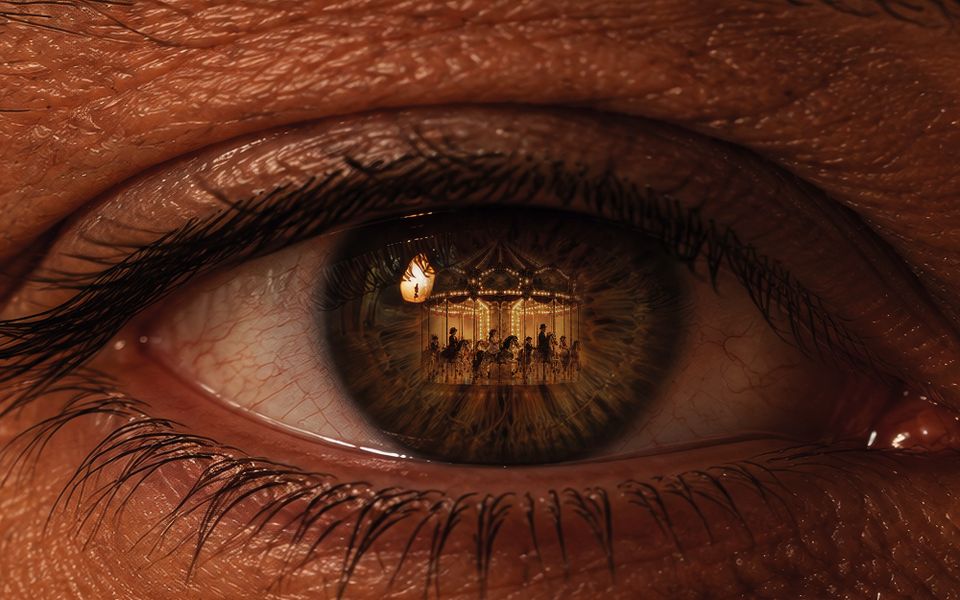
There is a scene in Alexander Pushkin’s short story “The Queen of Spades,” in which the young Hermann leans over the countess’ open coffin and is convinced that the dead woman looks at him mockingly and winks. Could it be a figment of Hermann’s paranoia?
“The Queen of Spades” has inspired films, theatrical productions and a major opera by Pyotr Ilyich Tchaikovsky, with a libretto by his brother Modest, which is being staged by the Greek National Opera in December and January, in a production directed by Britain’s Stephen Langridge.
‘All theater is, in some way, a version of “what if,” isn’t it? And I think that’s fun. Because it’s theater, we can do it for a few hours and see what happens. Then we go home’
The plot goes as follows: Hermann, a young officer in the military engineering corps, learns that an elderly countess knows the secret combination of three cards that guarantees success at gambling. He romantically pursues her young companion, Lisa, who gives him instructions on how to sneak into their home. Hermann demands that the countess reveal the secret combination at gunpoint, frightening her to death.
When her ghost later visits him, she reveals the three cards, but on the condition that he marry Lisa. For two nights, Hermann wins large sums of money by betting on the first two cards. On the third night, however, he stakes everything on the third, only to be dealt the queen of spades – which appears to wink at him! Hermann ends up in a psychiatric hospital.
We ask Langridge to discuss the few but significant differences between the short story and the opera. “In the short story, Hermann loses his mind and Lisa marries someone else, whereas in the opera, they both commit suicide. This distinction matters for a particular reason: tragic love was a central theme in Tchaikovsky’s music and a significant part of his personal experience.”
Are you referring to his suppressed homosexuality?
Yes. It was not that suppressed, really, but he couldn’t be completely open about it.
It has been said that he attempted suicide as a result.
There’s a little bit of a myth around it and there are certainly people who have come up with theories that he definitely did. It’s very difficult though, because, of course, a lot of the material is censored, stripped out by the Soviets.
So how did you approach the story for the stage?
I focus on the darkness and the impossibility around a relationship. In Pushkin, as you know, the motivation for Hermann is status and money to get the status. He only meets Lisa later, after he hears the story about the Queen of Spades. But in the opera, he’s already obsessed with Lisa, and that’s his objective. It’s a very big difference because it’s a question of whether the girl gets you to the status that you want, or you need the status in order to get the girl. It’s a complete change.

From end to beginning
Langridge is a delightful conversationalist; exuberant, with the requisite British dry wit. “I met the story through seeing it, through seeing the opera, not through reading Pushkin,” he says. “I always found it a fascinating piece. Then, when I began work on it, of course, I read the Pushkin. It’s extraordinary.”
Did reading the short story help you?
A lot of opera directing is about working backward from the result. The result is the opera. My job is to arrive at that in an imaginatively convincing way. So the only way of doing that is to go back through to the source. What inspired those artists, especially the composer, but also the librettist? It’s like a sort of archaeology, excavating. Let’s find out what’s underneath their unique decisions.
Such as?
Such as the questions around mental health, Hermann’s own sanity and what he’s experiencing. That is common in both. For me, it’s the story of three people who see in each other the fulfillment of their hopes. We have somebody who’s excluded from society because he’s not rich enough, who sees this beautiful young woman, and sees he needs to be in that society to meet her. That’s his objective. She has got this whole noble life. Marriage is set up. Everything’s rolled out. Lovely. She’ll go on and on, and then she’ll be 87, and she’ll be exactly like her grandmother. It’s all laid out in front of her. And she sees a way out with this. And the countess intervenes on this collision course, but again, it is different to the Pushkin. It is a fatal triangle, in a way.
You have not changed the setting from the original.
The original Pushkin is 19th century. Tchaikovsky said, “No, we’re going to put it in the time of Catherine the Great.” So they’re already pushing it further away from their own milieu of the 1890s, back into the 1790s. Very interesting. That world of Catherine the Great was glamorous, flamboyant, with plenty of parties where everyone was cross-dressing. And, you know, Catherine was into all of that. It’s even more mythologized now, from our distance. It is a flamboyant society, of which Hermann is not a part.
Nevertheless, the element of impossible love is timeless.
Yes, it’s eternal; it speaks to us today. And sometimes it is easier to key into at a distance when society was different rather than having to shoehorn it, to do a contemporary production. As you may know, I’ve been involved in plenty of productions where we’ve chosen to bring the story up to date. But this one? “No,” I thought, “let’s put it absolutely in that world so that there’s nobody going, ‘Oh, it wouldn’t be like that. That’s not how it is today.’ Then we can accept more readily the idea of something which just seems impossible to both of them.” You don’t have to scratch the surface very far to find people – maybe even our friends – who’ve been in a situation where they’ve fallen in love with somebody and it’s really not okay. Everybody – gay, straight, everybody – has had this at least once in their lifetime. All theater is, in some way, a version of “what if,” isn’t it? What if that moment when you caught eyes with somebody were extended? What would happen? Would you have to collapse the rest of your life? Would they have to collapse? What then? And I think that’s fun. Because it’s theater, we can do it for a few hours and see what happens. Then we go home. And if you can do that in such a way that the audience is open to play “what if” together, as opposed to the audience saying, “Oh, that’s so unrealistic,” then you have accomplished something important.
Hidden desires
I mention Tchaikovsky’s powerful symphonic poem “Francesca da Rimini,” inspired by the famous episode in Dante’s “Inferno” involving the tragic end of two forbidden lovers. I point out that some scholars have also interpreted the work as an expression of Tchaikovsky’s own anguish over his unfulfilled desires.
“Yes, it seems that, every now and then, he goes back to the same theme. We know about Tchaikovsky’s terrible married life. But being in a bad marriage or on the border of a bad marriage and freaking out, as Lisa does in the opera, is something Tchaikovsky understood; the feeling of ‘This is all wrong.’ ‘I have to escape from this.’ We all know people who got engaged and it all made sense. And then they thought, ‘I can’t go through with this.’ It’s a common experience,” he says.
“I didn’t have it myself,” says Langridge, laughing: “Just in case my wife is reading this.”
Story via the original publisher. Read the original article