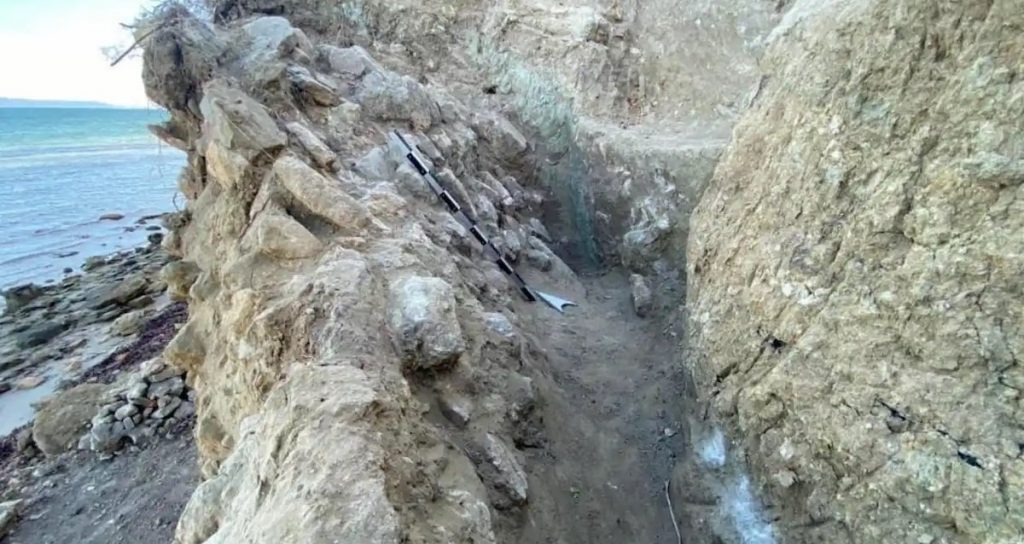
Researchers investigating Işıldaktepe Altı in western Turkey uncovered a seaside burial mound known as a tumulus that matches ancient accounts of Ajax’s burial.

F. Polat 2026Archaeologists believe they’ve found the burial site of the Homeric hero Ajax.
In Homer’s Iliad, which famously tells the story of the Trojan War, the Greek warrior Ajax the Great is said to have a colossal frame and bravery second only to Achilles. Now, researchers may have identified his tomb, right near the ruins of the ancient city of Troy in northwestern Turkey.
Upon its discovery along the Dardanelles coast, the site was initially believed to be a prehistoric settlement. But after excavations were conducted, researchers realized that the site was a tumulus, or intentional burial mound, built with materials taken from a nearby prehistoric site. And if this is in fact a tomb, its location strongly suggests that it could be the burial site of Ajax himself.
The Discovery Of The Turkish Tumulus That Could Be The Tomb Of Ajax
The site of the tumulus was named Işıldaktepe Altı, for the hill that sits above it. It was first discovered in 2011 by Rüstem Aslan, a professor at Çanakkale Onsekiz Mart University, and Fecri Polat, an archaeologist at the Troy Museum (Çanakkale).
Archaeologists had been doing a survey of the area to study how sea levels had affected early coastal settlements when they stumbled across the site at the foot of the hill.

F. Polat 2026The site sits along the Turkish coast of the Dardanelles just steps from the sea.
The researchers initially believed that the site held the remains of a Copper Age village, dating back at least 5,000 years that had been damaged by waves.
At the top of the hill, archaeologists found remains from a subsequent era, around 3000 B.C.E., which indicated that the settlement’s residents might have moved to higher ground as the sea levels rose over time.
Due to storms that presented a threat to the site, the Çanakkale Museum carried out rescue excavations in 2024.
It was during these investigations that archaeologists became convinced of a different possibility: the site was a tumulus, and its builders had carried soil from a nearby ancient settlement to form the burial mound. These findings were recently published in TRMuseum, the museum’s own journal.

F. Polat 2026Archaeologists believe that the tumulus was built with soil from a nearby ancient settlement.
First, excavators uncovered soil that had been dumped at the site during construction of a bunker during World War II, which likely caused some damage to the ancient structures below.
Then, the team was able to unearth rows of stones beneath the soil that had been joined together with clay. This mound was also covered by clay, about eight to 10 inches thick, which was perhaps used to keep the mound’s sides from slipping.
The soil used for the mound’s interior contained pottery from the Copper Age and Bronze Age, as well as spindle whorls, a bone awl, and a handle shaped like an animal. These finds, alongside several tuna vertebrae, indicate that the soil used to build the mound came from an ancient settlement.

F. Polat 2026The mound was created some time after the Late Bronze Age, but a precise date has not been determined.
This type of tumulus construction has been recorded elsewhere, like at the Beşik Sivritepe site, another ancient monument near Troy that’s associated with Achilles.
Researchers determined that the Işıldaktepe Altı mound was constructed sometime after the Late Bronze Age, but they do not yet have a specific date estimate.
Is This Really The Grave Of Ajax, Homeric Hero Of The Trojan War?
Işıldaktepe Altı sits close to the ancient greek city of Rhoiteion, which is identified by ancient authors as Ajax’s burial site.
Strabo, the ancient greek geographer, wrote that Ajax’s tomb was on a headland close to Rhoiteion.
Pausanias, another geographer who traversed Greece in the second century C.E., also recounted stories from locals about bones being exposed along the coast due to erosion from the waves.

Wikimedia CommonsA depiction of Ajax carrying a dead Achilles amidst the carnage of the Trojan War.
Said to have left behind bones that measured 16 feet long, Ajax was mythologized for his massive stature, and Pausanias wrote that locals had seen Ajax’s kneecaps, which they compared to “the discus of a boy competing in the pentathlon.”
Ajax’s tomb is not alone. Archaeologists C. Brian Rose and Reyhan Körpe wrote a 2016 paper arguing for a longstanding association between tumuli discovered northwest of Troy and the burial sites of Homeric heroes.
These tombs likely functioned as tourist sites for visitors, and were maintained regularly for such purposes.
Despite this evidence, the excavations did not fully confirm that Ajax was buried in this newly-found tumulus. More examinations of the mound’s structure must be performed in order to determine its precise age, and further excavations are needed to find what or who this burial mound was built for.
After reading about the possible discovery of the tomb of Ajax, dive into the Hittite Tablet and other physical evidence of the Trojan War. Then, learn about 12 Greek gods and goddesses from ancient mythology.
Story via the original publisher. Read the original article