
There is a growing tendency in European performing arts to dismantle the borders that once separated theater, concert and installation. Rather than asking whether a work belongs to one discipline or another, contemporary artists increasingly treat performance as a single space where sound, image and text negotiate equal rights. Greek production The Other Gaze, presented at the Tbilisi International Festival of Theater, belongs to this conversation. It is not a play accompanied by music, nor a concert supplemented with theatrical elements. It asks a different question altogether: what happens when music itself becomes dramaturgy?
Created by the Greek duo Seeds, brothers Mihalis and Christos Kalkanis, and directed by Amalia Bennett, the 70-minute work premiered last year at the Athens Epidaurus Festival before arriving in Tbilisi. Its point of departure is deceptively simple: two brothers returning to their roots and confronting the distance between urban life and the landscapes that shaped them. Yet biography is only the surface. What unfolds is an essay on memory: how it survives, how it transforms, and how sound often preserves what language can no longer articulate.
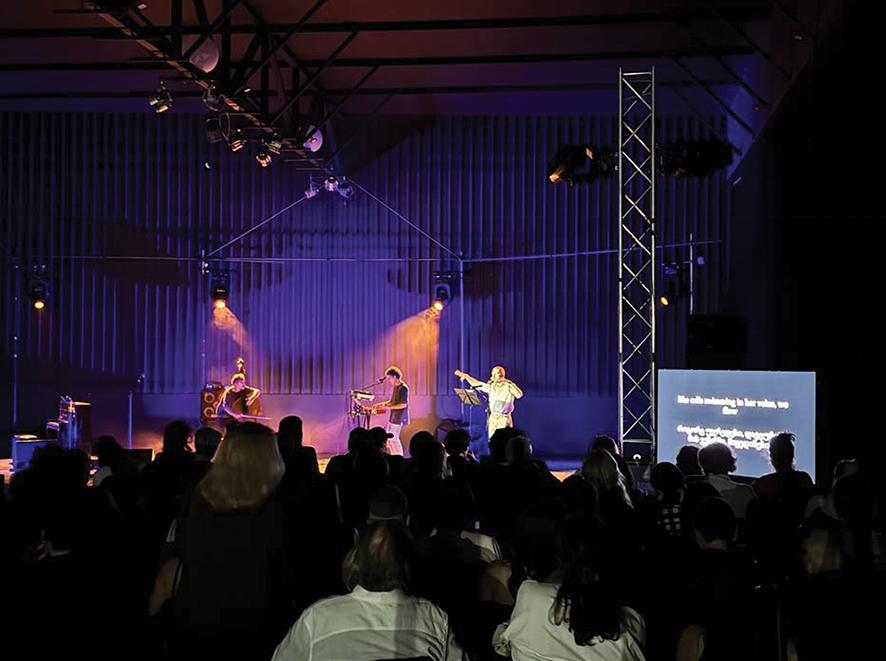
The performance resists narrative urgency. Nothing is explained too quickly, and nothing is resolved. Instead, meaning accumulates through repetition, rhythm and silence. Clarinet, double bass, piano, electronics and voice do not accompany the action; they generate it. Musical phrases return like fragments of recollection rather than thematic motifs, allowing the audience to navigate the work emotionally before they understand it intellectually.
This inversion of theatrical priorities is perhaps the production’s strongest quality. Contemporary theater often places increasing pressure on visual invention, but The Other Gaze proceeds in the opposite direction. It trusts listening. Images remain restrained, almost deliberately secondary, while the sonic landscape assumes responsibility for movement, tension and release. The spectator is invited not so much to follow events as to inhabit an acoustic environment.
Traditional Greek song appears throughout the performance, but never as folklore presented for its own sake. Detached from ethnographic framing, these melodies enter into dialog with electronics and contemporary composition, becoming part of a living musical language rather than historical quotation. The result avoids both nostalgia and exoticism: an achievement that is rarer than it should be.
There is also something quietly political in this choice. At a time when cultural identities are frequently reduced to recognizable symbols, The Other Gaze suggests that tradition survives less through preservation than through transformation. Heritage becomes meaningful only when it remains capable of producing new artistic forms.
The performers embody this principle with remarkable precision. The musicians never perform for the audience; they perform within the dramatic structure. The narrator’s voice is treated as another instrument, while the vocal lines move naturally between speech and song without insisting on either category. These transitions feel organic rather than demonstrative, making the boundaries between concert and theatre increasingly irrelevant as the evening unfolds.
What ultimately lingers is not the story itself, but its atmosphere. The performance leaves behind a sense of having traveled through someone else’s memories without ever claiming to possess them. It is an unusually generous piece of theater, allowing spectators to complete its meanings from within their own experiences rather than directing every emotional response.
For the Tbilisi International Festival of Theater, which has increasingly embraced interdisciplinary work over the past decade, The Other Gaze feels like a natural addition rather than an exception. It reflects a broader shift in contemporary performance away from literary theater and toward forms where composition, sound and spatial perception carry as much expressive weight as text.
In the end, The Other Gaze is less interested in telling a story than in changing the way we attend to one. It reminds us that theater does not begin with dialog, or even with action. Sometimes it begins with the act of listening.
By Ivan Nechaev