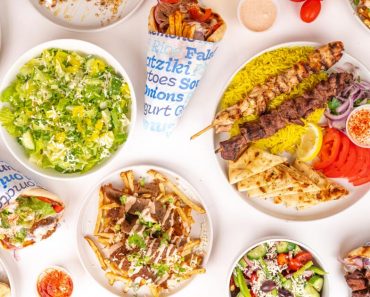


The Chicken Joojeh kabob platter is the best seller. | Photos courtesy of Rice Mediterranean Kitchen

The Mediterranean region covers a vast area, with countries as diverse as Greece, Lebanon, Israel, Turkey, Italy, and Tunisia contributing to the cuisine. And with over 470 locations across the U.S., fast-casual Cava has completely familiarized Americans with staples like hummus, feta, and tzatziki.
But Jafar Shabani, founder and CEO of the much tinier Rice Mediterranean Kitchen, wants diners to dig deeper into the foods he grew up with as an Iranian-American. Although his 10-unit Miami-based fast casual has the word “Mediterranean” in its name, the menu is rooted in Persian flavors and dishes.
“While we offer build-your-own bowls, like Cava or Naya, our signature is traditional Persian kabobs [the Persian spelling]. These make up half our menu,” said Shabani. And the menu lists them with their authentic names: Chicken Joojeh, Tenderloin Chenjeh, and Ground Sirloin Kubideh. They are prepared with marinades that include house-made yogurt, saffron, sumac, and fresh herbs, and everything is made to order.
Scaling the recipes
The recipes are time-consuming, said Shabani, but since all 10 restaurants are in close proximity in South Florida, a central commissary takes care of the advance prep. “Basically, all the sauces and marinades are made in the commissary and distributed by refrigerated truck every morning to all our locations,” he said. “There is a commissary director who manages all the marinations, sauces, dressings, and spices, and the making of the yogurt, so they are consistent at all locations. At other Mediterranean concepts, you sometimes can taste the difference from one location to another.”
The meats are marinated at the commissary for many hours before they are distributed, easing execution at the restaurants and facilitating the fast-casual model.
The most popular menu item since day one is Chicken Joojeh — a chicken kabob platter with saffron basmati rice and Greek salad. Customers can order the same platter with beef tenderloin, ground sirloin, or falafel kabob; prices range from $17 to $22.

The Persian kabobs, rice, and salads adapt well to catering.
One of the signature house-made sauces long offered at the restaurants is a creamy sumac dressing based on the restaurant’s homemade yogurt — not a completely traditional Persian dressing, said Shabani. “Customers started putting it on the kabob and rice and it became very popular. I never ate it that way growing up, but now I put sumac dressing on everything,” he said. “It’s really tasty and actually surprised us, so we made that change and now serve the platters with sumac sauce.”
The sumac dressing/sauce drew such a large following that Shabani began bottling it to sell in the restaurants. Fans as far away as New York and California have bottles shipped to their homes.
He tried introducing a couple of classic Persian stews to the menu, sampling them with existing customers in some of the locations. The recipes were based on Persian-spiced split peas, and there was one vegetarian version and one made with beef. “They didn’t go over very well, so they never launched on the menu,” he said. “A new item has to earn a nine out of 10.”
When Shabani opened the first Rice Kitchen, as he calls it, he offered only the traditional Persian kabobs. And while he really wants to turn on Americans to Persian cuisine, he has since added broader Mediterranean items and a few other proteins, like braised lamb and brisket. He also developed turmeric turkey as a limited-time choice around Thanksgiving a couple of years back, and the demand was high enough to add it to the permanent menu.
Catering is expanding, and the fast casual’s food travels well. Although protein is experiencing strong demand right now, Rice Mediterranean Kitchen has always offered generous portions of chicken and other meat in its bowls and platters. “We haven’t changed our menu based on today’s protein demand,” said Shabani. “We even see our customers taking home some of their order.”
Customers like the flexibility of the catering setup.
“We can do traditional kabob catering, where we send all the kabobs separately from the basmati rice and Greek salad, and everyone helps themselves, building their own platters or bowls,” said Shabani. But there’s also demand for individually packaged meals, especially among hospital and office workers, so curated single meals are available, too.
A separate catering team takes care of that part of the business.
What’s next
In Rice Mediterranean Kitchen’s newest location in Coconut Grove, Florida, Shabani is experimenting with coffee, tea, and pastries in addition to the regular menu. The barista-led coffee program features Counter Culture coffee beans, a specialty roaster based in North Carolina. The Persian-style teas are flavored with cardamom and rose water, and the pastries include baklava made by a local bakery. Also on offer are drinks with pomegranate and cherry syrups.

The newest location has a coffee, tea, and bakery program that invites guests to linger.
“We’re testing it out in one of the locations, and hopefully we will launch that to other locations,” said Shabani. “We’re also exercising the option of doing some breakfast items.”
In Iran, breakfast usually includes a bread, like lavash, with feta cheese, honey, or fig jam, said Shabani, but what will actually be on Rice Kitchen’s menu is, for now, “a surprise.”
“We definitely are not going to offer a typical American breakfast like pancakes and waffles. We want to come up with something very unique,” Shabani said.