
The distinction made in these passages between “lovers” (erastai or agapontes) and “beloved” (eromenoi or paidika) reflects the fact that in ancient Greece sexual relationships were rarely between people of the same age.
In Athens, first marriages were usually between a man in his late 20s and a girl of about 14.
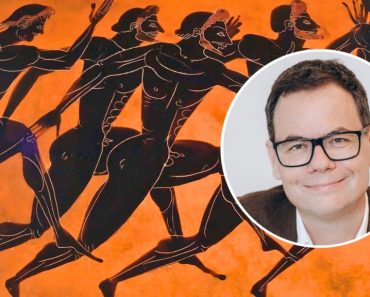
Similarly, homoerotic relationships, which were very common, were typically between an older man and an adolescent youth, anywhere from maybe around 12 (based on vase paintings) to whenever the adolescent started to grow a beard.
Erastai (lovers) were not exclusively homosexual: they would normally also marry and have children (as, one day, would their eromenoi, or beloved).
These were sexual relationships but this hasn’t always been openly acknowledged by historians. 19th-century Classicists mostly sought to shield the Greeks from the imputation that they had engaged in gay sex. Today, the worry is more about under-age sex.
The erastes–eromenos relationship had an aspect of mentoring but, within social demands of the time for a certain modesty, it was also clearly sexual.
Fighting together, sleeping together
The problem with the Theban Sacred Band is that the eromenoi would need to be old enough to face the enormous physical challenges of battle, normally reserved for men over about 20. That implies different social mores in Thebes from those at Athens.
See Also: How a Swedish King Went on Strike in 1768
In Athens, there were lifelong gay couples, including two of the characters in Plato’s Symposium, but they could often be the target of mockery. Athenians especially thought there was something shameful in an adult man being the “passive partner” in gay sex.
But possibly attitudes were different at Thebes, where gay couples seem to have pledged their love to each other at the tomb of Iolaos, the eromenos, or beloved, of Herakles (sometimes known by his Roman name Hercules).
The couples who made up the Sacred Band may have come together when the younger one was an adolescent and simply continued into adulthood. Were they still sexual partners?
Well, a passage in Greek writer Xenophon’s own text (also called Symposium, possibly written in answer to Plato’s work of the same name) explicitly and critically refers to soldiers who fought together and were also sleeping with each other.
So, probably yes.
Lovers who died together
Although some ancient historians remain sceptical, since the 19th century the story itself – whether true or not – has been inspirational to many.
The Theban Sacred Band came to be known for their strength, discipline, and ferocity.
Among their most famous successes was the important role they played in defeating the once powerful Spartans at the Battle of Leuctra in 371 BCE, which ended Spartan supremacy.
The men of the Sacred Band of Thebes died in the Battle of Chaironeia in 338 BCE, when Philip of Macedon and his son Alexander (later known to the world as Alexander the Great) defeated Greek forces led by the cities of Thebes and Athens.
Maybe these soldiers, discovered arm in arm in a mass grave in central Greece more than 2,000 years later, really were lovers who died together in the Band’s final defeat.
Today, the site is marked with a statue of a lion – symbolic of this elite fighting unit’s pride and strength.
[VS]
Suggested Reading: