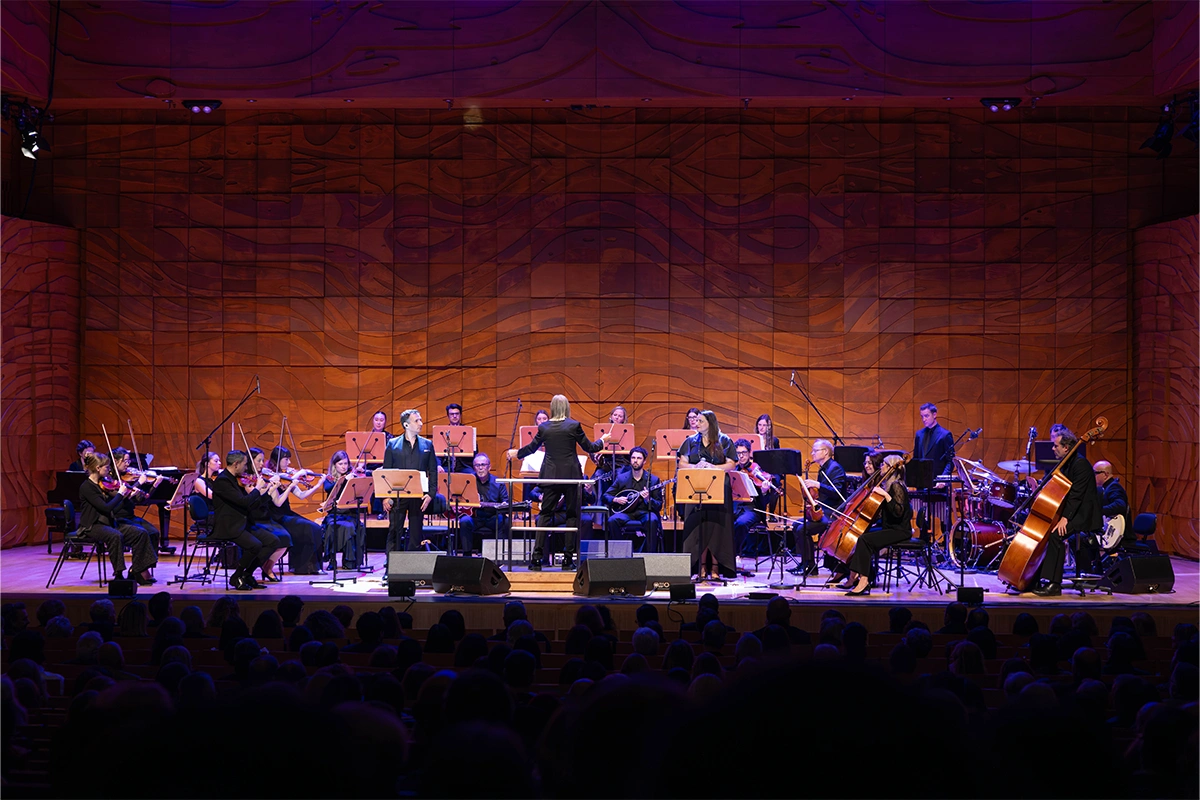


George Petrou conducting the oratorio ‘Messiah,’ composed by George Frideric Handel in 1741. The Greek conductor has completed five years as artistic director in Goettingen, Germany, and his tenure was renewed for another five years. [Alciro Theodoro da Silva]
“Come to the rehearsal tomorrow,” conductor George Petrou said, as we shared a meal at the Szultenburger, a traditional German tavern (which is actually run by a Greek) in Goettingen, a university town in Lower Saxony. We were joined at the table by the musicians of the city’s annual International Handel Festival, which took place in May, and where Petrou is artistic director, a post previously held by the likes of Sir Eliot Gardiner and Nicholas McGegan, among others. Taking up the invitation, I attended the rehearsal of “Messiah” the following day at the Junges Theater. Petrou would interrupt the musicians every so often to give them instructions in English and after soprano Ana Maria Labin sang the aria “I Know that my Redeemer Liveth,” the musicians expressed their admiration with a bow tap.
Afterward, Petrou drove me to a Vietnamese restaurant in the heart of Goettingen, whose famed university was attended by – among other luminaries – Greek poet and short-story writer Georgios Vizyinos in 1875.
One luminary who never visited Goettingen was George Frideric Handel. He was born in Halle in 1685 and moved to London in 1710, where he died in 1759. During that time in the British capital, the German composer wrote the world-renowned “Hallelujah” chorus from “Messiah” and the anthem “Zadok the Priest,” which is played at the coronations of English kings and queens (as well as at Champions League matches, albeit in altered form). Handel is immortal, however, thanks mainly to his operas.
And this is where Goettingen comes in. It is 1919 and German art and music historian Oskar Hagen is recovering from what could easily have been a deadly case of influenza. He spent part of his recovery in the university library, digging up old Handel opera scores that had earned him incredible popularity in his day, but had been completely forgotten by 1919. That was about to change thanks to Hagen’s persistence.
The festival dedicated to Handel was launched in 1920 with a few private performances, but it was so successful that Hagen decided to book the city’s municipal theater later that same year for a production of “Rodelinda.” And that is what eventually led to the Handel opera revival.
“I’ll be closing this year’s festival with an oratorio and an opera – ‘Messiah’ and ‘Deidamia,’” Petrou explained. “Both were written in 1741 and share a direct connection, having been composed in close succession: ‘Deidamia’ marked the end of Handel’s career as an opera composer in England, while ‘Messiah’ heralded the era of his great oratorios.”

The approach
The Greek conductor is renowned – and has been richly awarded – for his “historically informed performances” of Baroque works, both in front of a live audience and in the studio (labels include Deutsche Grammophon, Decca, MDG). His approach seeks to capture the sound and style of a composition as it would have been heard in the composer’s own time.
He also makes a point of using period instruments, as all musical instruments have undergone numerous modifications over the centuries. Of course, Petrou has also conducted bel canto operas – including at the major Rossini Opera Festival in Pesaro – as well as Classical and Romantic works, Greek operettas, and American musicals.
I recall him in 2012 at the Onassis Stegi, conducting the Camerata Orchestra in Beethoven’s Seventh Symphony and the ballet “The Creatures of Prometheus,” in collaboration with the Griffon dance company (Ioanna Portolou was the choreographer) seamlessly blending a historically informed interpretation of a Classical work with contemporary dance.
“It took years before people were convinced that this approach also had musical, rather than just historical, value,” he explained. “I am talking about an approach: No matter how hard we try, we will never fully understand how these works were heard in the times of Bach and Handel. Another thing you learn through this approach is the evolution through the 18th and 19th centuries, why Mozart and Beethoven composed something this way instead of that.”
Petrou has completed his five-year term as artistic director of the Goettingen International Handel Festival and has been invited to stay on. “It’s gone well. Everyone here is pleased, and I get to do the things I want to do. Financially it’s a struggle – but what isn’t? Mainly, though, the caliber of the musicians is very high. We have this fantastic orchestra that brings together top musicians from all over the world. I really enjoy working at this festival because there is nothing greater than the opportunity to do this music at this level.”
This year’s festival opened with “Deidamia” and closed with it, too, in a grand finale at the city’s historical Deutsches Theater. Petrou not only conducted, he also directed. Why did he choose this piece?
“Because it is special – and distinctly Greek in character: Achilles is hiding on Skyros, disguised as a woman, when Odysseus passes through on his way to the Trojan War, intent on persuading him to join the campaign. But first he must recognize him, and here lies a comic element. At the same time, Achilles has fallen in love with Deidamia; they marry at the end, but on the condition that he leave for war immediately after the wedding. So I’m not sure how much of a comedy it really is. The work grapples with that eternal inner conflict – that torments us all, in one way or another – between desire and duty,” he explained.
Petrou’s staging was fascinating and earned rave reviews: He set the opera’s action alongside choreographed movements of contemporary tourists on Skyros. Beyond the implicit ironic commentary on the relationship between ancient glory and modern tourism, the way time folds in on itself here suggests the timelessness of human struggles and desires: At their core, they remain unchanged.
As I got on the train back to Frankfurt, I thought of the warm applause Petrou received from what is undoubtedly a very discerning audience, not just at the opera’s finale, but also when he stepped up to the podium to conduct after the intermission.
Here in Greece, music aficionados will have the opportunity to see the conductor up close on Saturday, July 11, as he leads the Camerata Orchestra in Hector Berlioz’s 1859 adaptation of Christoph Willibald Gluck’s “Orfeo ed Euridice,” in concert form, at the theater of Ancient Messene in the southwestern Peloponnese.
The production is by the Athens Concert Hall and tickets are available on its website at megaron.gr.