
 Photo Credit: Boop
Greek island hopping has long been associated with spontaneity — travelers moving freely between islands and making decisions as they go. But in practice, that version of travel is quietly shifting.
A growing number of travelers are no longer building itineraries from scratch. Instead, they are following fully structured journeys that already exist — real trips created by other travelers and reused as complete, end-to-end itineraries.
These are not traditional travel guides. They are lived itineraries: day-by-day journeys that reflect how people actually experience places like Serifos and Sifnos in the Cyclades.
One example is a 13-day Greek island hopping route through Serifos and Sifnos that has been shared as a complete trip, not a list of recommendations or fragmented suggestions.
Rather than searching for individual recommendations for each destination, travelers are increasingly starting with cohesive itineraries that already map out a full experience. Inspiration may still begin on social platforms, but execution is shifting toward ready-made journeys instead of scattered posts, saved content, and disconnected planning tools.
This reflects a broader change in how travel is being structured. Planning is becoming less about assembling individual stops and more about adopting an entire journey that already exists in a usable form. The appeal is not just efficiency, but clarity — the ability to step into a trip without having to design it piece by piece.
In this model, the itinerary itself becomes the unit of travel.
Platforms like Boop are emerging directly from this shift.
Boop is a social travel platform built around a simple idea: most of the best trips already exist — they just aren’t structured in a way others can easily use. The app turns real travel experiences into complete, bookable itineraries that others can copy, remix, and follow.
 Photo Credit: Boop
Instead of starting from an empty map, users browse itineraries built from real trips shared on Boop, including a 13-day itinerary published by Find Us Lost. These itineraries can then be adapted with AI — adjusting pacing, style, or budget — and transformed into something personal without requiring users to build everything from scratch.
“Travel today is broken across inspiration, planning, and booking,” said Nancy Li Smith, founder of Boop. “People discover trips on social media, plan across scattered tabs, and book in isolation. Meanwhile, millions of real, high-quality itineraries sit unused in people’s camera rolls. Boop brings those together and turns them into something others can actually use.”
The product is also designed around a behavioral shift: travel is no longer just about inspiration or discovery, but about reuse. A trip is treated less like a one-time plan and more like a template — something that can be copied, adjusted, and re-experienced by others.
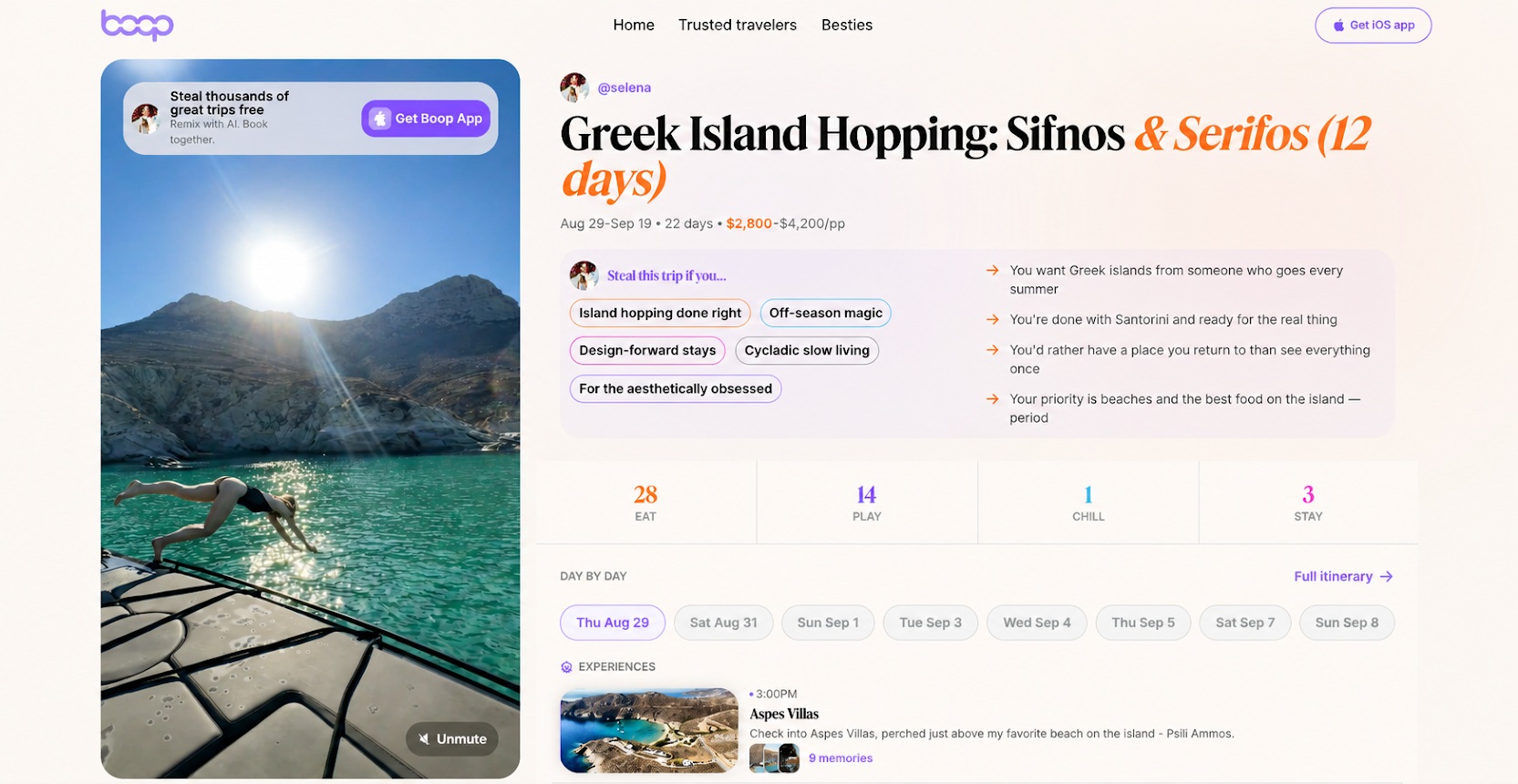 Photo Credit: Boop
That shift reframes what an itinerary actually is. It is no longer just a planning tool, but a reusable structure for travel itself.
In the case of island hopping in Greece, this becomes especially visible. Instead of approaching Serifos and Sifnos as separate research exercises, travelers engage with them as part of a pre-shaped experience that already accounts for pacing, movement, and flow.
What emerges is not just a new category of travel content, but a new behavior: following complete journeys created by others, rather than building them from scratch.
In this model, the itinerary is no longer just a planning aid.
It is the product.
And Greek island hopping — once defined by improvisation — is becoming one of the clearest examples of this shift toward structured, repeatable travel experiences.
Disclaimer: Written in partnership with APG.