
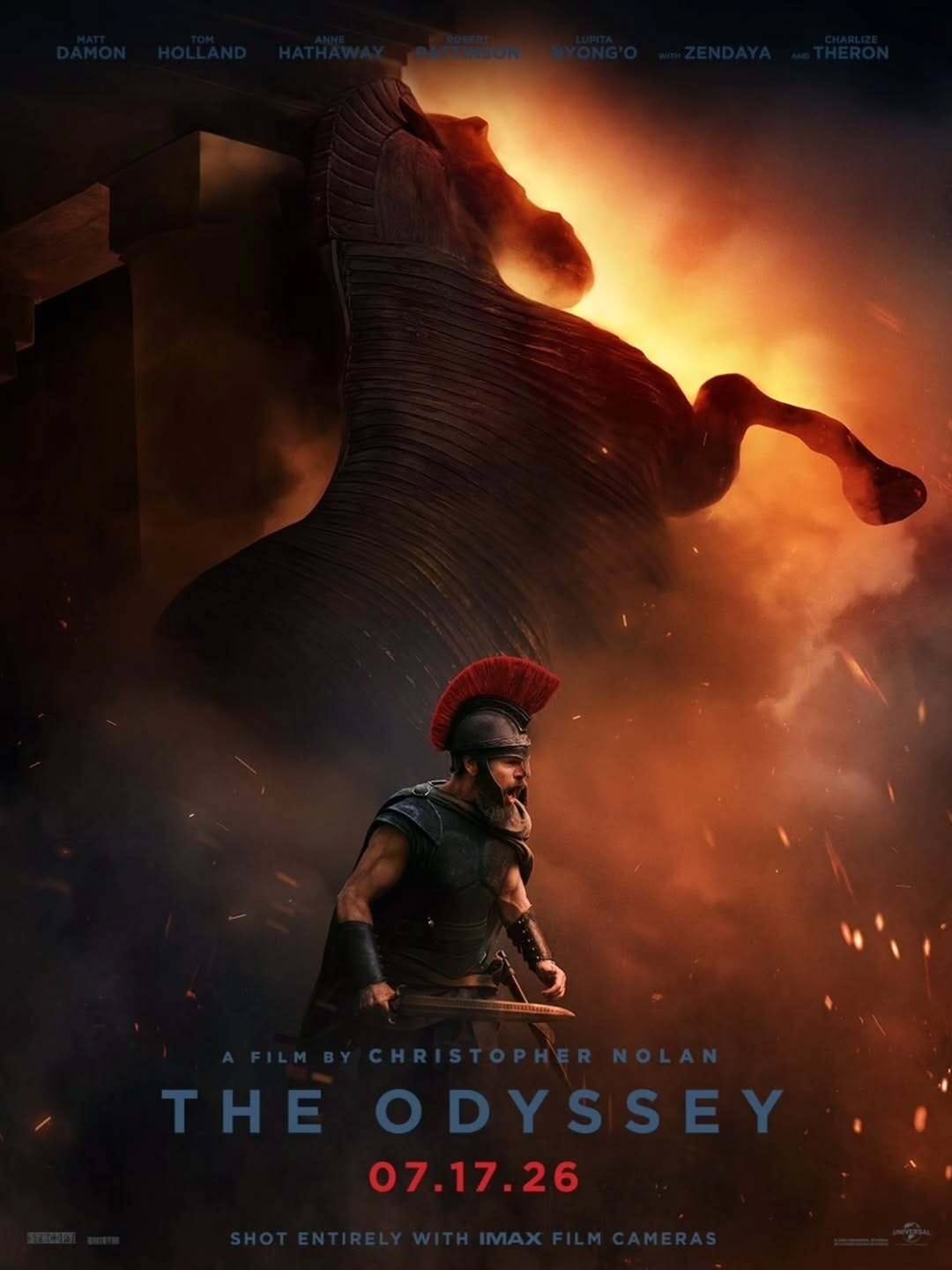
Everyone—including me—is talking about Christopher Nolan’s adaptation/reimaging of The Odyssey, which is coming out next month in cinemas and has been literally filmed for IMAX.
So as I have a literal Master’s degree in Classics, and have read more than my fair share of Homer’s works, along with Vergil’s Aeneid (the fan fic/creaton myth for Romans…), I figured I should write something as Classics is not something I talk about a lot, mainly because I don’t regard myself as an active classicist unless we’re talking about religion or mythology, especially things like Ptolemaic Egypt, the Mysteries of Eleusis and the Graeco-Roman Cult of Isis. Or games that have mythology as their backbone like God of War.
I first started studying Classics, well Classical Civilisations as it was then, at A Level. One of my tutors knew I was a mythology nerd and widely-read and mentioned it as an option (I also did Religious Studies, and English language, which I hated…) when I went up to our local Sixth Form in a nearby town.
I loved it, two years of history, mythology, art and literature. I tried Latin and confirmed languages are not my forte (and yet I still had to do two semesters of Biblical Hebrew at uni…) and I learned a little Greek. However, as this was in the late nineties, it was really hard to consume content in its original language because the internet didn’t exist yet. So I read widely in translationl I read poetry and hymns, plays and myths, tragedy and comedies…
The Bacchae remains my favourite, even years later…
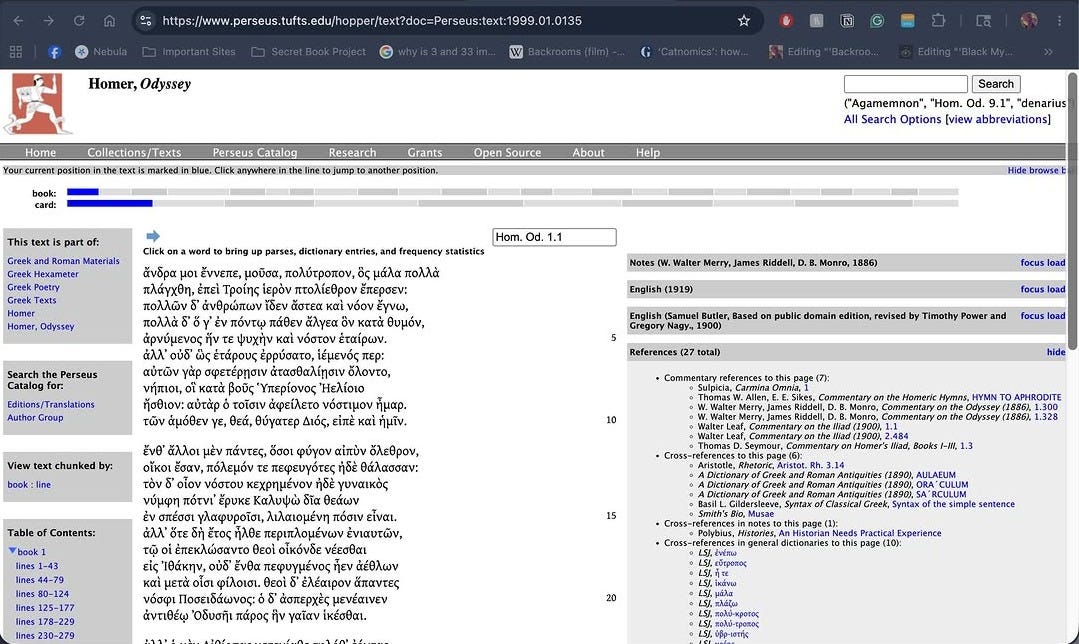
The major thing was that I lived and breathed Perseus, which went online just as I started my A Levels but the internet wasn’t common yet and so I didn’t really get to use it until I started at St. Mary’s (which not only had a massive library, but like fifty PCs with internet access… dial-up internet…). It quickly became one of my most visited sites. This was where you’d go to read, both in the original Greek and Latin, but also with translation options. It’s still my go-to nearly three decades later.
(I was still looked down upon as ‘not a proper Classicist’ during my Master’s because I couldn’t speak Latin and Greek. Also cause I wrote my dissertation on Sailor Moon and Greek myth… I can read a little, I know the alphabets and maybe a few hundred words and the grammatical basics. I can basically read The Odyssey in Greek, with some translation. Frankly, my liturgical Latin is better and that’s mainly cause I went to a Catholic uni, despite not being Catholic or even Christian…)
I love how so many people on social media are expousing their love of Classics. On YouTube, we have Raffaello Urbani (aka Metatron) and Cinzia duBois, the Lady of the Library, along with short-form creators like @patmandziy6725. My other recent favour, oddly, is an AI content channel called EchoNomad, who has been recreating The Odyssey in the original Greek, and I finally understood why Odysseus calls himself Nobody…
Short version: ‘Odysseus’ is Ὀδυσσεύς in Greek, ‘nobody’ is Οὖτις, they sound very similar. See below:
(Yes, it’s AI… Can we just agree that once in a while it’s possible for AI to be useful, even beautiful… I like it and I’m going to keep listening. Again, remember, when I first read The Odyssey, it was almost impossible to listen to it in ancient Greek, and the internet did not exist as it does today…)
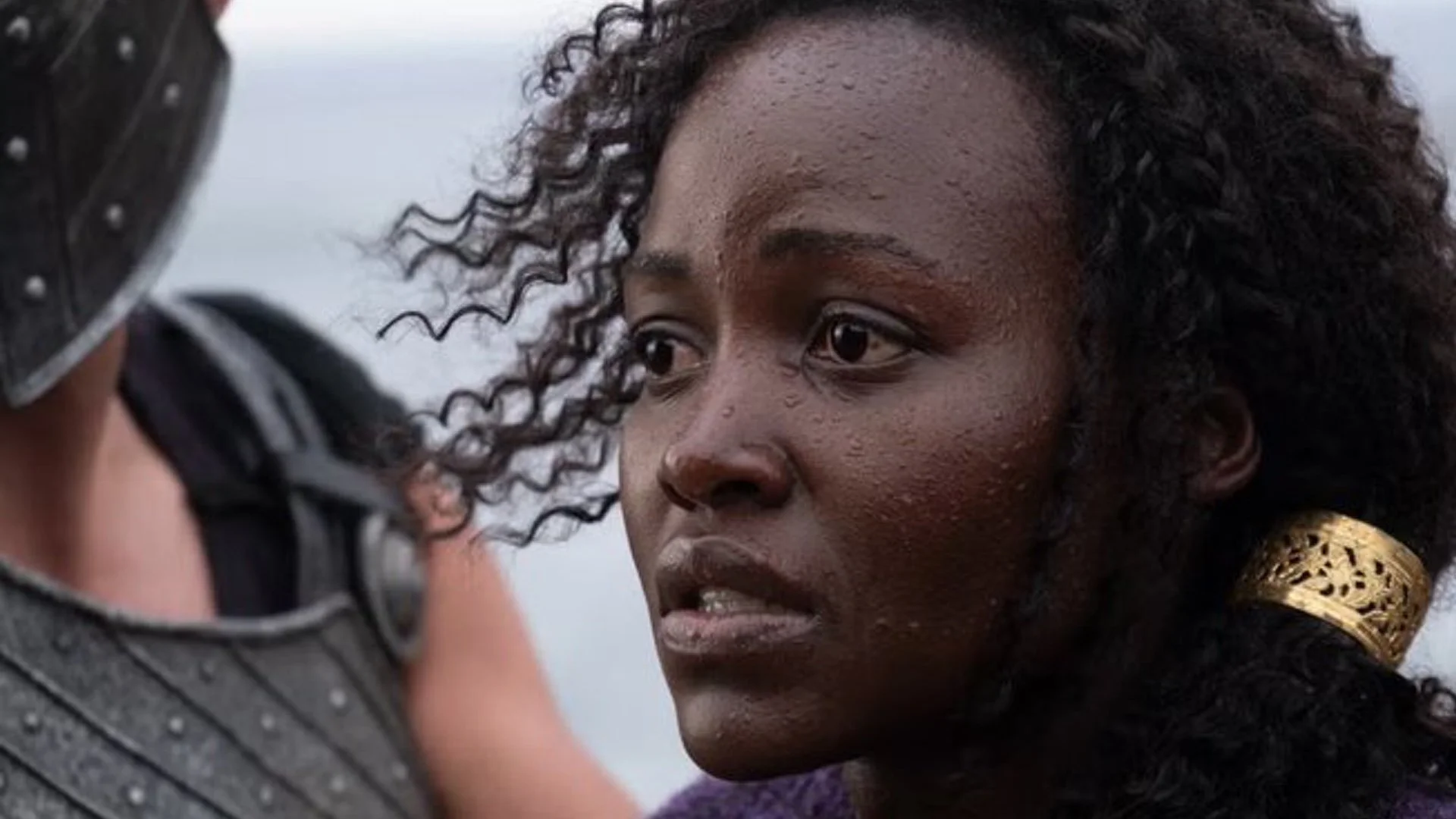
So, in the run-up to Nolan’s adaptation, there’s been some… discourse around the film, including a healthy ‘discussion’ between Metatron and Cinzia mainly surrounding Dr. Emily Wilson’s 2017 translation of The Odyssey which Nolan admits using for his adaptation. Yes, it is an adaptation and it looks like it’s more about the action than it is faithfully recreating the epic (which is fine, I love Epic! The Musical, for this same reason…) although that does look like a Norse ship, rather than a Greek one, and the armour is definitely nowhere near accurate.
I do like the Wilson translation (she also did The Iliad, in 2023…), as it reads well and I consumed it for enjoyment, rather than with an eye for accuracy. It’s good, but the discussion around the translation has gotten quite heated. I’m also not an expert when it comes to Greek translation, or metre in ancient poetry…
I do agree with Cinzia that translators always have their own agendas and unconscious biases. That’s just how translation works and given the number of men who have translated The Odyssey, it is refreshing to have a female perspective.
I am glad that this discourse is making people more aware of the classics, of the stories, and in making the texts more accessible (I, for example, have Wilson’s translation in both e-book and audiobook, which is so accessible it makes me happy…) The translation also has a load of front and back matter, from maps to essays which really helps give more context to the world and to making readers truly comprehend Odysseus’ trials and his journey home.
But I am also looking forward to the film because Nolan is directing. I’m not going to be pulling apart every casting choice (though the choice for Helen is … interesting…) or the authenticity of the ships and armour, beyond my previous note anyway. I’m genuinely excited to see the film and am sure it’s going to be a visual feast, even if it might not be what I think of when someone mentions Homer…
I do plan on seeing it in IMAX (UK tickets go on sale on 15th June) and I will be reviewing the film once I’ve seen it, so do please check back in July if you want to know my thoughts.
The Odyssey (R in the US, probably 15 in the UK but we’re waiting on the BBFC classification) is out in cinemas, and filmed for IMAX, on 17th July 2026.