
Dimitris Basis says that when he sings, he tends to look at people’s faces. To notice them from the very first moments of a concert, to read the emotion in their eyes, to sense when a song is not merely being heard, but returning within people as memory. Perhaps that is why his relationship with the Greek diaspora in Australia does not feel merely formal. Because behind the successful concerts, the repeated visits, and the grand musical evenings, there is something deeper: a shared language of nostalgia.
Born in Stuttgart to Greek migrant parents and later raised in Cherso Kilkis, the beloved performer says he personally “knows what it means to live far from home.” Speaking to Neos Kosmos shortly before his appearance at the Melbourne Recital Centre for the tribute marking 100 years since the birth of Mimis Plessas, he reflects on the songs that made his parents cry, Byzantine music, the land that kept him grounded, Psithyroi Kardias (“Whispers of the Heart”), and the great mentors who helped shape his path.
AUSTRALIA AND THE LOVE OF THE PEOPLE
You visit Australia often. What keeps bringing you back to the Greek diaspora here?
“First of all, thank you for welcoming me here to the offices of Neos Kosmos, a historic newspaper, from what I know.
I believe I’ve come to Australia eleven times since 1999, when I first visited. What keeps bringing me back is the love of the people. Over all these years, I’ve performed in countless concerts, with different projects, with large orchestras, with my own orchestra, with my own repertoire, across many cities.
Every time a tour ends and I leave, I say goodbye to the people without knowing when we will meet again, because Australia is such a distant country. And yet, almost like magic, it is the love of the people that keeps bringing me back.”
For him, Australian audiences are emotional, demanding, and “cultured.”
“The Greek diaspora, the communities, the parishes, the associations have done such incredible work that, truly, the heart of Greece beats strongly in this part of the planet,” he says. “Here, you have to come and give 100 per cent of yourself.”

SONGS OF MIGRATION
When you sing songs about migration and life abroad in Australia or within the diaspora more broadly, do you feel audiences hear them differently?
“Of course. I focus on faces beneath the stage. It’s something I do at every live performance. I feel the need to take something from certain faces. I notice them from the first moments of a concert. Many times, I see emotion in their eyes.
There are moments I will never forget. I remember in New Zealand, when I was ending the concert with Mi Mou Thymoneis Matia Mou (‘Don’t Be Angry With Me, My Love’), a song about meeting again. I could see tearful faces in the crowd. In that moment, I had to hold myself together too, just to finish the song and the performance.”
For him, migration is not an abstract idea. It is a childhood memory. Born in Stuttgart to Greek migrant parents, he returned to Greece at the age of eight. Yet the memories of Greek migrant homes in Germany, the weekend gatherings, and the songs of Stelios Kazantzidis remained deeply embedded within him.
“I know what it means to live far from home,” he says. “I’ve seen my parents cry when listening to songs about migration, because through those songs they would mentally travel back to their homeland.”
Is there a particular song that immediately brings you back to your parents?
“I remember the songs of Kazantzidis. On weekends, groups of Greeks relatives and friends would gather in people’s homes, and whenever those songs were played, I remember seeing tearful faces.
Psomi tis Xenitias (‘The Bread of Exile’) is a Kazantzidis song that always reminds me of my parents. I remember them wiping tears from their eyes whenever they listened to it.”

FROM STUTTGART TO CHERSO, KILKIS
From Germany, the family returned to Cherso Kilkis. There, as he says himself, “is my homeland.” The transition from an apartment in Stuttgart to the freedom of village life became life-changing. From Stuttgart to Cherso, Kilkis, how did that transition shape you?
“It influenced me and shaped me for the better. In Germany, until the age of eight, I grew up quite restricted, in an apartment, because my parents worked all the time. I didn’t really have close friendships. There was a lot of caution, anxiety and fear from my parents.
For me, life changed when I came to the village. I made friends very quickly, started Greek school in Cherso, and began experiencing carefree living, security, and my parents becoming more relaxed.
From the very first moment I went there, I felt that I belonged there. Even though I was born in Germany, even though my first language was German, when I arrived in the village, I felt that was my place. That transition happened easily, consciously, and with a sense of relief.”
BYZANTINE MUSIC AND THE VILLAGE CHURCH CHANTER
It was in Cherso that Dimitris Basis first developed a deep connection with music. His grandmother would send him to church. The village chanter recognised his talent and invited him to stand beside him at the chanting stand. That was how Byzantine music first began to captivate him.
How did music enter your life?
“I believe there is also something hereditary in it, because my grandfather was a musician. Our roots are from Constantinople, and my grandparents came to Kilkis during the population exchange, as refugees. My grandfather played the gaida [traditional bagpipe].
When I came to Greece, I used to go to church. I loved dressing as an altar boy and carrying the church banners. That’s where I discovered the magic of Byzantine music, ecclesiastical music, and chant.
At one point, after the church service ended, the village chanter said to me: ‘Instead of carrying banners, would you like to come stand with me?’ I said, ‘I would.’
That man, Theodoros Mavrozidis — may he be well — saw that I had talent and began teaching me music.
I studied Byzantine music. Then, around the age of 15, I began discovering the singers of that era. I listened a lot to George Dalaras, Haris Alexiou, Eleni Vitali, and Glykeria. And I started to realise that perhaps what I truly wanted was to become a singer myself. That is how the transition from Byzantine music to singing happened. Laïko songs carry pathways and influences from Byzantine music.”
Through music and his early experiences in the village, Dimitris Basis discovered something else that would stay with him throughout his life: the land itself. Before the major concert stages, there was the daily reality of life on the tractor, the agricultural family, the anxiety over the weather, the harvest, and whether the year would be a good one.

THE LAND AS A LIFE LESSON
You have described yourself singing and chanting while riding on a tractor as a young boy. How much did your connection to the land help keep you grounded?
“It has a lot to do with it. Everything begins at home. A person’s character is shaped by their family environment and by what their parents give them.
I came from a farming family. When my parents returned to Greece and settled permanently, they worked in agriculture. From a young age, I had to help them and go with them to the fields. I grew to love the land because it was what sustained us. My father taught me to worry about the weather, about whether the year would go well, because our family’s future depended on it. When success came in music, that helped keep me grounded because I had seen the other side of life. We were a poor family. My parents left for Germany with almost nothing and returned a little better off. That kept me grounded when success arrived, because our industry is very glamorous and it doesn’t take much to lose yourself in it.”
PSITHYROI KARDIAS AND THE WEIGHT OF SUCCESS
Success came early. At just 25 years old, Psithyroi Kardias (“Whispers of the Heart”) introduced him to the wider public and connected him to a song that has followed him for nearly three decades.
Psithyroi Kardias became an enormous success. For you, was it a blessing, a burden, or both?
“Success came at a very young age, when I was 25. It was all of those things at once. It was a blessing, but it was also a burden and a source of anxiety. The pressure of making what I was experiencing last. Fortunately, I had very good people beside me, such as Christos Nikolopoulos, who wrote the songs for Psithyroi Kardias. Nikolopoulos kept me grounded. He used to tell me: ‘Now the difficult part begins, because we have to prove that you are not a singer of just one song.’ I realised that if what I was living was not going to become a ‘bubble,’ it would require a great deal of hard work. This industry is so glamorous, and your life changes so dramatically overnight, that if you don’t have character or people around you to explain that what you’re experiencing now may not exist in six months, you won’t understand it.”

THE GREAT MENTORS
Throughout your journey, you worked alongside great composers and performers. What did you take from them?
“I took something from all of them. George Dalaras, when I was 16 and studying his work, was my teacher. Whenever I call him that, he says to me: ‘Stop calling me your teacher.’ And I reply: ‘You are my teacher, because you are the one who inspired me, who made me dream and say that I want to become a singer.’
Christos Nikolopoulos was the man who signed off on my first major successes and stood by me to help me manage them. Because success requires the same kind of management as failure. In failure, you have to rise again, but in success, you also need balance.
Mikis Theodorakis is a hugely important chapter in my career. I recorded two albums with him and had the privilege of spending a lot of time with him, visiting his home and speaking with him.”
What was Mikis Theodorakis like in person, beyond the myth?
“Anyone who met him was overwhelmed. It felt as though you had the Acropolis standing before you. Yet he was such a simple human being that he made you let go of that awe. He was very friendly and had a great sense of humour.
Even in the studio, he helped free me from the anxiety of comparison. I was singing works first performed by enormous singers such as Grigoris Bithikotsis. Mikis would tell me: ‘Don’t think right now about who has sung these songs before. Just sing. I know what I will get from you.’ He was someone who brought the very best out of you.”
From Dimitris Mitropanos, he says he learned generosity. From Lina Nikolakopoulou, he carried with him a phrase whose deeper meaning he only understood later: “Great careers are built when you have the strength to say no.”

GREEK MUSIC TODAY
Where do you believe Greek laïko music stands today?
“Greek music has gone through many phases. I entered the industry in the 1990s, during a time when there was a huge flourishing of songwriting, record companies, artist development, and careers being built. Today, songs have become digital. There are no records, no CDs, no physical format anymore. Everything is uploaded onto platforms. Laïko music is trying to find its identity within this evolution. But I believe laïko music, from rebetiko through to the 1950s and 1960s, has left an incredibly powerful imprint. It exists within our DNA. I see 20-year-olds listening to old songs. That means something. There is nothing wrong with looking back. The past is a point of reference. The question is what path we choose afterwards.”
GIVING BACK TO THE DIASPORA
Recently, Dimitris Basis was honoured by the Parliament of New South Wales for his contribution to the community, particularly for supporting charitable initiatives for aged care homes.
What does that recognition mean to you?
“It was a significant honour for me. The Parliament of New South Wales recognised my contribution to the aged care homes of Sydney.
I do not like charitable work being promoted in a showy way. I do it because I feel the need to give back for what God has given me. The gift, the blessing of being able to sing and make my dream a reality. Seeing Greeks here in Australia striving with such passion to keep aged care homes and schools alive, at one point I spontaneously told them: ‘I want to do something for you. If you think there is somewhere I can help, I would like to do it.’ My mother is 93 years old and, when I see elderly people, it is like seeing my own mother. I try to offer them something through my art.”

UPCOMING PLANS AND THE TRIBUTE TO MIMIS PLESSAS
What are you working on artistically at the moment, after Australia?
“For us artists, summer always finds us on the road… It’s a way of life for us, and I personally enjoy that immensely.
I return to Greece on June 2. On June 5 and 6, I will be performing with Stavros Xarchakos at the Odeon of Herodes Atticus, together with Iro Saia and Lina Nikolakopoulou.
These concerts are especially significant because the Herodeion will remain open for only one month, June, before closing for restoration works for several years.
After that, together with my orchestra, I will travel throughout Greece and abroad. I am also preparing my next personal album after quite a few years, though I do not want to say too much yet because it is still in its early stages.”
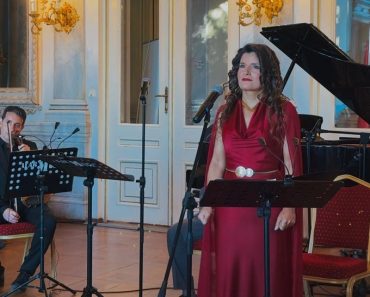
On May 31, you will appear at the Melbourne Recital Centre in the tribute concert marking 100 years since the birth of Mimis Plessas. What does this evening mean to you?
“We already held a performance in Sydney on May 8, and it was one of the most beautiful evenings. The theatre was full… 1,200 people, completely sold out. Mimis Plessas was presented in Australia for the first time in symphonic form. The audience knew every song and sang along to all of them. For me, it is deeply important that I am bringing his music to Australia, especially with a symphony orchestra and all the grandeur that his work deserves. I came to know Mimis Plessas personally from my very first steps in music. We performed many concerts together. I feel a responsibility, without wanting it to sound too heavy, to pass on his songs and works to the next generation. In Melbourne, we will bring audiences a great Greek composer through songs people already know, though perhaps have never heard performed with a symphony orchestra. We will transport the audience in Melbourne back to the homeland.”

WHAT HE WOULD TELL HIS YOUNGER SELF
The conversation ends where, in many ways, it all began: with the child who returned from Germany to the village, discovered his voice through church chant, and listened to songs of migration move his parents to tears.
If you could speak to young Dimitris, the boy discovering his voice at the village chanting stand, what would you say to him today?
“I would tell him that he made it. That he did well. This question also makes me reflect on myself. I believe I did not lose my values. I am a grounded person; I know what is happening to me. I live every day as though it is a great day and I thank God for allowing me to live to see the next one. I consider myself blessed and fortunate. What began as my hobby, singing, became my profession. I make my living from it, I have received tremendous love from people, and I have travelled all over the world. I am deeply grateful.”
In his answer lies, in many ways, the entirety of his journey. From the altar boy carrying church banners in Cherso Kilkis to the acclaimed performer Dimitris Basis, travelling to the other side of the world to meet people who carry Greece within their memory, language, and music through songs that once again become whispers of the heart.