
Editor’s note: This story is an excerpt from WBUR’s weekly arts and culture newsletter, The ARTery. If you like what you read and want it in your inbox, sign up here.
This Sunday is Mother’s Day, and it’s a special one for me. It’s my first as a parent, but it’s also my birthday. My mom likes to remind me every year that, after days of labor, I was born on a Friday and she got to take me home that Sunday. I was the perfect Mother’s Day gift.
Since giving birth last August, I’ve been thinking a lot about motherhood. You all have read the results of some of those musings (reimagining a new self, and finding creativity in parenthood). My birthday this year feels surreal, almost like time folding in on itself. I’m the child my mother carried home on a Sunday all those years ago, and the mother now carrying my own child through the world.
My baby is only 9 months old, and I still have time to learn the shape of parenthood. But I’m sure that by the time I chart the territory of what it means to be a mother at this moment, the borders will expand and change as I myself and my child grow and change.
Art has been a way for me to digest how motherhood is really an act of becoming, over and over again. Lately, I’ve been drawn to work and experiences that resist flattening motherhood into something sentimental or singular. Things that make space for contradiction, for the person you were and the person you are still becoming.
The following works and events serve as reminders that there is no clean, tidy narrative arc to parenthood. There’s only the messy and sacred work of showing up.
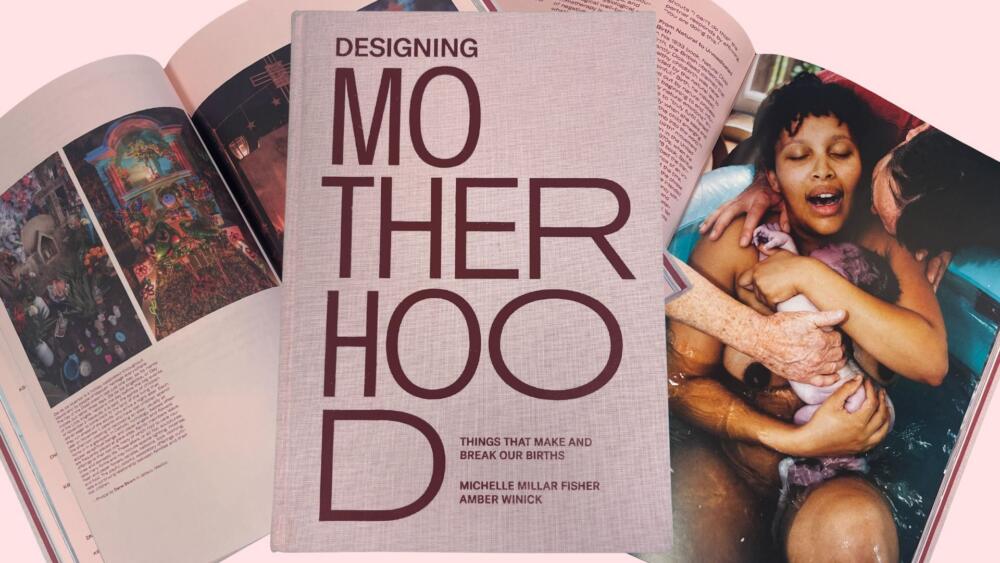
A beautiful melange of photos, artwork and text, “Designing Motherhood” by Michelle Millar Fisher and Amber Winick breaks open the nuances of conception, pregnancy, labor and the postpartum stage. It also takes a critical look at topics like forced sterilization and maternal mortality rates through interviews and conversations with birth workers and artists.
The section of the book that got me emotional was the one on cesarean births. My partner and I had planned for a homebirth with a midwife, but complications necessitated a hospital birth and c-section. I never really mourned the birth experience I didn’t get to have. For a while, I felt like I was “less than” because I didn’t birth my son the “traditional way” and I didn’t get to see him emerge into the world.
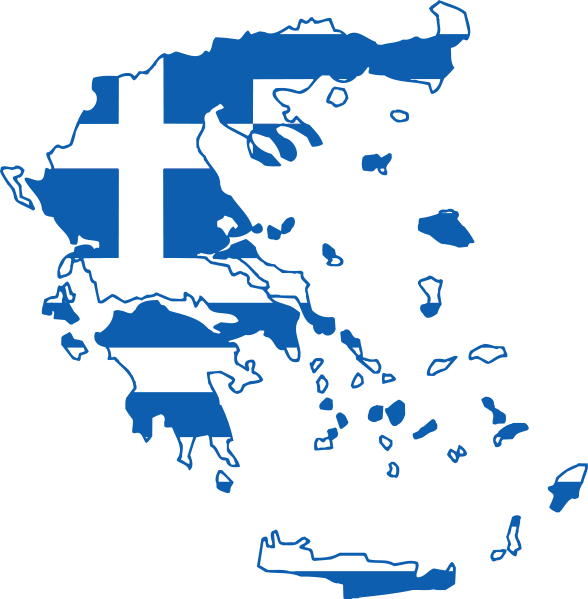
In actuality, c-sections are an ancient practice referenced often in folklore, including Greek mythology — some of the gods, like Adonis, are said to have been born via cesarean birth. C-sections are also the most commonly “performed surgery in the world.” Reading that was an affirmation that I’m not alone in my experiences and that my birth story is just as valid and beautiful as any other.
When this movie came out, it received critical acclaim for its visual effects, effective and sometimes mind-bending storytelling and the stellar performances from the cast. Recently, my partner and I rewatched it and I found myself bawling my eyes out (like most people) at the end of the film. Except this time, I understood Evelyn (played by Michelle Yeoh) a little bit better.
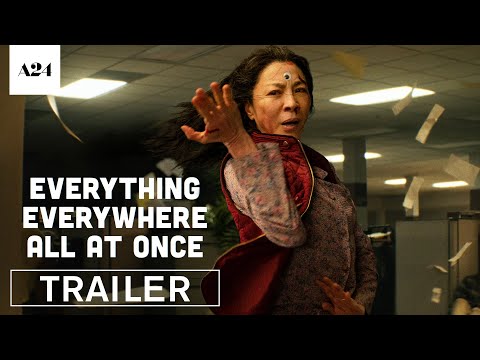
Evelyn’s relationship with her daughter, Joy, is so strained. It seems like Evelyn is constantly putting her foot in her mouth when it comes to her daughter’s weight or sexuality. Evelyn is a mother who loves her child, but she’s still deeply flawed. Without meaning to, she’s passed down her own traumas to her daughter. And in another universe, those experiences harden Joy into a villain.
The film was really a meditation on the risks of parenthood — that you must give up your need for control and perfectionism and release any expectation of a certain result. Parenthood is a continual choice to see and hold your child as they are. Love doesn’t always require understanding. Sometimes all it requires is being there.
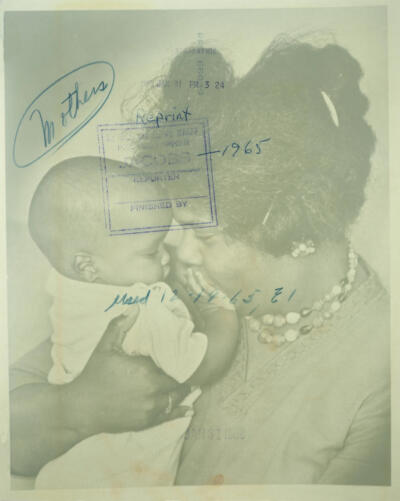
“Mothercraft” is an ongoing series by Boston-based artist and photography professor Toni Pepe. I came across her work a few years back when the series was exhibited at the Boston Athenaeum. Collecting old photos from places like eBay and thrift stores, Pepe uses a backlight and rephotographs them. The process means that words or captions on the back of the photo appear on the front. The results are unique and striking combinations of text and image.
Pepe says that “Mothercraft” is a way for her to examine the trajectory of motherhood in the 20th century and how it shifts and changes. One image I was drawn to is titled “Mothers.” It shows a woman holding a baby as the baby explores her face with its hands. It reminded me of all the soft and tender ways I interact with my own child. Though we are decades removed from the 1965 photograph, I felt a sense of deep familiarity looking at it.
“Mothercraft” isn’t currently on view, but you can read about it and see many of the images included in the series on Pepe’s website.
These monthly walks are led by Stefanie Belnavis and her organization Birthlooms. A licensed mental health clinician and a perinatal movement psychotherapist, Belnavis captures hard and tender moments on the perinatal journey through photography.
Natal Walks are done in collaboration with rotating perinatal wellness facilitators, and the events bring together POC families and birth practitioners. The group goes on a 1.5-hour gentle trek in the Fenway/Riverway area.
The experience is about much more than exercise. There are moments and space for reflection, connection and discussion around the many varied prenatal and postpartum experiences, including bereavement and isolation. You don’t have to share your story if you go, but you’re more than welcome to listen to what others have to say.
The first walk of the season is on May 16. RSVP is required, but the event is free to attend.
Reading and seeing work by and about mothers and parents has been so reaffirming.
There’s no mold to fit into or pattern to follow.
This is an experience that will continue to shape me in ways I can’t yet fully see. I just have to trust in the process.