

By Catherine Tsounis
“Before 1821, Greeks were not free. They wanted freedom and dignity. Faith gave Greeks strength,” are themes taught to our Greek American and Phil-Hellenic youth on the 1821 Greek Revolution. These ideas were expressed by the marchers and floats of the 2026 New York City Greek Parade Honors the 205th Anniversary of Greek Independence and the 250th Anniversary of American Independence on Sunday, April 26th , 2026. Communities from the Northeast participated in solidarity to support our freedom, in the background of the Iran War and gunfire at the White House Correspondents Association dinner April 25th.
The outstanding work of the New York City police safeguarded the public safety of all. The Parade began at 1:30 P.m. till late afternoon. Marchers from Churches, fraternal societies, public and private organizations paraded along 5th Avenue from 61st Street to 74th Street. The EVZONES military guard of Greece was a major parade attraction. The Federation of Hellenic Societies of Greater New York sponsored the Parade with prominent persons from the United States, Greece and Cyprus goverments, business and education sectors. For more informantion, contact by email nyhellenicsocieties@
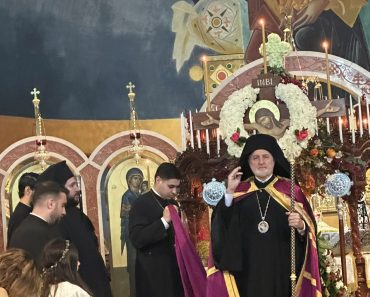
The Parade Program included: Honorary Chairman, His Eminence Archbishop Elpidophoros of America: Grand Marshals John Catstimatidis and Nikolas Tsakos; Organizations Grand Marshalls, The Hellenic Initiative and Capital Link; Honorary Grand Marshalls, Metropolitan Ieronymos of Kalavryta and Alkiviadis Stefanis; Parade Chairman Lou Katsos; Parade Vice Chairs, Yannis Stroumbakis, George Paralemos, George Venizelos, George Meinstassis; Parade Executive Director George Kontzamanis; Executive Director of Administration, Stavros Papagermanos; Parade Announcers, Mariana Apostolatos, Demetris A. Filios, Dimitris Filippidis and Michael Stratis; Education Committee Chairman Dr. Constantine Hatzidimitriou.1
“We must remember our roots,” explained Parade Chairman Lou Katsos on the April 24th Dimitris Filippis HellasFM program. “Without history, the parade is nothing. We must remember where we come from, Most Hellenic people don’t understand that the Greek Revolution was an international event. The nations supported the Ottoman Empire, because no one wanted revolution after the defeat of Napoleon. The Governments did not support the Greek Revolution. The people supported the Greeks. We had 14 lectures, meetings and concerts leading up to the parade. America’s Founding Fathers knew Greek and studies Greek history. People of many nations participated in the Greek revolution.”
Parade Chairman Katsos was referring to the Philhellenes. They are persons who have a love of Greek civilization that is in the heart of Western thought, art and democracy. Philhellenism links persons of all backgrounds who love the Greek nation and culture. Americans saw in the fighting Greeks of 1821, the descendants of the glorious Hellenes. They believed that the modern Greeks were entitled to the immediate assistance of the Western World, which owed so much to ancient Hellas. Philhellenism spread in the United States: mostly among the people. It failed to impress the United States government, beyond words of sympathy.2
The parade commemorates the 200th Anniversary of the Exodos of Missolonghi. The death of Lord George Gordon Byron at Missolonghi, Greece, during the Greek War of Independence was an event that resonated around the world like an earthquake. The subsequent Exodus of Missolonghi intensified international attention and sympathy for the Greek cause. Together, Byron’s death and the dramatic fall of Missolonghi sparked a powerful wave of Philhellenism across Europe and the United States. This surge of support played a crucial role in strengthening the struggle that ultimately led to the emergence of the modern Greek nation.3
Education Committee Chairperson Dr. Hatzidimitriou is the author of “Byzantium: The Missing Link to Understanding the History of Western Civilization:” Innovative Byzantine History Teachers Resource Guides. It will be disseminated to the Archdiocese’s Greek American schools throughout the United States, and to other interested organizations. For more information, contact [email protected] .
“Women who survived catastrophes of Chios, Psara, Missolonghi endured hunger and death rather than be sold into slavery,” explained Dr. Despina Afentoulis in an April 18th CosmosFM Greek radio broadcast. “Greek women were sold as slaves in the Ottoman Turkish Empire and sent into Eastern Anatolia. Slavery was a profitable trade in the Turkish Empire. War was seen as profitable in selling women and children after the men were killed. That was the fate of families when the fighters were killed. The fighters sent their families to the Ionian and Aegean islands to escape slavery. Thousands of women and children from the Chios Catastrophe were sold into slavery in Cairo and Constantinople. Captured women and children were viewed as live merchandise. Prices were based on age and beauty.” Dr. Afentouli must translate her Greek research into English for all to learn the horrors of Greek slavery.
Theodore Kolokotronis gave a historic speech to youth in 1838 known as “KOLOKOTRONIS’ SPEECH TO STUDENTS AT THE PNYX”. The Unique man of honor explained “You must keep your faith and strengthen it, because when we took up arms, we first said, “For the Faith” and then “for the country.” Every nation of the world has and keeps one religion or another. Even the Jews who are persecuted and are hated by all the nations of the world remain firm in their religion….Always listen to the advice of your teachers and elders, according to the saying, Learn a hundred things and know a thousand. Let your progress become a climbing axe, not only for yourself, but also for the good of the community, for it is in the latter that your own well-being lies.,,, Long live the wise teachers! Long live the Greek Youth!”4 Kolokotronis urged students to learn, stressing that knowledge of the past is vital for building a strong future. He believed Orthodox Christianity as a cornerstone of Greek identity. It was a driving force behind the revolution.
In my opinion, the Greek Independence Day NYC Parade will continue for the following reasons: Support by the Greek Orthodox of America Archdiocese churches and Greek schools: Parents of Greek and Philhellenic backgrounds who support the parade, financial contributions by affluent NYC Greek Americans who are active in NYC and NY state politics. That is the core of the survival of the NYC parade and the Greek culture in America based on Greek Orthodoxy, understanding the Greek language and civilization.
All photos by Despina Siolas MD/Ph.D.
References
1. https://www.anamniseis.net/i-
2. 2. https://hellenicnews.com/2021/
4. KOLOKOTRONIS’ SPEECH TO STUDENTS AT THE PNYX