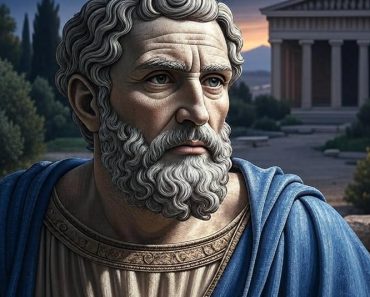

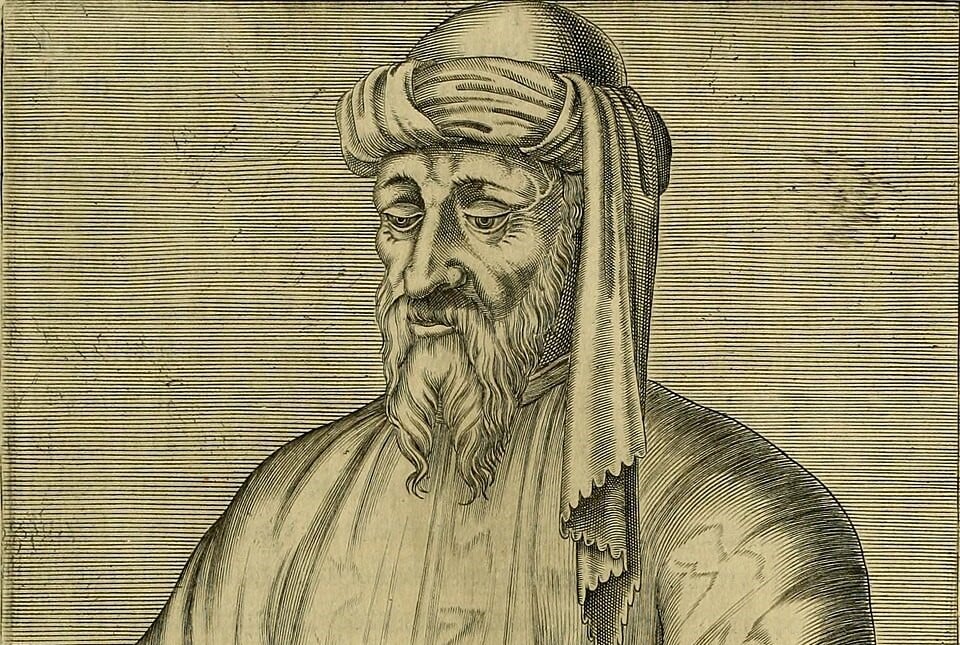
The late Ancient Greek philosopher Porphyry was a defender of Hellenistic paganism and promoter of veganism, causing ire among Christians that led them to burn his books.
Porphyry of Tyre was one of the founders of Neoplatonism. Born around 234 (died c. 305) in Roman Phoenicia (today Libya), he moved to Athens as a young man, where he studied rhetoric, mathematics, and philosophy with Longinus, the “living library and walking museum.”
In 263, he migrated to Rome and joined the circle of Plotinus, the founder of Neoplatonism, becoming a fervent and favored acolyte, although he remained with him for no more than five years. In 268, he fell ill with melancholy, and Plotinus urged him to go south to Sicily for the sake of his health. After Plotinus died in 270, Porphyry played a crucial role in organizing and spreading his teacher’s ideas. He was interested in how people could live better, more disciplined lives and move closer to truth and spiritual understanding. In simple terms, his thought combined logic, ethics, and spirituality into one system aimed at improving the human soul.
At the center of Porphyry’s philosophy is the idea that reality is ordered in levels, from the highest and most perfect to the lowest and most material. This idea comes from Neoplatonism. At the top is “the One,” a perfect and simple source of everything. From the One comes the intellect (mind), and from the intellect comes the soul. Finally, at the lowest level is the physical world, which we experience through our senses.
For Porphyry, human beings exist between these levels: we have bodies, but we also have souls that connect us to higher reality. This means that our lives are a kind of journey. We can either stay focused on material things or try to rise toward the intellectual and spiritual realm.
The Greek philosopher Porphyry and his search for the right way to live
One of Porphyry’s main concerns was how we can make this upward journey. He believed that philosophy is not just about thinking but about living correctly. To him, philosophy was a way of life and included practicing self-control, avoiding excess, and seeking truth. He strongly supported vegetarianism, not only for health but also for ethical reasons. He argued that animals have souls and harming them unnecessarily damages our own moral character. This demonstrates how seriously he took the idea that all living beings are connected within a larger order.
Another key aspect of Porphyry’s philosophy is his work in logic. He wrote an introduction to Aristotle’s logic, called Isagoge, which became one of the most influential textbooks of the Middle Ages. In this work, Porphyry explored how we classify things and understand categories such as genus and species. For example, he examined how we define a “human” as a type of “animal.” These questions might seem abstract, but they are important because they shape how we think and communicate. Porphyry raised a famous problem about whether categories like “species” and “genera” truly exist in reality or only in our minds. This question later became central in medieval philosophy and is known as the problem of universals.
The importance of the soul
An important aspect of Porphyry’s thought is his emphasis on the soul. He believed that the soul is immortal and can either become trapped in the material world or rise toward the divine. The way we live determines this outcome. If we focus only on pleasure, wealth, and physical desires, we become more attached to the body and are unable to understand higher truths as readily. On the other hand, if we practice discipline, study philosophy, and live ethically, we strengthen the soul and move closer to the divine. This idea gives his philosophy a strong moral message: our choices matter not just in this life but in a broader spiritual sense.
Porphyry also emphasized the importance of education and intellectual training. He believed that learning logic, mathematics, and philosophy helps purify the mind. This process allows us to see reality more clearly and avoid being misled by appearances. In this way, knowledge is not just useful. It is actually transformative. It changes who we are and how we relate to the world.
In his philosophy, Porphyry questioned certain religious beliefs and practices. Unlike some of his contemporaries, he was critical of practices he considered superstitious or irrational and believed that true religion should be philosophical and aim at understanding the divine through reason. At the same time, he defended traditional pagan religion against Christianity, arguing that ancient traditions contained deep wisdom. Nonetheless, he did not reject religion altogether; instead, he sought to purify and connect it with philosophy.
God in Neoplatonism, the Greek philosopher Porphyry, and the controversy with Christians
According to Neoplatonic philosophy, God is an all-powerful intellect. To live in accordance with God’s intellectual nature, one should strive to make one’s own life intellectual—that is, to refrain from transient, bodily desires and cultivate only those interests that produce knowledge and virtue.
Porphyry’s most important contribution to Neoplatonism, and more broadly to the history of philosophy, lies in his attempt to rethink the relationship between religion and philosophy. For thousands of years, religious thinkers and philosophers have competed to provide ultimate answers to the fundamental problems of human existence. According to Italian scholar Giuseppe Muscolino, Porphyry was the first Neoplatonic philosopher who, in analyzing the problem of salvation, asked whether a universal salvific path for all humankind existed.
The controversy between Porphyry and Christianity, on the one hand, presents the Greek philosopher of Tyre as denying the existence of a single path of salvation for all people. On the other hand, it reflects the Christian position that identifies Christ as the universal savior of humankind.
Philosophical critique of Christianity
Porphyry’s most controversial work, Against the Christians (Adversus Christianos), written in approximately fifteen books, represents one of the earliest sustained intellectual critiques of Christianity. This work, now lost, survives only in fragments quoted by Christian authors who sought to refute it. The disappearance of the Greek philosopher’s manuscript was not accidental but was explicitly targeted by Christian emperors, most notably Theodosius II, who ordered copies of Porphyry’s text to be burned—first in 435 AD and again in 448 AD.
The destruction of his writings was both systematic and effective. As a result, modern scholars must reconstruct his arguments through hostile sources. This circumstance alone is revealing, as it suggests that Porphyry’s critique of Christianity was perceived as sufficiently dangerous to warrant deliberate eradication. According to one scholarly summary, the work was “a fierce critic of the new religion,” marking Porphyry as one of Christianity’s most formidable intellectual opponents.
Contradictions and inconsistencies
Although the original text is lost, surviving fragments and testimonies allow the modern reader to glimpse the nature of Porphyry’s critique. His approach was not merely rhetorical but was also analytical and philological, examining Christian scriptures with the tools of classical scholarship and pointing out contradictions, inconsistencies, and historical discrepancies.
The modern scholar R. Joseph Hoffmann describes the work as “an educated man’s studied attack on Christian theology,” emphasizing its intellectual rigor and deliberate method. Porphyry challenged several key elements of Christianity, specifically the authority and consistency of the Bible, divinity of Jesus, reliability of the apostles, and coherence of Christian doctrine.
As one academic description explains, his critique “extended to key figures, beliefs, and doctrines of Christianity,” including the resurrection and the concept of God as a whole. Porphyry’s method was particularly striking. Rather than rejecting Christianity outright, he frequently turned its own texts against it, using internal analysis to expose what he saw as contradictions within scripture—an approach that underscored both his scholarly precision and the seriousness of his critique
Legacy of the Greek philosopher Porphyry, whose manuscripts were decimated by Christians
The Greek philosopher Porphyry connects reason, ethics, and spirituality. He taught that reality is structured in levels and human beings have the ability to rise toward higher understanding. Through disciplined living, ethical behavior, and intellectual effort, we can improve our souls and move closer to truth. His philosophy reminds us that thinking and living are not separate activities but are deeply connected.
Even though Porphyry lived many centuries ago, his ideas remain relevant to this day. His emphasis on ethical living, respect for animals, and the search for deeper meaning speaks to modern concerns, while his work in logic laid the foundation for later philosophical developments. His questions about reality and knowledge are still discussed in university lecture halls, but perhaps most important was his belief that philosophy should guide how we live.