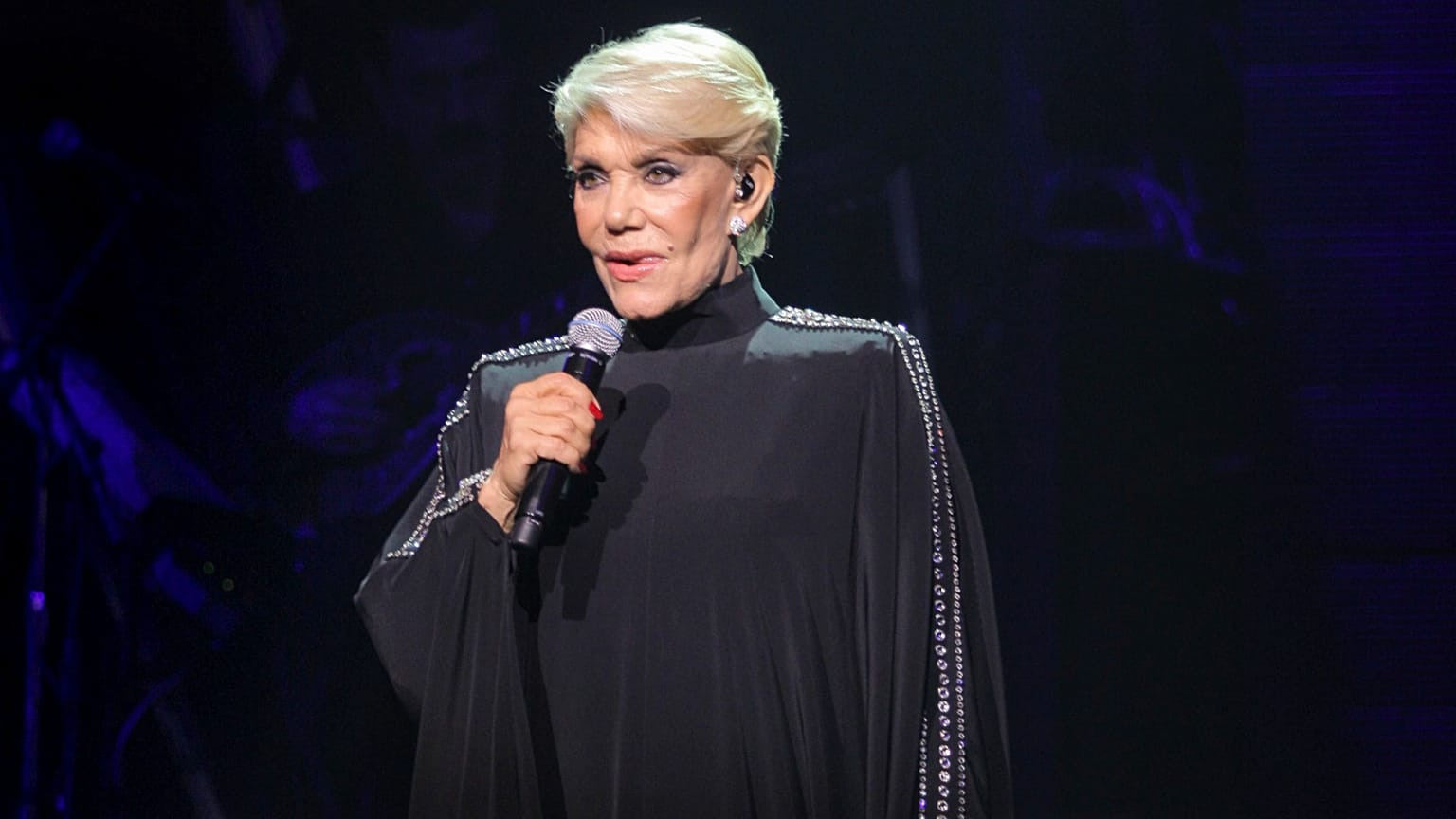
On March 28, 2026, Greece lost more than a singer. It lost a living archive of emotion, memory, and cultural identity. Marinella—born Kyriaki Papadopoulou—passed away at the age of 87 in Athens, closing a career that stretched across nearly seven decades and defined the sound of modern Greek music.
Her death, following complications from a stroke she suffered on stage in 2024, has triggered a wave of reflection—not only on her achievements, but on what her voice represented to generations of listeners.
A Voice Born in Hardship, Shaped by History
Marinella’s story begins in Thessaloniki in 1938, in a refugee family from Constantinople. Her early life was marked by scarcity and resilience, shaped by the aftermath of war and displacement. Yet, even in those constrained circumstances, music was constant.
By the age of four, she was already singing on radio programs, signaling a rare instinct for performance. That instinct matured quickly. By her late teens, she was touring with theatrical troupes, stepping into roles when opportunity demanded—and never stepping back again.
Her transformation into “Marinella” came in the mid-1950s, when her stage name was coined during a nightclub performance. It marked the beginning of a professional career that officially launched in 1956 and would continue uninterrupted for nearly 70 years .
The Duet That Defined an Era
The turning point came through her collaboration with Stelios Kazantzidis. Together, they formed what many still consider the most iconic duet in Greek music history.
Their partnership—both personal and professional—was intense, productive, and ultimately short-lived. Married in 1964 and divorced in 1966, they nevertheless created a body of work that became foundational to laïko music.
Their songs were not simply popular—they were lived experiences, capturing migration, heartbreak, and longing in a way that resonated deeply with Greek audiences at home and abroad.
Reinvention: The Solo Years and Cultural Ascendancy
After her separation from Kazantzidis, Marinella did not retreat. She recalibrated.
Launching a solo career in 1966, she expanded her artistic range and established herself as a dominant solo performer. Over time, she collaborated with leading composers such as Mikis Theodorakis, Manos Hadjidakis, and Stavros Xarchakos, reinforcing her position at the center of Greece’s musical evolution.
Her output was prolific—66 solo albums across genres including folk, laïko, blues, and rebetiko .
But more than volume, it was her interpretive depth that distinguished her. Critics often noted her ability to merge theatrical expression with vocal control, giving each performance an emotional immediacy that felt almost conversational.
Eurovision 1974: A Historic First
In 1974, Marinella stepped onto an international stage that would mark a milestone not just for her, but for Greece.
Representing the country at the Eurovision Song Contest 1974, she performed “Krasi, thalassa kai t’ agori mou”—becoming the first Greek artist ever to compete in Eurovision.
Although she placed 11th, the significance extended beyond rankings. Greece had entered the European cultural conversation, and Marinella was its voice.
That same year, the contest itself would be remembered for ABBA’s victory with “Waterloo,” placing Marinella in a historic lineup of global music moments.
Beyond Music: Film, Theatre, and Cultural Presence
Marinella was not confined to recording studios or concert halls. She appeared in Greek cinema, musicals, and theatrical productions, reinforcing her identity as a performer rather than simply a singer.
Her involvement in productions such as Gorgones kai mages and later stage performances demonstrated a versatility that allowed her to move between artistic forms without losing authenticity.
She also helped redefine live performance in Greece—introducing choreography, costumes, and lighting concepts that influenced future generations of performers.
The Final Performance and a Long Goodbye
In September 2024, at the historic Odeon of Herodes Atticus, Marinella suffered a severe hemorrhagic stroke while performing.
The moment was stark: a performer collapsing mid-song in a venue that symbolized artistic excellence. She spent months hospitalized before returning home, but never fully recovered .
Her death on March 28, 2026, was not sudden—it was the final chapter of a gradual farewell that began on stage.
Her family’s statement captured the tone: a quiet, dignified goodbye to “our beloved mother and grandmother” .
Personal Life: Love, Independence, and Distance
Marinella’s personal life was as layered as her music.
She was married twice—first to Kazantzidis and later to Tolis Voskopoulos (1973–1981). Both relationships were significant, though neither endured.
In later interviews, she spoke candidly about choosing independence. Her reflections on love were direct and unsentimental, emphasizing experience over permanence.
She is survived by her daughter, Georgina, and grandchildren—a private family life that remained largely separate from her public persona.
Influence, Legacy, and Cultural Weight
To describe Marinella simply as a “successful singer” would be reductive.
She was a cultural institution.
Her music became a bridge between generations—linking post-war Greece to contemporary audiences, and connecting diaspora communities to their roots. Her performances were not just entertainment; they were acts of cultural continuity.
As one critic noted, her voice carried “the warmth of the sun” and the emotional weight of a people’s history .
Even internationally, she commanded respect. Anecdotes recount admiration from figures like Frank Sinatra, who reportedly recognized her global potential.
Net Worth and Commercial Impact
While precise figures are not publicly documented, Marinella’s financial standing reflected a long and successful career built on:
- Album sales spanning decades
- Sold-out concerts across Greece and internationally
- Collaborations with top composers and artists
- Appearances in film, theatre, and major cultural events
Her influence extended beyond income—she shaped industry standards, particularly in live performance production and audience engagement.
Public Perception: The Artist Who Refused the Myth
Interestingly, Marinella resisted being labeled a “legend.”
In interviews, she minimized her own stature, emphasizing instead the connection with her audience. She described looking into the crowd and addressing it as one face—an approach that defined her performance philosophy.
This resistance to mythologizing herself made her legacy more compelling, not less.
Final Reflection: When a Voice Becomes Memory
Marinella’s death has reignited interest in her music, her Eurovision milestone, and her extraordinary longevity. But the renewed attention also underscores a deeper reality:
Artists like Marinella are not replaced. They become reference points.
Her voice now belongs to memory—archived in recordings, replayed in homes, and echoed in the performances of those she influenced.
For Greece, and for audiences far beyond it, Marinella was not just heard. She was felt.