An Egyptian archaeological mission has uncovered the remains of an early monastery in Wadi El-Natrun, offering new insight into the origins of organized Christian monastic life and its links to the wider Greek-speaking world.
The discovery was made by a joint team from the Supreme Council of Antiquities and the Faculty of Archaeology at Cairo University. The site lies in the buried monasteries area in Beheira Governorate, a region long recognized as one of the earliest centers of monasticism.
Researchers date the structure to between the 4th and 6th centuries AD, a period when Christian communities began shifting from isolated hermit life to organized communal living.
Planned layout reveals structured monastic community
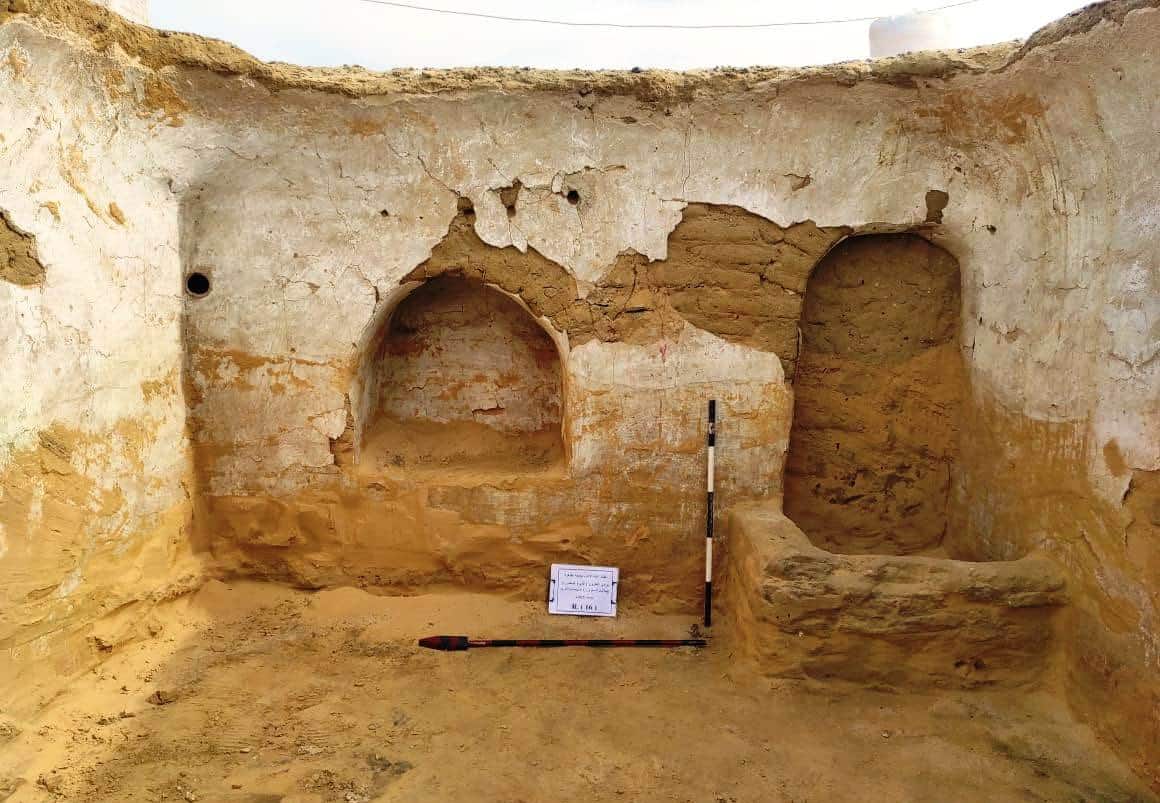
The complex covers about 2,000 square meters and is built from mudbrick. Thick outer walls provided protection, while thinner inner walls divided the space into functional units. At its center lies an open courtyard that likely served as a shared gathering area.
Smaller courtyards extend from this central space and lead to monks’ cells of varying sizes. The layout suggests a structured community rather than scattered individual dwellings. In the western section, archaeologists uncovered kitchens, ovens, and storage rooms, indicating the monastery operated as a self-sufficient settlement.
Burial spaces highlight spiritual and communal traditions
Burial areas found within the complex contained human remains believed to belong to monks. This reflects a tradition in which religious life and burial practices were closely connected, with monks often laid to rest within their spiritual community.
Architectural analysis revealed the use of vaulted ceilings and domes built from mudbrick. Interior walls were coated with white plaster and decorated with murals featuring crosses, palm motifs, and geometric designs.
Greek inscription points to wider religious influence
One of the most notable findings is a painted cross accompanied by a Greek inscription that translates to “Wood of Life” (Ξύλον Ζωής). Researchers say this phrase reflects early Christian symbolism linking the cross to salvation and eternal life. Its presence highlights the influence of the Greek language and theology in early Egyptian monastic communities.

Additional inscriptions written in Coptic script include monks’ names and short prayers asking for mercy and forgiveness. These texts help date the site and offer rare insight into the people who lived there.
Discovery reflects transition in monastic architecture
Scholars note that monastic practices developed in Wadi El-Natrun were later recorded in Greek and spread across the Byzantine world. This helped shape early Eastern Christian traditions, linking Egypt’s desert communities to a broader religious network.
Dr. Yasser Ismail Abdel Salam, head of the mission, said the structure represents a transitional stage in monastic architecture. Early monks lived in isolated cells, but over time these evolved into organized complexes like the one uncovered.
Officials say the discovery strengthens efforts to preserve Egypt’s Coptic heritage while highlighting Wadi El-Natrun’s lasting historical and spiritual importance.