
In the tropical rainforests of northern Australia and the islands of New Guinea lives an eight-legged hunter that could pass for a character taken from Greek mythology or, according to some interpretations, from a nineteenth-century religious controversy. It is Mopsus mormon, a jumping spider that is not only one of the largest in Australia — reaching up to 20 millimeters in body length — but also one of the most striking because of its emerald-green coloration and its peculiar face.
For lovers of natural history and the archaeology of expeditions, this species is not just another arachnid. Its name is a window into the past, a nod to classical myths and a reflection of the way nineteenth-century scientists tried to classify a world full of astonishing forms. This is the story of Mopsus mormon, a creature that combines the stealth of a feline with the strategy of a seducer.
The scientific history of this spider begins in 1878, when the German arachnologist Ferdinand Karsch published its original description. To name the new genus, Karsch turned to classical culture. He chose Mopsus, in reference to a famous seer from Greek mythology. Mopsus, was a prophet who appears in works such as the Argonautica by Apollonius of Rhodes, known for his ability to interpret signs and predict the future. It was an appropriate name for a spider that, with its enormous frontal eyes that resemble modern sunglasses, seems to be observing the world with an almost prophetic intensity.
However, the origin of the species name, mormon, is an enigma that has fueled the curiosity of naturalists for decades. Karsch left no written explanation as to why he added that surname. In the absence of documentation, two main theories have emerged.
One suggests that it could be a reference to the Mormon religious movement, which in Karsch’s time was gaining worldwide notoriety, especially for its missionary practices. The other theory points to a more physical aspect: the spider’s face, especially in males, displays a kind of black “mask” with white hairs that resembles a beard or fake mustache, which may have inspired the term. However, none of these interpretations has been directly confirmed with primary sources, leaving Mopsus mormon with a name wrapped in the same mystery as its hunting tactics.
The taxonomic history of this species is a labyrinth in itself. Initially described from specimens collected in Rockhampton, Queensland, the species was almost immediately synonymized with another name, Ascyltus penicillatus, also described by Karsch that same year.
Later, in 1883, the arachnologist Keyserling reclassified it as Mopsus penicillatus. It took later revisions, such as those by the renowned naturalist Eugène Simon in 1903 and more recent work such as that of Prószyński in 2017, for researchers to consolidate the name and establish that Mopsus mormon was the only valid species within a genus that, to this day, remains monotypic. That is, it has no close relatives within its own genus; it is a unique case in the evolution of jumping spiders.
The anatomy of an elite hunter
The first thing that draws attention about Mopsus mormon is its size. With a body length that can reach 20 millimeters in females — males are smaller, about 12 to 15 millimeters — it is considered one of the largest jumping spiders in Australia.

Subscribe to our newsletter
Receive our news and articles in your email for free. You can also support us with a monthly subscription and receive exclusive content.
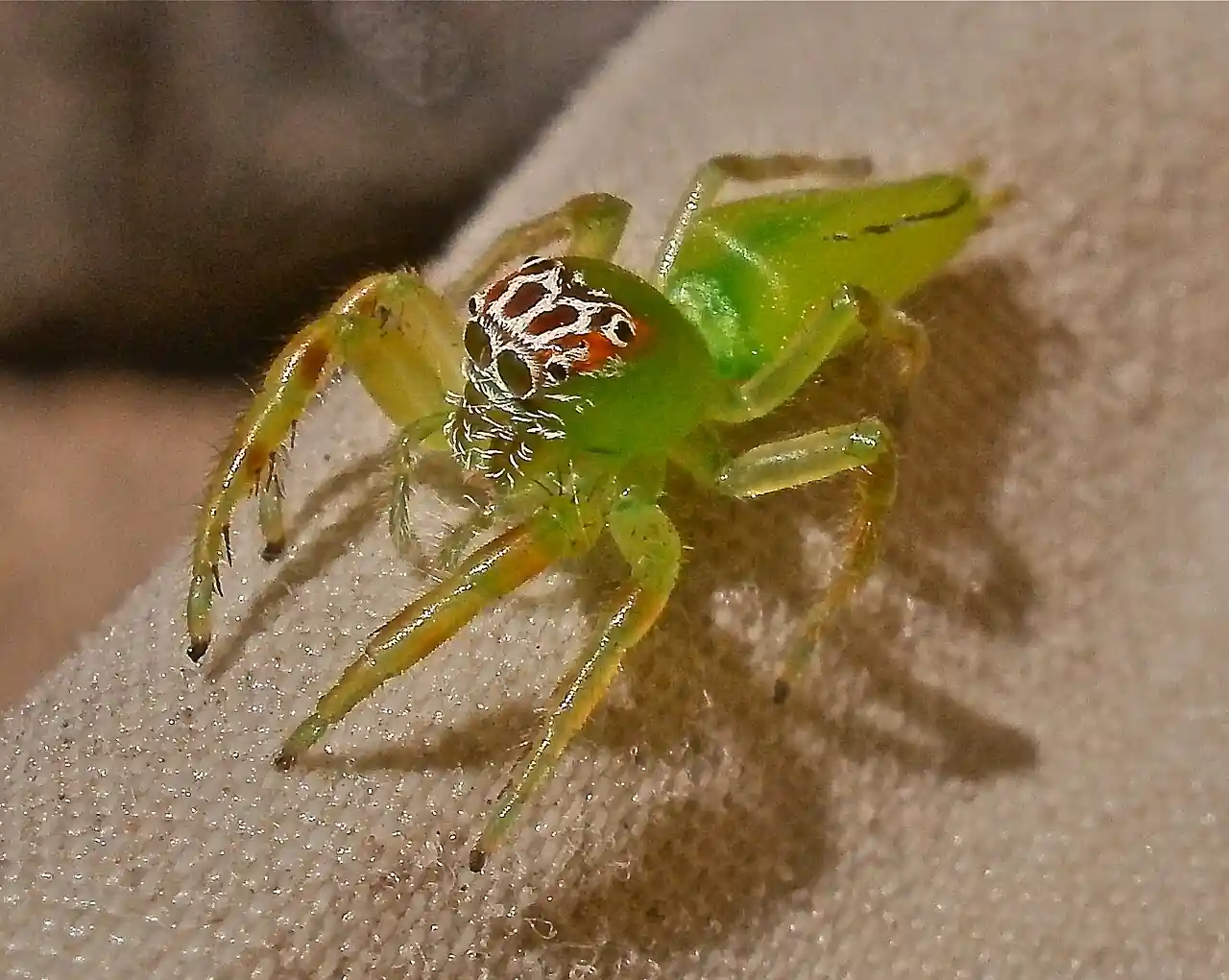
But if the size impresses, its coloration fascinates. A bright green predominates, often with a subtle metallic sheen, which serves as perfect camouflage among the leaves of its jungle habitat. The legs and abdomen are usually adorned with white markings that imitate leaf veins or the patterns of light filtering through foliage.
Its body is built for arboreal life: an elongated abdomen that tapers toward the rear and a rounded cephalothorax (the head fused with the thorax) that reaches its highest point just behind the eyes and then slopes gently downward.
Like all salticids, it possesses eight eyes arranged in two rows. The front row is dominated by two enormous anterior median eyes that provide sharp, almost telescopic vision, essential for measuring distances with millimeter precision before launching onto its prey. The other, smaller eyes give it nearly 360-degree peripheral vision, impossible to deceive.
If there is one aspect that distinguishes Mopsus mormon from other spiders, it is the marked difference between males and females, a phenomenon known as sexual dimorphism. They are so different that they could be mistaken for different species.
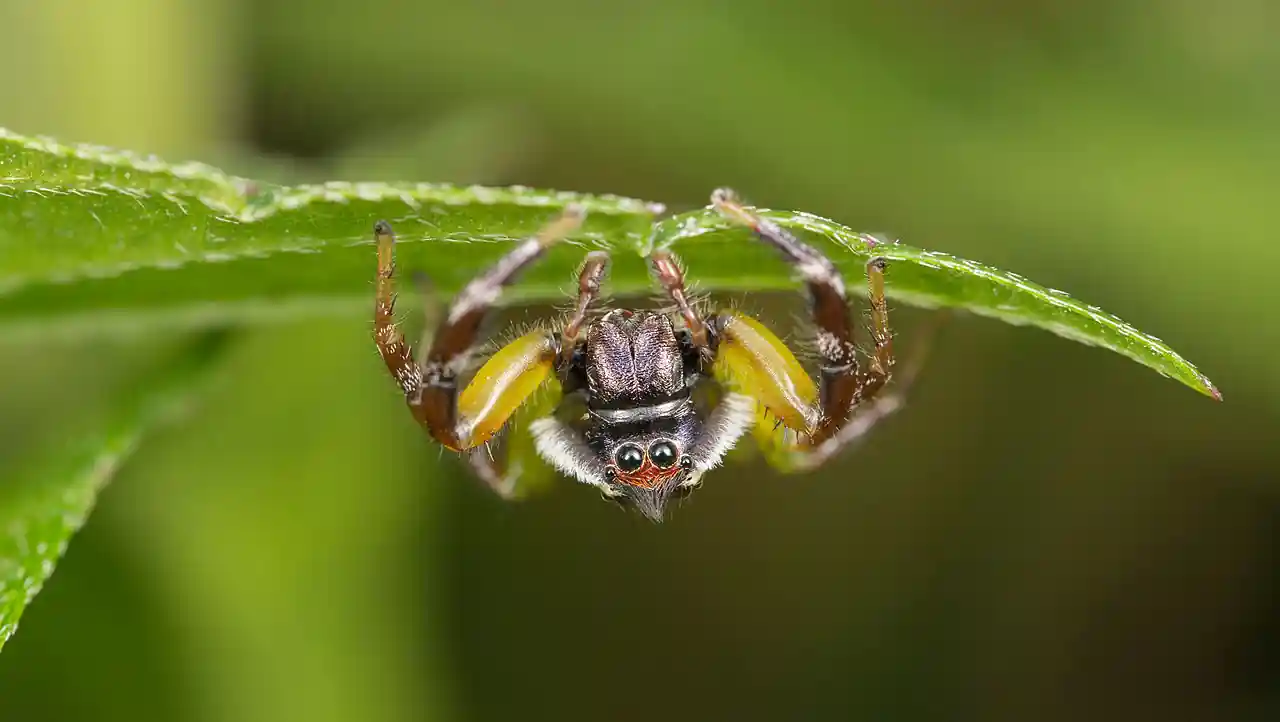
Males are the most extravagant. In addition to being smaller, they possess a tuft of black hairs on the top of the cephalothorax that gives them a “crest”-like appearance. On the sides of the face, long white setae form characteristic “sideburns” or lateral whiskers. Historical texts describe this ensemble as having a profile “resembling that of a baboon.” Their cephalothorax and legs range from dark brown to black, while their abdomen is a vibrant lime green, often with iridescent reflections and red accents in the head region.
Females, by contrast, display a more robust and uniform appearance. They lack the tuft and white sideburns. Their face shows a red and white “mask” above the eyes, but the rest of the body is a more subdued and uniform green, including the legs, which are a pale green tone. Their larger size is not accidental: it is directly related to their reproductive role, since they are the ones that build silk nests in rolled leaves and protect the egg sacs.
A home in the tropics
Mopsus mormon is an inhabitant of warm climates. Its distribution spans northern and eastern Australia, with confirmed records in the Northern Territory, Queensland, New South Wales, and Western Australia. It is found from lush humid tropical rainforests to drier wooded areas, as long as abundant vegetation is present. Its presence also extends beyond the Australian continent, reaching New Guinea, both in the Indonesian region and in Papua New Guinea.
Within Australia, its range includes various biogeographic regions such as the Wet Tropics, the Brigalow Belt North, and the Cape York Peninsula. Specimens have been documented from coastal zones to inland areas, and even on islands in the Torres Strait, where it has been recorded on six different islands.
Its preferred habitat consists of subtropical and tropical environments with high or moderate rainfall. It is an eminently arboreal spider that spends most of its life in trees, shrubs, foliage, and tall grasses. It does not build webs to capture prey, but it does use silk to create shelters or “nests” in curved leaves or on the underside of foliage, where it protects its egg sacs and rests. Although it can be found in gardens and on the edges of urban areas, its greatest abundance occurs in natural scrublands and forests with dense vegetation.
Hunting and seduction strategies
The behavior of this spider is as fascinating as its appearance. It is a diurnal hunter that does not passively wait for food to fall into a web. Its strategy is stalking. It uses its keen vision to detect a fly, a moth, a beetle, or another arthropod. It approaches stealthily, sometimes moving in slow motion, until it is within striking distance. Then, with precise calculation, it leaps onto its victim, immobilizing it with its chelicerae.
This active hunting technique is common among salticids, but Mopsus mormon takes it to another level thanks to its size and strength. Despite its imposing appearance, experts point out that it does not represent a significant threat to humans. Bites are rare and, when they occur, their effects are mild.
But if there is one area where this arachnid demonstrates surprising complexity, it is courtship. Males of Mopsus mormon have developed a repertoire of mating tactics that depend on the female’s situation. Researchers have documented at least three distinct tactics.
When a male encounters a mature female that is outside her nest, he begins an elaborate visual display. He moves his legs, waves his palps, and orients his prominent tuft to attract the female’s attention from a distance. It is a ritual designed to demonstrate vigor and avoid being attacked as if he were prey.
However, when the mature female is inside her silk nest, or when the female is subadult (about to mature), the male radically changes strategy. Instead of displaying himself, he employs a nonvisual tactic. He approaches the nest and begins to drum with his legs on the silk, sending vibrations.
With a subadult female, this vibratory courtship can lead to a situation of cohabitation: the male builds his own silk chamber adjacent to hers and lives beside her in a platonic manner until she molts and reaches sexual maturity. Only then, within the safety of the nest, does mating occur.
Mopsus mormon is a creature of the day. Its activity begins at dawn and ceases at dusk, since its hunting depends on sunlight. At night, it remains inactive. There are anecdotal reports suggesting that some individuals spend the night suspended from a single silk thread attached to vegetation, a strategy that may serve to evade nocturnal predators.
The period of greatest activity is concentrated in the warm months, from spring through summer, when it is easier to find them moving through foliage in search of a mate or food. During colder periods, especially in the southern part of its distribution, its movement and visibility decrease notably.
To survive extreme temperatures, this spider employs thermoregulation techniques. On cool mornings, it can be seen basking in the sun on exposed surfaces. By contrast, during the intense midday heat, it seeks refuge in its silk nests inside curved leaves, where humidity is higher and temperature more stable, thus avoiding desiccation.
Mopsus mormon is a living example of evolutionary adaptation, an elite hunter with extraordinary vision and a repertoire of social behaviors that rivals that of many vertebrates. Its name, loaded with mythological references and historical mysteries, reminds us of the era of great scientific expeditions, when naturalists such as Ferdinand Karsch tried to make sense of the world’s biodiversity from their European cabinets.
From the forests of Queensland to the islands of New Guinea, this small green seer continues its daily dance among the leaves, a silent witness to history that, thanks to science, we can tell today.
This article was first published on our Spanish Edition on March 23, 2026: Cresta y gafas de sol: así es la Mopsus mormon, la araña que no caza con telas y practica el amor platónico