Getting your audio player ready…
A lost page from one of the most important scientific manuscripts of antiquity, the Archimedes Palimpsest, has been identified in the collection of the Musée des Beaux-Arts in Blois, central France. The discovery was made by Victor Gysembergh, a researcher at the French National Center for Scientific Research (CNRS), and represents a significant development in the ongoing effort to recover the lost works of the ancient Greek mathematician Archimedes of Syracuse. The rediscovered folio, identified as leaf 123 of the palimpsest, contains a passage from Archimedes’ treatise On the Sphere and the Cylinder, Book I, Propositions 39 to 41 — a foundational text in the history of mathematics. The findings were published on 6 March 2026 in the journal Zeitschrift für Papyrologie und Epigraphik.
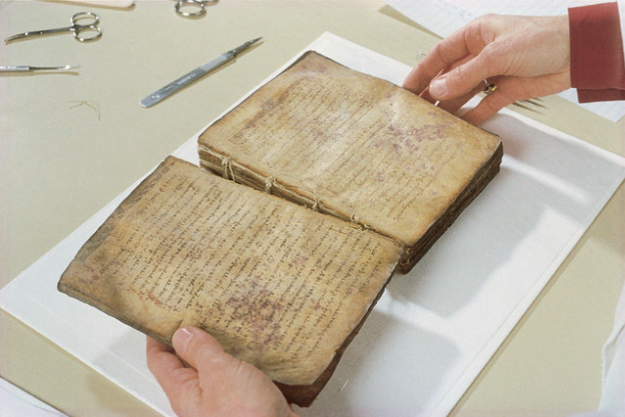
The Archimedes Palimpsest: Unbinding the Manuscript. (Walters Art Museum)
The Incredible Journey of the Archimedes Palimpsest
The Archimedes Palimpsest is a 10th-century Byzantine Greek manuscript that was overwritten in the 13th century with a Christian liturgical text. This practice of creating a palimpsest, or a reused manuscript, was common in the Middle Ages due to the high cost of parchment. The original text, containing several of Archimedes’ treatises, was scraped away to make room for the new prayers. For centuries, the hidden genius of Archimedes lay dormant beneath the religious text.
The manuscript’s journey is as remarkable as its contents. After its creation, it was housed in the Mar Saba monastery in the Judean desert. It was later moved to Constantinople, where it was photographed in 1906 by the Danish philologist Johan Ludvig Heiberg, who recognized its importance. After disappearing for decades, it was eventually sold at auction in 1998 to a private collector who generously made it available for study at the Walters Art Museum in Baltimore.
A Fortuitous Discovery in Blois
The recently identified page, folio 123, was one of three leaves that had been documented in Heiberg’s 1906 photographs but were later found to be missing from the manuscript. Its rediscovery at the Musée des Beaux-Arts in Blois was not the result of a systematic search, but rather the sharp eye of a specialist who recognized, among the loose leaves of an art collection, a fragment that scholars had been seeking for decades. Gysembergh was able to confirm the identification beyond any doubt by comparing the folio with the original Heiberg photographs, now preserved at the Royal Danish Library in Copenhagen. One side of the page contains a largely legible passage from Archimedes’ work, partially covered by a medieval prayer text, while the other side is obscured by a 20th-century illumination of the Prophet Daniel surrounded by two lions, reportedly added around 1942 by a former owner who may have been unaware of what lay beneath.
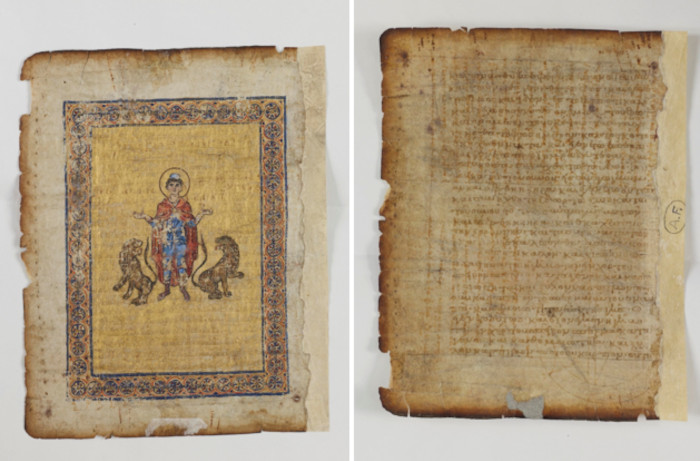
The lost page of the Archimedes Palimpsest, showing (left)an illumination of the Prophet Daniel and (right) the text side of the rediscovered folio, with the faint writing of Archimedes visible beneath the later liturgical text. (© Blois, Musée des Beaux-Arts, Inv. 73.7.52. Photography IRHT-CNRS)
Unlocking Ancient Secrets with Modern Technology
The discovery of this lost page opens up new possibilities for research. Subject to the necessary authorizations, Gysembergh plans to conduct imaging campaigns within a year, using a multispectral approach combined with synchrotron-based X-ray fluorescence analysis. These methods, far more powerful than those available during the initial study campaign in the early 2000s, could penetrate the layers of 20th-century paint and reveal the ancient text beneath without damaging the delicate parchment. Similar techniques have been used to reveal hidden texts in ancient manuscripts across the world, and the results have often been remarkable.
This new research could not only reveal the full text of the lost page but also lead to a re-examination of the entire palimpsest with the latest technology. This could improve the reading of passages that remained illegible during the initial studies in the early 2000s. The ongoing story of the Archimedes Palimpsest is a testament to the power of modern science to unlock the secrets of the ancient world, revealing the incredible intellectual achievements of figures like Archimedes and shedding new light on the history of ancient Greek science and technology.
Top image: The Archimedes Palimpsest undergoing analysis to reveal its hidden text. Source: The Walters Art Museum
By Gary Manners
References
Carvajal, G. 2026. A Lost Page of an Archimedes Manuscript Is Found, with an Enigmatic Image Added Over the Ancient Text. Available at: https://www.labrujulaverde.com/en/2026/03/a-lost-page-of-an-archimedes-manuscript-is-found-with-an-enigmatic-image-added-over-the-ancient-text/
CNRS. 2026. Lost page of the Archimedes Palimpsest identified in Blois, central France. Available at: https://www.cnrs.fr/en/press/lost-page-archimedes-palimpsest-identified-blois-central-france