
Introduction
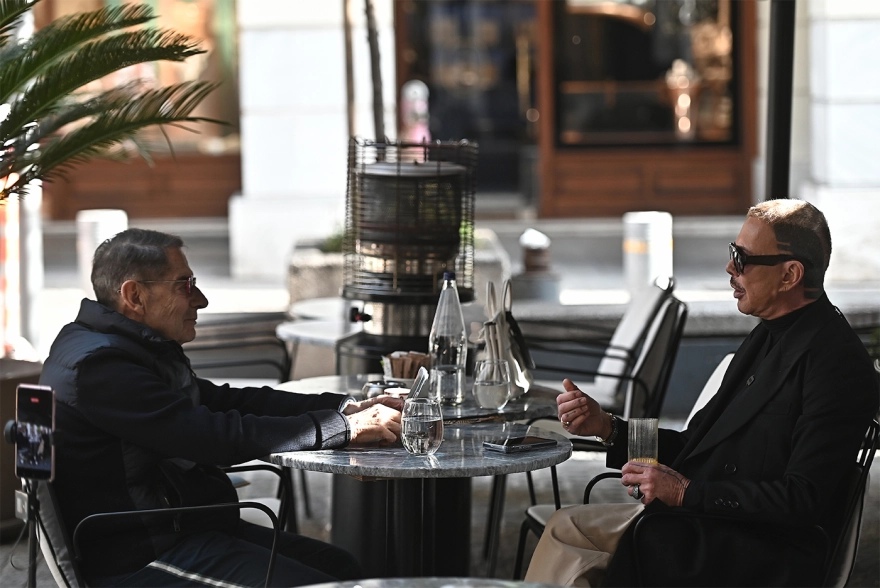
I decided to skip politics, politicians and history and turn instead to fashion. And who better than Lakis Gavalas?
A man of many faces. Everything packed into one personality. Both the tavern and the glamour. Both the port and the salon. Passionately in love with a woman at times—and with men as well. Incredible. And brutally honest. He has nothing left to lose.
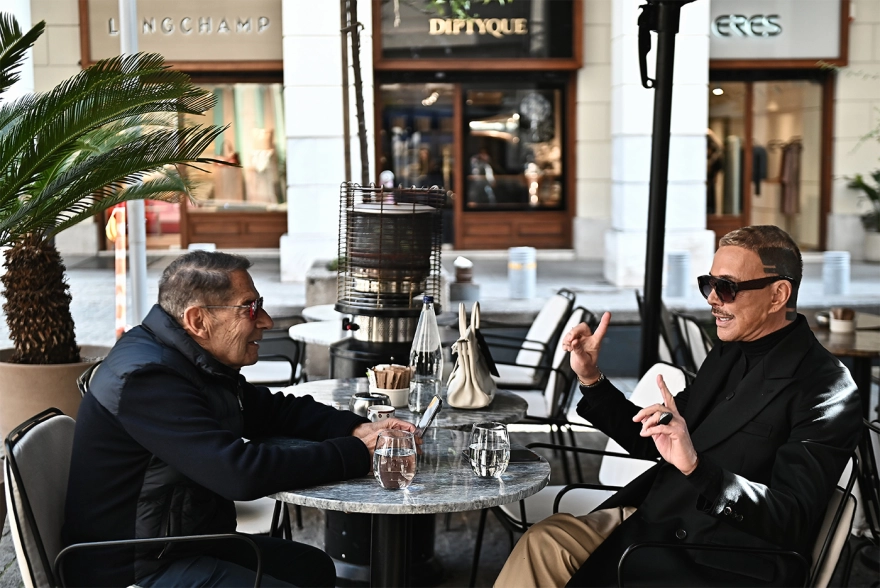
He arrived at our meeting wearing a long Comme des Garçons jacket (from Japan) and Zara trousers. That’s him. Contrasts attract. It’s a matter of style—and he carries it naturally, almost at a cellular level.
I wore a hat too. He liked it.
“Who designed it?” he asked.
Aspa Xydaki, I told him.
“Great. I’ll interview her.”
The moment I turned on the recorder he burst out like a torrent. And what didn’t he say…
“I adore women.”
“Greece is a disgrace in every phase.”
“I’ve been a prisoner all my life.”
“I lost everything, I gained everything.”
And his self-awareness:
“Maybe it was for the best that they took everything.”
And his certainty:
“I’m still a stud—nothing discourages me.”
“I used to be all-powerful. The whole lifestyle scene was in my hands.”
“I thought I was the water, the electricity and the antibiotic.”
“From a 2,000-square-meter villa, I now live in a 150-square-meter apartment.”
And his roots:
“Remember this: Lakis is a working-class kid from Korydallos.”
I present him to you: Life lessons by Lakis Gavalas.
Dimitris Danikas: Tell me, Lakis—could you live in Iran?
Lakis Gavalas: I’ve actually been to Iran. I danced there in 1973. I was in Beirut at the Casino du Liban and went with the ballet troupe to perform in Tehran. We were six people touring. I was a dancer—that’s part of my story.

Danikas: But now?
Gavalas: Military style suits me very well. I’d be fine. Why Tehran? Isn’t there a war here in Greece every day? First of all, a war of style. Zero style. Zero culture. People don’t know which theatre to go to, how to eat, what to eat, when to eat.
So yes—there’s a war here too. A war of style.
Danikas: Was prison the worst moment of your life?
Gavalas: No. I’ve been a prisoner my whole life—in my own discipline. That’s harder than a prison cell. Discipline means waking up in the morning and asking myself: how will I improve today? What are my responsibilities? What will give me joy?
I also have responsibilities to myself: to be polite, to share the knowledge I’ve gained.
After all, I teach 148 students.
Danikas: Where?
Gavalas: At IEK ALFA in Athens, Piraeus and Thessaloniki, and also at the University of Central Lancashire in Cyprus. I teach Business in Fashion—styling, tailoring, trends.

My classes are supposed to be three hours but I never do less than four. And I take students outside the school too—to stores, to meet designers, to interview them.
Danikas: What gives you pleasure?
Gavalas: Shopping. Going to shows and galleries and getting inspired. I collaborate with galleries now as well.
And sometimes I see artists making works out of recycled materials. So when I see someone collecting things from garbage bins in Athens I joke and ask: “Excuse me, are you an artist?”
Because sustainability and recycling—these new words—sometimes sound pretentious, but they do produce something good.
Yes, I’m a shopaholic. Someone who loves buying things.
Danikas: Who are the best designers?
Gavalas: The Japanese—by far. Now the Koreans are incredible too. Then the French.
I parody haute couture. I wear it backwards, tie it differently. I don’t wear it the way a typical lady would.
Even today I still work as a buyer for stores in Thessaloniki, Halkidiki, Costa Navarino and the Mandarin Oriental.
Danikas: And yet you lost everything.
Gavalas: Yes—and maybe that was lucky. Imagine today if I still had 300 employees. How would I pay them? Businesses were making less than 2% profit. Maybe it was better that they took it all.
He talks about the huge building in Kantza that once housed his fashion empire. It cost him €66 million, but was later auctioned for just €9 million.
“I was all-powerful back then. I had all the companies, the whole lifestyle world in my hands.”
He blames the Greek state for the collapse of many businesses.
“When customers stopped buying, they told me to take back the merchandise. And the state still demanded VAT—even though nothing was selling.”
“Shops are closing everywhere. Go look at Kolonaki—bars and souvlaki places everywhere. No proper merchandise anymore.”
Danikas: How’s your love life?
Gavalas: Very good. I have a steady relationship and a flirt.
Danikas: At the same time?
Gavalas: Just one flirt that interests me.
He describes himself as someone who can enjoy both humble taverns and glamorous parties.
“I grew up in Korydallos listening to Tsitsanis and Moscholiou with my father. Sometimes I go to taverns just to sing those old songs.”

For Gavalas, style is important only initially.
“If someone has good body language and behaves well, I don’t care if their clothes are expensive.”
He even says he finds many wealthy women in Athens lacking style, while sometimes someone in a modest neighborhood like Exarchia can have a striking personality.
At 18 he moved to Italy after being discovered while dancing in a theatre in Athens.
He danced on Italian television with Raffaella Carrà.
Later he worked in Paris with Jewish merchants styling their shops.
After nearly ten years abroad he returned to Greece and entered the fashion business.
“I started as an artist but became a merchant—just like my father wanted.”
Speaking about modern fashion culture, he criticizes celebrity influence.
He calls Kim Kardashian “ridiculous” and says young people may get the wrong idea from such figures.
He also talks about reality shows like Greece’s Next Top Model, where he has worked as a judge.
He believes modern relationships are changing.
“You see groups of men alone with their phones and groups of girls alone. When will they meet each other and hold hands?”
“People satisfy themselves through the internet.”
He says online sexuality and platforms like OnlyFans have transformed relationships.
Gavalas ends the interview with harsh criticism of Greek society.
“Greece is a disgrace in every phase. People think they’re something when they’re nothing.”
He says real cultured people stay home, read books, light a fireplace in winter and enjoy simple gatherings with friends.

After once living in a 2,000-square-meter villa, he now lives in a 150-square-meter apartment with three dogs and a cat.
But despite everything, he says he feels free.
“I’m free now. I fly everywhere like a bird.”
Ask me anything
Explore related questions