
The deepening of relations between Greece and Armenia was highlighted by the president of Armenia, Vahagn Khachaturyan, in an interview with Kathimerini’s “K” magazine. Ten years since the last visit by an Armenian head of state, Khachaturyan paid a three-day visit to Athens, during which he presented his vision for transforming his country into an energy and trade hub, in an event at the Grande Bretagne Hotel.
In an interview, hours after the signing of a memorandum of cooperation between the Acropolis Museum and the History Museum of Armenia, Khachaturyan referred, among other things, to the TRIPP trade route (Trump Route for International Peace and Prosperity), while stressing that the training of Armenian officers at Greek military academies should continue.
The last visit by an Armenian head of state to Greece took place in 2016. How have bilateral relations evolved over the last decade, and what are the objectives of your visit?
It is not I who established relations between Greece and Armenia, but it is our people who decided that this is our history and our destiny. Today, we have the opportunity to talk about substantive issues and present our concerns. In this regard, the meetings have actually succeeded. And of course, if you come to Athens, you must also interact with the culture that Athens represents. It may seem usual for you because you live here. But for us, it is something extraordinary and very important.
Your government has set a strategic goal of transforming Armenia into a regional energy and transit hub, as part of the TRIPP project, which aims to interconnect infrastructure and energy networks with neighboring countries. How will this affect Armenia’s role in the region?
We have always been interested in the energy sector and in our region’s role as an energy hub for Europe. It is no secret that until recently, we faced certain challenges. Three years ago, Azerbaijan presented its plans to export green energy to Europe, without including Armenia. I remember very well that in 2024, at the “Global Gateway Summit,” where these issues were discussed, I raised in my statement the issue of Armenia’s participation. And the EU leadership approved it. [European Commission president Ursula] Von der Leyen in particular said: “Indeed, we need to support Armenia to also participate.” These are real opportunities for us, and the TRIPP project provides for energy cooperation.
Armenia has great potential for these purposes. We have a surplus of green energy and are looking for ways to utilize it. We have increased our solar capacity almost tenfold, already reaching 16% of our energy balance, a target we had set for 2030, but we have reached it already.
‘[There] are groups of people who prefer the historical memory for their action. Memory is important … but this should not hinder us from being pragmatic’
Government policies were so attractive that the private sector was very fast embrace it. However, we now face a practical challenge: In the summer, we do have solar energy, but we do not have storage capacity. We will have to limit the operation of thermal power to use solar energy. However, this is an issue that can be resolved.
Based on Prime Minister Nikol Pashinyan’s doctrine of “real Armenia,” where patriotism and historical symbolism are separated from the concept of “historic Armenia,” how do you define modern Armenian identity?
I have spoken partially about this with the president of the Hellenic Republic. These are groups of people who prefer the historical memory for their action. And memory is important; it will not be forgotten, no one can be forced to forget, but this should not hinder us from being pragmatic. Real life has its own demands. Historical memory should not prevent us from pursuing development and prosperity for our countries. The key is to combine the two.
There is no point in looking for someone to blame or for treason. Every citizen is a patriot of their country. Personally, I do not allow myself to make stereotypical assessments. There are different opinions and different assessments of the situation. What matters is political responsibility. Eight or nine months ago, no one could have imagined that we could initiate a peace agreement with Azerbaijan, but with international support, we managed to move forward.
In August 2025, a 17-article peace agreement was signed between Armenia and Azerbaijan, which provoked internal reactions. How are the balances in the region shaping up?
Nowadays, there is a real and visible possibility for lasting peace in the region. For over a year, there has been no shooting at the border, but rather we have started trading with each other, and representatives of civil society meet in Baku and Yerevan.
Recently, a delegation from Azerbaijan crossed the border from the part that has been delimited, and a big gathering happened in Armenia. Similar initiatives, even with the participation of European countries and young people have progressed smoothly and without problems. These are tangible signs of progress.
I am not saying that we need to relax, and we still have people internally who are pessimistic and have other opinions and perspectives for the future of the country. The important thing, however, is that everything is done openly and publicly. There is no secrecy. There are different opinions, but the processes are transparent.
On January 14, the Armenian foreign minister and his American counterpart signed the framework for the implementation of the TRIPP plan. Also in January, we issued government bonds worth 50 billion Armenian drams, approximately $120 million. Demand was three times higher, reaching 150 billion drams. The final interest rate was set at 8.06%. The answer is that for the economy, political stability is very important, and also trust toward the government.
How do developments in the war in Ukraine affect Armenia’s strategy and security, given that we are seeing a shift in your country toward the EU and the US?
In fact, what is happening in Ukraine, in one way or another, affects us directly. There are about 500,000 Armenians living in Ukraine and almost 2 million in Russia. Today, unfortunately, they find themselves on opposing sides. It is not often said publicly, but it is a pain that we all feel.
That is why we do not take sides and insist on a peaceful resolution of the issue. At the same time, there is another important thing that needs to be talked about. We have reached an agreement with Azerbaijan over a very important point, which the Armenian side has avoided touching upon. We recognized each other’s territorial integrity.
I believe that a common basis is needed for resolving disputes in the post-Soviet space. Otherwise, each state could raise claims against others. The Baltic countries, for example, chose to act on the basis of clear principles, joined the European Union, and they have guaranteed security. This is the direction that should guide us. We all look forward to the finalization of the negotiations, a development that will be decisive. And when we mediate or express opinions, one should be extremely careful. The basic principle shall be one: Do no harm.
During your visit to Athens, you met with representatives of the Greek political leadership. In which areas do you see scope for further deepening Greek-Armenian cooperation?
In all areas: politics, economics, culture, science, tourism. Armenia has changed. The political objectives of our country now have new context. Therefore, now we are prepared to elevate our relations with Greece to a strategic partnership.
‘During the meeting [in Athens] a young woman asked me what she could do for Armenia. I simply replied: “Buy a ticket and come visit us”’
In the economic sector, we already have important agreements with the US and Nvidia. We are implementing a project to create an artificial intelligence center. Until recently, we were talking about investments of $500 million. Now we are speaking of billions. This is a development that requires serious preparation and absorption capacity, but it also creates opportunities, including for large companies.
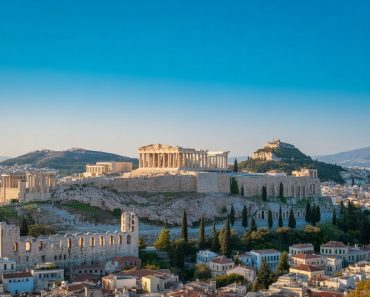
Most importantly, we have already received permission from the US to import Nvidia chips, and many companies can participate in the negotiations. Commercial activity is becoming increasingly intense. Furthermore, education and culture are also key pillars. We visited the Acropolis Museum, where a memorandum of cooperation was signed with the History Museum of the Republic of Armenia for exhibitions to be brought in. The same goes for the field of education.
Following the signing of the Military Cooperation Program between Greece and Armenia for 2026, which includes, among other things, joint training of special forces, do you believe that the two countries can further strengthen their defense cooperation?
Following the visit of JD Vance to Armenia, where he presented a super new, modern drone, something that was not accessible to us until a few months ago, the possibilities have expanded. There are now prospects in high technologies for defense, but also capacity for the space sector. Most importantly, however, we have a tradition and experience in defense. And let us not forget that many of our officers have been trained in Greece. It is a continuous process. And the alumni who graduated from Greece are very much respected in our army. Therefore, we have to continue it.
Your schedule also included a meeting with the Armenian community in Greece. What role do you attribute to the Armenian diaspora in preserving national identity, and what message would you like to convey to the younger generation of Armenians living in Greece who have not visited Armenia?
We are particularly pleased that there are now daily direct flights between Athens and Yerevan, taking just three hours. During the meeting, a young woman asked me what she could do for Armenia. I simply replied: Buy a ticket and come visit us. We have also made special agreements regarding visas. And this allows people from Armenia to go and travel the world, and also allows people to visit Armenia.
The meeting with the community was very important. There were expectations and questions, mainly about the internal political situation, the borders, and our relations with our neighbors, especially Turkey and Azerbaijan.