
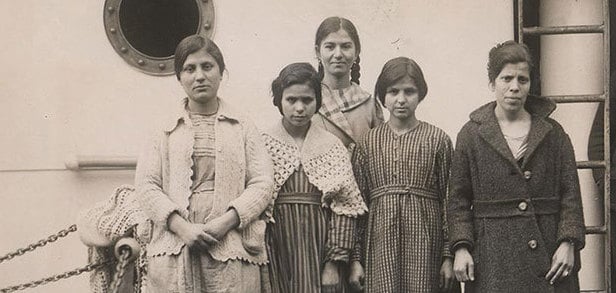
Greek-American scholar Kathryn Vaggalis has recently untangled the complex racial identity of early Greek immigrants to the US in her research of Greek “picture brides.”
Picture brides, or women in their home country who were “matched” with a husband in the US merely through a picture, are most commonly associated with Japanese and Korean-American history. In the late 19th century, many men from Japan and Korea went to Hawaii to work on sugar plantations, and, by the early 20th century, there was a substantial Japanese and Korean community there.
Picture wives associated with Japanese, Korean Americans but were common in other immigrants groups
Soon, matchmakers began pairing up men in Hawaii with potential brides in their home country using only pictures. While most commonly associated with these groups, it was also a usual practice among the Greek immigrant community.
Vaggalis, who is a doctoral candidate in American Studies at the University of Kansas, has studied the history of Greek picture brides and the implications the practice had on the forming of Greek-American identity in the early 20th century. Many Greek picture brides met with their husbands for the first time at ports of entry like Ellis Island, using only a photograph to recognize their new spouse.
During growing anti-Asian rhetoric in the US, epitomized by the Chinese Exclusion Act, legislation passed in 1882 which banned all immigration of Chinese laborers, Japanese and Korean picture wives became the source of major controversy. Many people began framing the practice as an immigration scheme to get Japanese and Korean women into the country rather than a legitimate way of matchmaking. Critics also feared the laborers themselves would settle in the country and have children once their wives arrived.
“Incoming wives meant Japanese men were settling down and starting families. Nativists used this fact to stimulate racist fears of migrants coming to steal their jobs and rob them of American resources. They grossly exaggerated their numbers, disparaged their cultural practices and spread gross propaganda about their fertility and number of children,” Vaggalis stated.
Japan ceased distributing travel documents to such “picture brides” after pressure from the US, and the practice soon died out among Japanese and Korean women. But it continued with many European groups, with Greeks, Italians, Germans, and Armenians using similar matchmaking techniques at the same time without the same criticism aimed at Asians.
This sparked Vaggalis to question why the standards were different for the two groups. Her own grandmother, Calliope Tavoularis, came to the US as a picture bride from Greece in 1949. She wrote letters to her future husband for a short time before he bought her a plane ticket to Nebraska, where they were married. Rather than criticizing the couple, as was common with Asians, local media called theirs an “airmail romance.”
Greek picture brides not viewed in same way as Asian counterparts
Yet this wasn’t always the case for Greek immigrants. In the late 19th and early 20th century, many groups that would be considered “white” today were not then, such as the Irish, Italians, Greeks, and even Germans. Such groups, including Greeks, were even victims of discriminatory attacks from racist groups like the Ku Klux Klan during that period in time.
In fact, the Greek-American group AHEPA, or the American Hellenic Educational Progressive Association, was founded in 1922 to fight against discrimination and attacks from the KKK. As anti-Asian sentiment grew in the US and Greeks began to be viewed as “white,” Greek picture brides were described as virtuous, unlike the Japanese brides, who were viewed with suspicion.
Vaggalis also noted that the Greek family model often relied on traditional gender roles, including women staying home, which made them a model immigrant group in the eyes of some. “The biggest strategy they used is the idea that ‘we are not them,’ stressing that Japanese people were the ones to be wary of” rather than Greeks, Vaggalis explained.
Through her research, Vaggalis hopes to show that such conversations regarding race, nationality, and gender still play a prominent role in current discourse regarding US migration. “In order to have a more just system of migration, we need to recognize the ways that race and racism still shape the system and our perception of who and what is considered American.”
“To overcome our past, we must address our present wrongs,” she maintained.