
Some exhibits were provided by the Center for Research of Belarusian Culture, Language and Literature of the National Academy of Sciences, the Belarusian National Public Association of Collectors, the Belarusian Union of Artists, and the Slutsk Sashes enterprise.
Viktor Suvorov, a member of the Belarusian National Public Association of Collectors, contributed his porcelain figurines to the exhibition. “Our association has a long history of collaborating with the library. This is my fourth project here, having previously participated in exhibitions dedicated to porcelain, New Year, and lottery tickets. When asked if I had anything related to Ancient Greece, I discovered two putti figurines, a bust of Aphrodite, and sculptures of the Three Graces. According to one version, their father was Zeus, and according to another, Dionysus,” the collector said.
 According to Associate Professor Aleksei Kozlenko, a Candidate of Historical Sciences and a lecturer at the Department of Ancient and Medieval History of the History Faculty of Belarusian State University (BSU), Greece is the cradle of the entire European civilization. It is not only the oldest civilization in Europe but also the first civilization of the written word. The first European-language texts were the Iliad and the Odyssey, which originated in the mid-8th century BCE.
  Svetlana Bondarchuk, Director of the Slutsk Belts enterprise, emphasized that many geometric elements in the patterns of Belarusian folk arts, as well as elements of folk dances and music, resonate with Greece. Despite the two cultures having developed in relatively different conditions, they share a common approach to universal human milestones: family, marriage, and the birth of children. Many rituals characteristic of the Greeks can also be found in Belarusian culture.
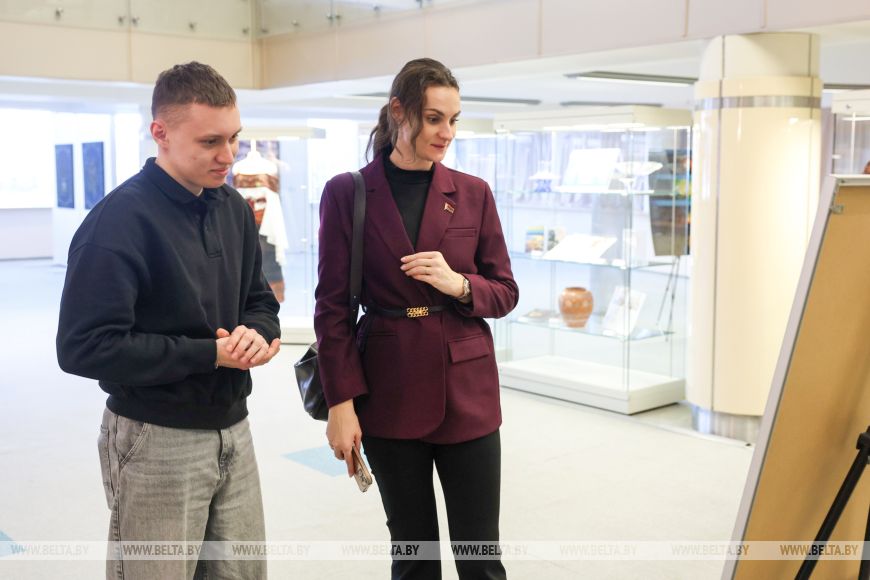
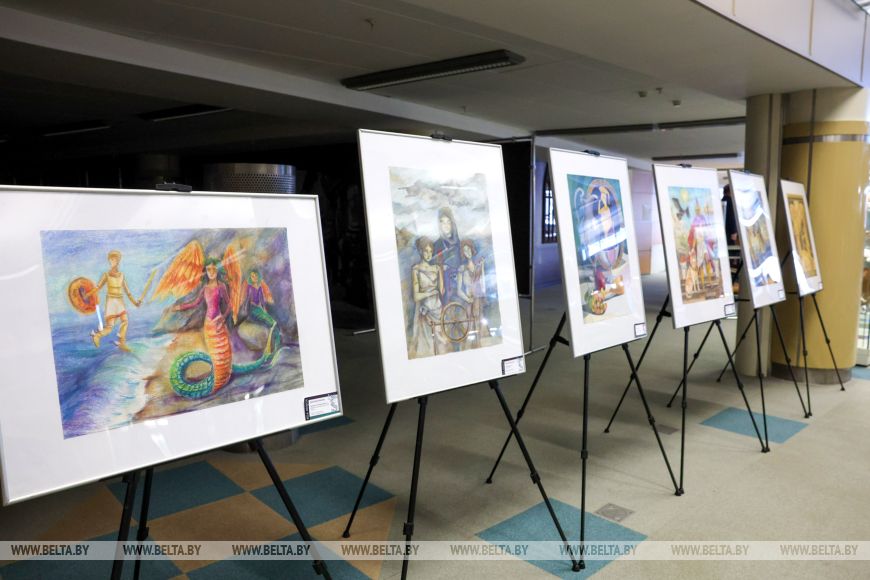 The exhibition space was complemented by contemporary artworks by students of the Minsk State Gymnasium-College of Arts, inspired by classical mythology. According to Olga Lysak, the Deputy Director for Academic Affairs of the gymnasium-college, they presented around 20 paintings, a handmade book, and ceramic works. “Belarusian folktales and Greek mythology both generate great interest among students of various ages. Of course, they read and studied specific works and created illustrations for them in collaboration with teachers who specialize in this area,” said Olga Lysak.
 The exhibition will continue through 15 May. Admission is available with a reader’s pass or a pass to the National Library’s sociocultural center.
Photos by Tatyana Matusevich