
Greek farmers’ road blockades – in protest of the government’s agricultural policies and the recent subsidy fraud scandal – will persist during Christmas week, albeit with measures to ease the strain on travellers.
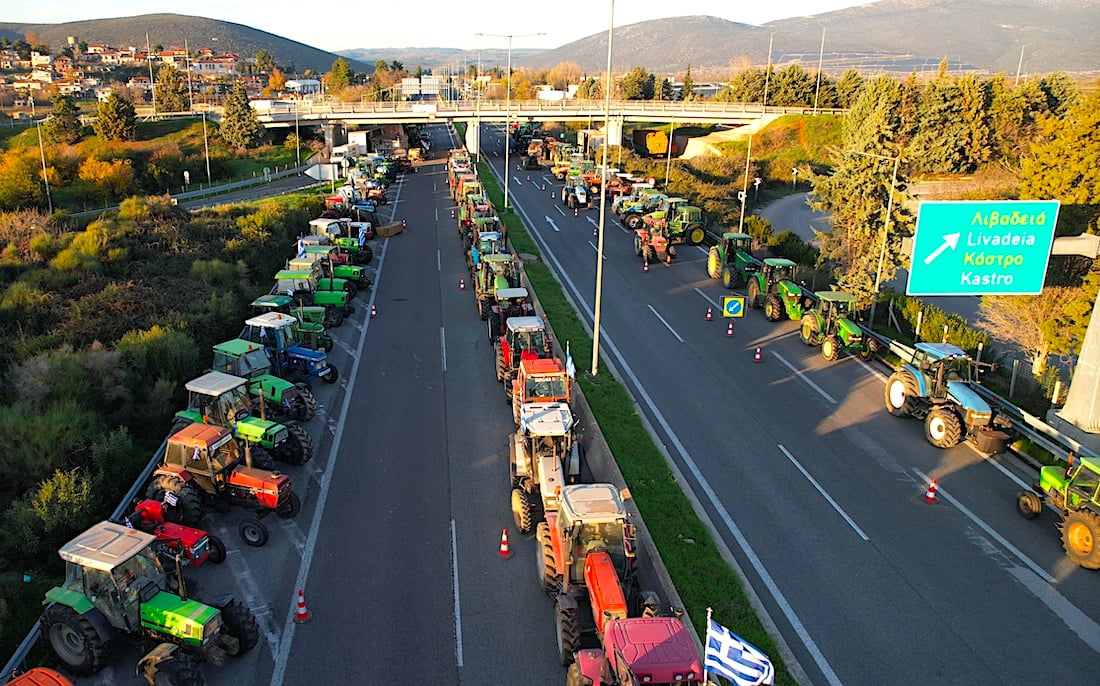
Tractors and agricultural vehicles are used since November 30 to block major roads connecting different parts of the country, most notably in the regions of Macedonia, central and western Greece, and the northern Peloponnese, as well as on big islands like Crete and Samos, following the decisions of the assemblies of local farmers’ unions.
While the vehicles will remain on the roads, they will be parked sideways to allow the passage of holiday travellers from Tuesday, December 23, the Greek public broadcaster ERT reports.
If their demands are not efficiently dealt with by then, the blockades will become harsher after the holiday, the portesters warn.
Farmers’ blockades extended and reinforced but lifted for Christmas
Thousands of tractors are lined up in protest in more than fifty road blockades across Greece.
From Friday, December 19, the blockades were expanding to country roads in some areas, in addition to the national highways, while more tractors were joining the protest.
The farmers at the Malgara blockade, outside Thessaloniki, have obstructed incoming traffic towards the city since 12 noon on Friday and will continue until December 23, while the lanes in direction to Athens have remained closed since December 1st. Just on Friday, the farmers at the site decided to allow passage for lawyers and witnesses participating in the Tempi train disaster trial, according to AMNA.
Traffic will be allowed to pass through the blockades ahead of the Christmas holiday so that everyone can travel home for the festive days.
Farmers’ symbolic moves for impacted travellers
During the weekend, the farmers in several areas will proceed to symbolic moves of solidarity for the public, such as the temporary lifting of the toll barriers near certain roadblocks, so that drivers can pass without paying a fee. In an interview with AMNA, the Greek minister of Infrastructure and Transport, Christos Dimas, estimated that the cost of the opening of the tolls by the farmers could cost the state 2.5 million euro (2.9 million USD) per day.
At some blockades, farmers will be also offering fresh produce to travellers in compensation for impacting their travel.
Major highways, border crossings, and ports have so far been heavily affected, causing travel delays, route closures, and logistical challenges for domestic and international travellers and hospitality businesses amidst the festive period.
Hellenic Train’s buses serving the Volos-Larissa connection in Central Greece were cancelled on Friday because of farmers’ blockades and following the directions of the Greek police.
Government says most of farmers’ demands are dealt with, protesters deny claim
In a Friday statement, the Greek government contends that 20 out of the 27 formal demands of the protesters have either been fulfilled or are underway being examined or discussed, while the remaining seven cannot be resolved either because they conflict with basic European regulations and the Common Agricultural Policy or because they are fiscally unfeasible.
The farmers though have denied the claim, stating that they have not received solid reassurances that their demands will be fulfilled.
Their message to the goverment is that they will not back down in their protests and go to dialogue until they see true commitment from officials in resolving their many challenges.
These include, among others, the considerable delays in subsidy payments, the high production costs, the request for the implementation of guaranteed minimum prices for agricultural products, as well as the payment of damages for the sheeppox outbreak which has continued to decimate the country’s livestock for over a year, forcing many breeding units to shut down.
On Tuesday, Prime Minister Kyriakos Mitsotakis, announced additional support of €160 million ($187.3 million) for farmers during a contentious parliamentary debate that ended with approval of the budget. The establishment of a cross-party committee was also prοposed which would work within a four-month deadline to identify problems facing farmers and producers and draw up consensual, binding proposals applicable to future governments as well.