
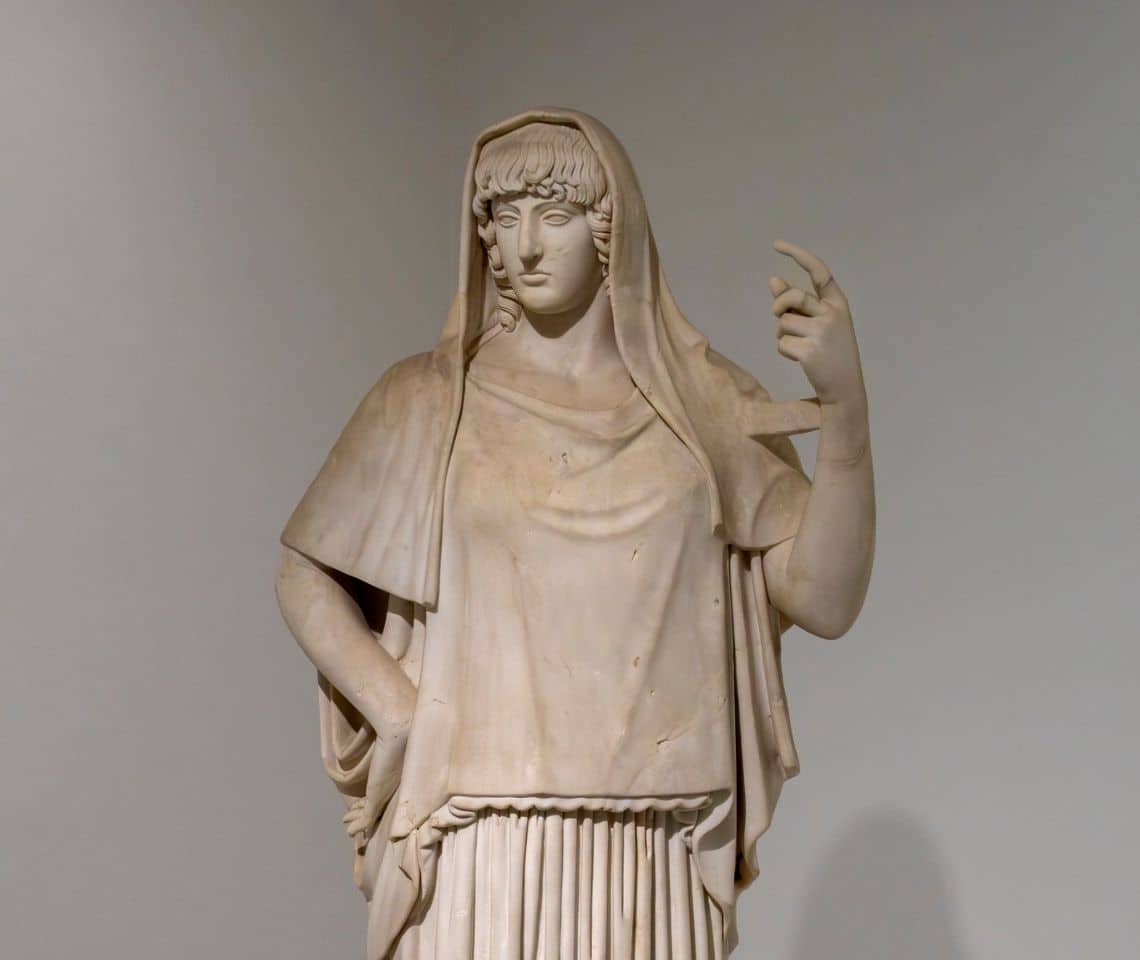
Archaeologists in western Turkey have uncovered a marble head believed to represent Hestia, the Greek goddess of the hearth, offering rare insight into ancient religious life and civic identity in the Hellenistic world.
The sculpture was found at the ancient Greek city of Metropolis (Greek: Μητρόπολις), located in İzmir’s Torbalı district. Researchers say the finely carved head once belonged to a monumental statue dating back more than 2,000 years. If confirmed as Hestia, the discovery would mark one of the most significant representations of the goddess ever found in Anatolia.
Hestia held a unique place in Greek belief. She was the goddess of the hearth, home, and social stability. Unlike other Olympian gods, she was not linked to dramatic myths or heroic conflicts. Instead, she symbolized continuity and order. Every household hearth was dedicated to her, and every public sacrifice began and ended in her name. Cities maintained an eternal flame in her honor, seen as the spiritual heart of the community.
Archaeologists in western Turkey have uncovered a marble head believed to depict Hestia, the #Greek goddess of the hearth, dating back more than 2,000 years.#GreekMythology #Archaeology pic.twitter.com/1ToACw5e1C
— Tom Marvolo Riddle (@tom_riddle2025) December 16, 2025
Found outside a temple setting
Archaeologists uncovered the marble head in an area identified as a commercial structure. The location surprised researchers, as statues of major deities are usually associated with temples or sanctuaries. The find suggests that religious symbols also played an important role in public and economic spaces.
Researchers argue that this context reflects the close interconnection between religion, commerce, and civic life in ancient cities. A statue of Hestia in such a setting may have symbolized protection, unity, and moral order in everyday public life.
Artistic clues point to the Hellenistic period
Prof. Dr. Serdar Aybek of Dokuz Eylül University stated that the sculpture’s hairstyle, facial proportions, and realistic features clearly point to the Hellenistic period, which lasted from approximately 323 to 31 BC. He also highlighted the statue’s advanced construction technique.
The head was carved from two separate marble pieces and later joined using metal clamps. Archaeologists say this method was common in large, high-quality statues of the era. Hellenistic artists favored realism, scale, and emotional restraint, all of which are visible in the sculpture.
After cleaning by conservator Didem Taner, researchers observed that the pupils of the eyes were deliberately hollowed during carving. Similar examples from ancient Greece suggest the cavities once held colored stone or glass, creating a lifelike gaze.
“The dimensions suggest that this head belonged to a monumental statue,” Aybek said. “It provides valuable evidence for the level of sculptural expertise and artistic ambition present in Metropolis during the Hellenistic period.”
Possible link to the council house

Earlier excavations at Metropolis uncovered a torso fragment inside the city’s bouleuterion, or council house. Researchers believe it depicted Hestia as the protector of civic order. Aybek said the newly discovered head appears proportionally compatible with that earlier fragment, raising the possibility that both pieces once formed a single statue.
An experimental visualization carried out by conservator Taner Özgür has helped researchers imagine the statue’s original appearance. The reconstruction suggests polished marble, light, and subtle color combined to create a calm yet authoritative presence.
A city shaped by faith and exchange
Metropolis has a history stretching back to the Neolithic period and later became an important urban center in ancient Ionia. The city is known for its theaters, council buildings, bath complexes, and sanctuaries. These remains reflect centuries of cultural exchange between Anatolian traditions and Greek influence.
Archaeological research at Metropolis began in 1989 and has been led since 2007 by Aybek. Excavations continue under Turkey’s “Heritage for the Future” initiative, supported by the Ministry of Culture and Tourism and the Sabancı Foundation.
Researchers say the discovery of the Hestia head adds a powerful chapter to the city’s story. If confirmed, the statue would stand among the most important Hellenistic finds in Turkey, offering a rare glimpse into how ancient Greeks expressed civic unity, belief, and daily life through art.