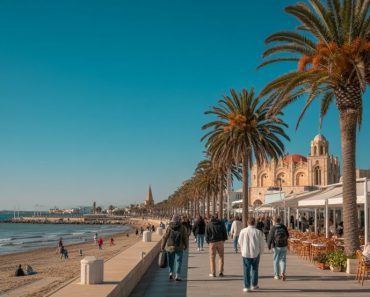


Ermou Street in central Athens has strengthened its position in the world ranking of the most expensive shopping streets by one place in this year’s annual report by Cushman & Wakefield, which records trends in the retail market. According to the survey, Ermou is now in 15th place (up from 16th last year), as rental prices have increased by 7% and now amount to 310 euros per square meter on a monthly basis, or €3,720/sq.m. annually. The increases in tourism and investments have strengthened the commercial value and image of the historic center. London’s New Bond Street has captured the top spot for the first time.
The Greek urban landscape underwent dramatic changes in the post-war period, and many cities were transformed. Living conditions clearly improved, but a significant part of their historical identity was lost. Urbanization was, and remains, a complex phenomenon.
I have in my hands the annual wall calendar published by the Association of Friends of Thessalian History, in Larissa, titled “The Buildings of Tachydromeio Square.” It reminds us, of course, of the lost tradition of wall calendars, which were collectible items – especially when issued by cultural institutions. Above all, however, it brings us face to face with the old form of Larissa, in one of its most central areas. Old postcards and photographs, some by the late Larissa-born photographer Takis Tloupas, reveal different qualities and interpretations of urban space. Had there been foresight to preserve some of the buildings depicted, Larissa would now possess a richer historical identity and greater added value in its architectural stock.
Scattered restorations of historic buildings often remind us of the multiplying effects of architecture on local pride, economic development, tourism, social cohesion, and a sense of belonging
This calendar provides an opportunity to reflect on how historical self-awareness has evolved in Greek urban centers. Even before the war, there were associations, historians, and researchers, but more organized social movements emerged after the restoration of democracy in 1974 – also known as the Metapolitefsi period – and especially after 1990. I remember that period: After the fall of the Berlin Wall, interest was reignited across Greece in reconnecting with entire historical regions and tracing Greek paths in the Balkans, the Black Sea, Asia Minor, and Egypt – a trend reflected in publications, exhibitions, lectures, and research.
These phenomena were sporadic, yet real and significant. The more the historical character of cities was destroyed, the stronger the need became for private individuals or organizations to investigate and preserve it – primarily to cultivate public awareness of the value of cultural heritage.
Today, Greek cities almost universally suffer from a lack of vision for the future. Yet scattered restorations of historic buildings often remind us of the multiplying effects of architecture on local pride, economic development, tourism, social cohesion, and a sense of belonging.
Despite the destruction of the historical character of Greek cities, there remains the possibility, on the one hand, to preserve buildings of value, and on the other, to create incentives for high-quality, contemporary architecture.