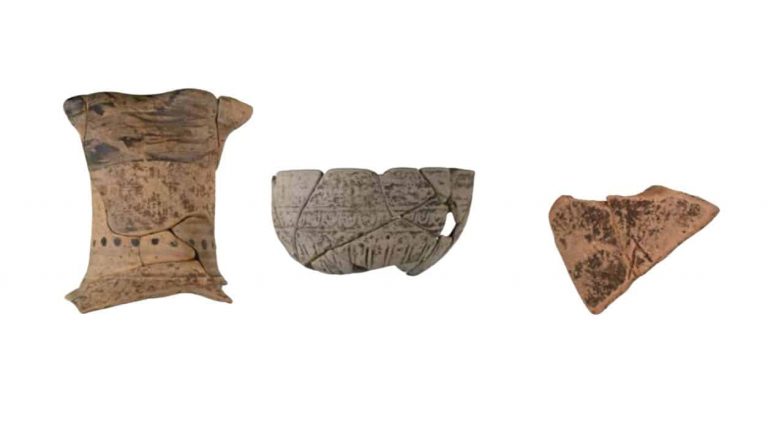
The sanctuary likely served as a place of worship where local inhabitants gathered to make offerings to the gods and participate in communal feasts.
A 2,900-year-old sanctuary has been discovered in the mountains of the Greek island of Euboea, around 50 kilometres northeast of Athens. The archaeological site sheds light on the connection between mountains and Greek gods in the religious beliefs of the ancient local population.
No traces of buildings have been found at the site. The sanctuary likely served as a place of worship where local inhabitants gathered to make offerings to the gods and participate in communal feasts.
The sanctuary was used from the ninth century BC until the first or second century AD. The first traces of its existence were discovered in 2025 by a team led by Chloe Choseau, an archaeologist at the Swiss School of Archaeology in Greece and director of the excavations.
“We know that religious life in ancient Greece was not limited to large temples and urban sanctuaries. Mountain sanctuaries are frequently discovered during archaeological excavations across Greece. The problem is that these sanctuaries often leave very few archaeological traces, and sometimes there are no visible structures at all, making them particularly difficult to identify,” the archaeologist explained.
A large quantity of pottery was uncovered at the sanctuary, with the oldest specimens dating back to the ninth century BC. This suggests that the site was visited for several centuries, possibly even more than a millennium.
The sanctuary was primarily used by inhabitants of the nearby ancient city of Eretria. Situated on the summit of a remote mountain, the site required considerable physical effort to reach.
“The final part of our ascent involves a hike of approximately three kilometres with an elevation gain of 650 metres,” Choseau said.
Closer to the gods
The challenging ascent raises questions about the spiritual significance of the mountain.
“People were willing to devote considerable time and energy to reaching these places, and in our case, this appears to have continued over several generations,” the archaeologist said.
In ancient Greek mythology, the immortal gods were believed to inhabit the summit of Mount Olympus, which rises to around 2,900 metres between Thessaly and Macedonia in northern Greece. By comparison, the mountain on the island of Euboea reaches nearly 1,100 metres.
The belief that Mount Olympus in northern mainland Greece was the dwelling place of the gods dates back to the poems of Homer and Hesiod, composed around the eighth century BC.
“In antiquity, Eretria had a very rich religious life, with sanctuaries both within the city itself and throughout its territory. Mount Olympus dominates much of the surrounding region, and its prominent location probably played a role in the choice of this site,” Choseau explained.
Although no altar has yet been discovered at the sanctuary, it may have been dedicated to Artemis, the goddess of nature, as suggested by an ancient inscription mentioning “Artemis Olympia”.
Excavations also uncovered sheep and goat bones, some bearing traces of burning – evidence of animal sacrifices and ritual feasts. | BGNES
—–
Lauren Bruncher, Slate
Story via the original publisher. Read the original article