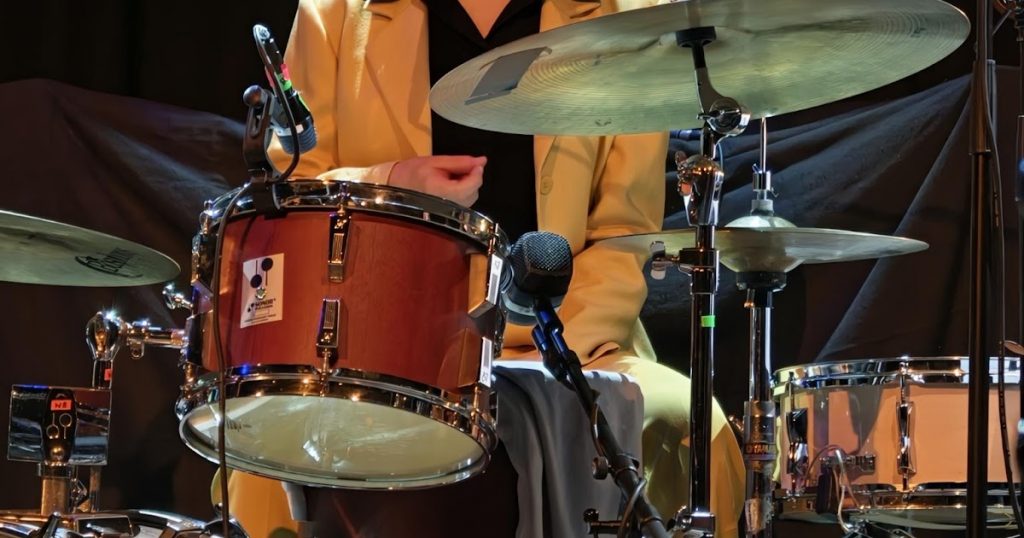
The program of the 40th edition of the Austrian Music Unlimited festival was
curated by Brazilian, Berlin-based prolific drummer, vocalist, and composer
Mariá Portugal, who shaped it with a clear mission: to shed light on the
often-overlooked diverse and creative music scenes of South America, with a
cryptic, poetic title: The Navel of the Dream (“to listen to the music of
the question, of the next question, the one that does not yet exist. From
there, perhaps, we can look deep into the eye of the navel of the dream”).
Portugal, who already curates the concert series Toma Chocolate in Berlin
focusing on South and Latin American expat musicians in Berlin, is known for
her duos with Fred Frith, Angelika Niescier, Marta Warelis, the trio Endless
Breakfast, the quartet Monster, and in Mats Gustafsson’s Fire! Orchestra and
Fire! Trio.
 |
| Mariá Portugal |
Portugal explained her approach to improvisation and curating: “I personally
understand improvisation as a form of composing. In this sense, I’m very
(Edgard) Varèsian: for me, music is organized sound. And I always like to
add that when we listen to music or sounds in this environment, we are
potentially composing as well, because we are actively organizing what we
hear. I also understand curating as a form of composing – bringing ideas,
thoughts, and feelings into a musical form”. In her opening speech, she
added that by celebrating and embracing diversity and many forms of
differences, we – the festival’s community of musicians and audience – offer
an act of resistance.
Thursday, Nov. 5
The festival was extended to four days and began with two performances. The
New York-based sound artist, electronics player, and flutist Ka Baird used
her body, covered with mics, as an imaginative sonic garden, transforming
Laurie Anderson’s pioneering sonic inventions into a much more visceral,
restless but very poetic, moving – literally, and even ecstatic form of
articulation, liberation, and physical exertion.
The French percussion trio OTTO – Camille Émaille (a disciple of Fred Frith,
Roscoe Mitchell, and William Winant), Pol Small (who explored traditional
Turkish and Greek music), and Gabriel Valtchev (of Bulgarian roots), played
the traditional Bulgarian tapan double-headed drums, gongs and other
percussive devices. The trio offered a tight form of hypnotic pulses woven
into a deeply captivating, trance-like set that morphed patiently with
nuanced shifts until its ecstatic, cathartic coda.
Friday, Nov. 6
The evening began with Portugal’s Berlin-based Erosão Percussion Trio, with
Mexican drummer-percussionist Emilio Gordoa and German drummer-percussionist and electric
bassist Burkhard Beins, which released its debut self-titled album this year
(Kassiani/Fun in the Church). This trio suggests experimental percussive
adaptations of Brazilian traditional rhythms and some of the Brazilian
classic songs by Antonio Carlos Jobim and Caetano Veloso, delivered by
Portugal’s suggestive, deeply emotional vocals. This set focused on the
stimulating tension between Portugal’s sensual and direct rhythmic approach
and the contrasting, more inquisitive and experimental, timbre-oriented one
of Beins and Gordoa, which played with sound and pulse as a tactile,
vibrant, often noisy material, always searching for new, uncharted sonic
territories.
The Sleep Of Reason Produces Monsters – British turntable wizard Mariam
Rezaei, Danish alto sax player Mette Rasmussen, Italian trumpeter and
electronics player Gabriele Mitelli, and Viennese drummer Lukas König – is
called after a famous painting by Spanish painter Francisco Goya, and
visited the festival during its European tour promoting its sophomore album,
Reason (Corbett vs. Dempsey). It offered a hyperactive, uplifting
celebration of psychedelic, kaleidoscopic, genre-defying sounds that created
a deeply compelling, free improvised yet organically flowing, intense sonic
storm. This great quartet offered rituals of resistance (as the opening
piece of Reason is titled) that defy all familiar notions of linear forms of
structure and form.
The evening ended with the duo of American spoken word artist and poet Moor
Mother (aka Camae Ayewa) and Panamanian-born trumpeter and electronics
player Aquiles Navarro, both of whom are playing in the Irreversible
Entanglements quintet. It was a deeply immersive, spiritual, poetic, and
surprisingly optimistic set, highlighted by Moor Mother’s commanding,
mythical chants about the coming “winds of change” and “wind of compassion”,
enforced by collective, attentive breaths, complemented by Navarro’s
inventive, ritualistic sounds.
 |
| gabby fluke-mogul |
In between, Peruvian vocalist, guitarist, and electronics player Alejandra
Cárdenas (aka Ale Hop) presented her most personal and ambitious work to
date, A Body Like a Home, focusing on the tragic history of Peru, and
accompanied by guitarist Ignacio Briceño and American violinist gabby
fluke-mogul. The burden of delivering complex and detailed texts on the
painful history of Peru, playing the electric guitar, and paying attention
to the intractable knobs of the modular synth rarely synchronized, but we
were able to enjoy some inspired solos of fluke-mogul and Briceño.
Saturday, Nov. 7
 |
| Aram Abbas |
The afternoon performances at the local conservatory began with a solo set
by French-Syrian Aram Abbas, who explored the surprisingly, almost
orchestral yet heavily noisy palette of the electrical, static sounds of the
no-input mixer. He connected assorted cables from the mixer to other devices
and triggered suggestive loops, abstract melodic threads, and other
subversive noises, all cleverly organized into insightful, exploratory, and
highly addictive, dense textures.
The Viennese BRRRDS+Y quartet lacked its sick leader, Maja Osojnik, but the
remaining trio of flutists Christine Gnigler and Sara Zlanabitnig, and
modular synth and electronics player Milena Georgieva offered a convincing
case of the collective process of expanding and mutating the resonant,
ethereal breaths of the flutists into a tangible sonic material that can be
enriched by the live electronics. This quartet just released its impressive
debut album, Glashaus (Mamka).
The evening began with Portugal’s Erosão Septet – Danish sax player Lotte
Anker, German sax player Angelika Niescier, trombonists Matthias Müller and
Moritz Wesp, tubaist Carl Ludwig Hübsch, and double bass player Reza Askari
– which was presented by Portugal as a sonic lab exploring the Brazilian
traditional rhythmic patterns, deliberately attempting to subvert the
conventional format of a pop or jazz performance. The septet suggested a
different dynamic of the Erosão Trio, and quite a thought-provoking one. It
contrasted Portugal’s deeply emotional, sensual, and quite meditative vocal
and percussive delivery with the much freer, unsentimental, and often fiery
or subversive reflections of the European schools of free improvisation.
Still, this set reached its emotional climax when Portugal invited Brazilian
vocalist Ilessi and the members of the Marcelo Galter trio to sing with her
the classic song “Juízo Final” (Final Judgment) by Brazilian
singer-songwriter Nelson Cavaquinho, with an imaginative arrangement of the
septet. Perhaps, if borrowing Portugal’s text for photographer Petra
Cvelbar‘s new (and highly recommended) book, In Women’s Hands, may capture
the dynamic of this septet. Portugal imagines herself, as a woman and
artist, as a Kintsugi (the traditional Japanese art of repairing broken
pottery) artifact, “constantly being distorted and reorganized. I would like
us to reach a point where we see ourselves as these carefully assembled
cracked pieces of ceramics, in all our multiplicity and complexity, in all
our contradictions and humanity”.
 |
| Cansu Tanrıkulu |
The quartet Marmalsana – Egyptian guitarist and sound artist Maurice Louca,
Lebanese acoustic bass guitarist Tony Elieh, German percussionist Burkhard
Beins, and the new addition, Turkish-born, Berlin-based vocal artist and
clarinetist Cansu Tanrıkulu – performed a criminally short, but one of the
best of this year’s festival. Marmalsana released its debut, self-titled
album as a trio, without Tanrıkulu (Ruptured, 2024), that stressed its
compelling aesthetic – abstracting Middle Eastern exotic themes and hypnotic
pulses through experimental timbral searches and deep-listening collective
improvisations. The highly nuanced and introspective chamber performance had
an immediate yet elusive, story-like quality, enjoying the profound rapport
of these imaginative and resourceful improvisers.
In between, the Brazilian piano jazz trio of pianist Marcelo Galter, double
bass player Ldson Galter, and percussionist Reinaldo Boaventura, in its
first-ever European performance, introduced the rich musical legacy of
Bahia, augmented by the more experimental vocalist Ilessi (whose name means
House of Being in Yoruba). This playful and likeable set featured music from
Galter’s latest album Marcelo Galter Investiga A Beleza Sem Fim De Dorival
Caymmi (Marcelo Galter Investigates The Endless Beauty of Dorival Caymmi,
Rocinante, 2026). The festival’s program presented Chinese-born,
Brooklyn-based Otay:onii (aka Lane Shi) as an experimental artist whose art
corresponds with such groundbreaking artists like Diamanda Galás, Meredith
Monk, Joanna Newsom, and Björk, but her performance provided more
pyrotechnic visual sparks and thin, substantive musical moments, until its
last moments, when she flirted with dense techno pulse.
Sunday, Nov. 8
 |
| Susana Gartmeyer |
The afternoon sets of the fourth and last day of the festival were at the
pastoral Bildunshaus Schloss Puchberg. The first set was by Viennese bass
clarinetist Susana Gartmeyer (of the Monster quartet, So Sner duo, and the
Vegetable Orchestra), who masterfully explored the resonant acoustic
architecture of the beautiful setting while building her own layered and
polyphonic architectures of breaths and deep-toned, resonant sounds that
sounded deeply emotional and thought-provoking at the same time. Gartmayer
is about to release her long-anticipated solo album Speicher (Memory) on
Relative Pitch next month.
The duo Agua Dulce (Fresh Water) – Peruvian, Berlin-based cajón player Laura
Robles and guitarist and sound player Alejandra Cárdenas (aka Ale Hop)
offered a playful and imaginative combination of Afro-Peruvian traditional
rhythms and experimental sonic flights. Robles’ humour balanced Cárdenas’
uncompromising and dead serious approach, and without the burden of vocal
delivery, Cárdenas introduced an original language of extending the sonic
palette of the electric guitar through a modular synth and various
electronic effects.
The evening program began with Toma Chocolate! Ensemble, an extension of the
concert series Portugal curates at the Berlin club Sowieso, focuses on South
and Latin American musicians with the idea of offering a space for musical
exchange beyond stylistic and geographical boundaries. This ad hoc ensemble
featured cajón player Laura Robles, who composed a graphic score for the
ensemble; Argentinian tenor sax player Camila Nebbia, Brazilian flutist and
sound artist Marina Cyrino, Cuban-Belgian percussionist and trumpeter Lázara
Rosell Albear, Argentinian cellist Paula Sanchez, Brazilian vocalist Illesi,
Mexican percussionist Emilio Gordoa, and Panamanian-American trumpeter
Aquille Navarro. Naturally, it was impossible to create a collective, mostly
free improvised textual space for such a varied and uneven ensemble, but
this performance suggested some poetic solos of the most experienced
improvisers – Nebbia, Sanchez, Gordoa, and Navarro.
 |
| Marta Warelis |
The free improvising duo of Polish, Berlin-based pianist Marta Warelis and
German, Cologne-based alto sax player Angelika Niescier was one of the best
of this year. Niescier opened the set with a typical powerful and passionate
solo, soon abstracted by Warelis into a refined, lyrical, and deeply poetic
statement. Warelis and Niescier seamlessly steered the attentive and
emphatic dialogue between free jazz, free improvisation, and subtle sonic
experiments, balancing between imaginative forms and urgent freedom and
between risk-taking and loose compositional themes. They flowed with their
instant, constantly shapeshifting compositions, with captivating, poetic
elegance that never surrendered to technical virtuosity. Free improvisation
at its most inspiring and highest form possible.
The last performance was by the international, Berlin-based sextet Banquet
of Consequences, led by Italian double bass player and composer Antonio
Borghini and featuring Japanese pianist Rieko Okuda, British reed player
Tobias Delius, French reed player Pierre Borel, Turkish cellist Anil
Eraslan, and Australian drummer Steve Heather. The sextet released its
second album last year, Resta chi va (We Insist!), which solidified the
passionate way this ensemble celebrates and subverts melodic compositional
themes, with free improvisation and swings – literally – between formal
tradition and joyful, Dadaist chaos and humour. Borghin’s compositions
allowed generous, spontaneous freedom for its opinionated voices. It sounds
like a well-rehearsed, happy and energetic ensemble, eager to push all
boundaries and genre conventions.
Story via the original publisher. Read the original article