NOVEMBER 23RD:
On this day in 1996, Irene Skliva of Greece was crowned the 46th Miss World at the annual pageant held in Bangalore, India. Earlier that year, she had earned the title of Miss Hellas at the Miss Star Hellas competition. Just 18 years old at the time, Skliva was stunned by her victory. “I had the feeling it was just another rehearsal,” she recalled. “In one rehearsal, they used me as the mock winner.” The 1996 Miss World pageant was overshadowed by weeks of protests from groups who argued that the competition demeaned women and undermined India’s cultural traditions. Demonstrations intensified in the days leading up to the event, with clashes between protesters and police. One protester died after setting himself on fire, while others threatened similar acts. Despite the controversy, the competition went ahead, and Skliva made history as the first Greek woman to win the Miss World crown, a distinction she holds to this day. After completing her Miss World duties, she returned to Greece, where she pursued a career in television and modeling. She appeared on the covers of numerous Greek magazines, including Diva and LipStick, and participated in fashion shows in Athens, Milan, and Munich.
NOVEMBER 25TH:
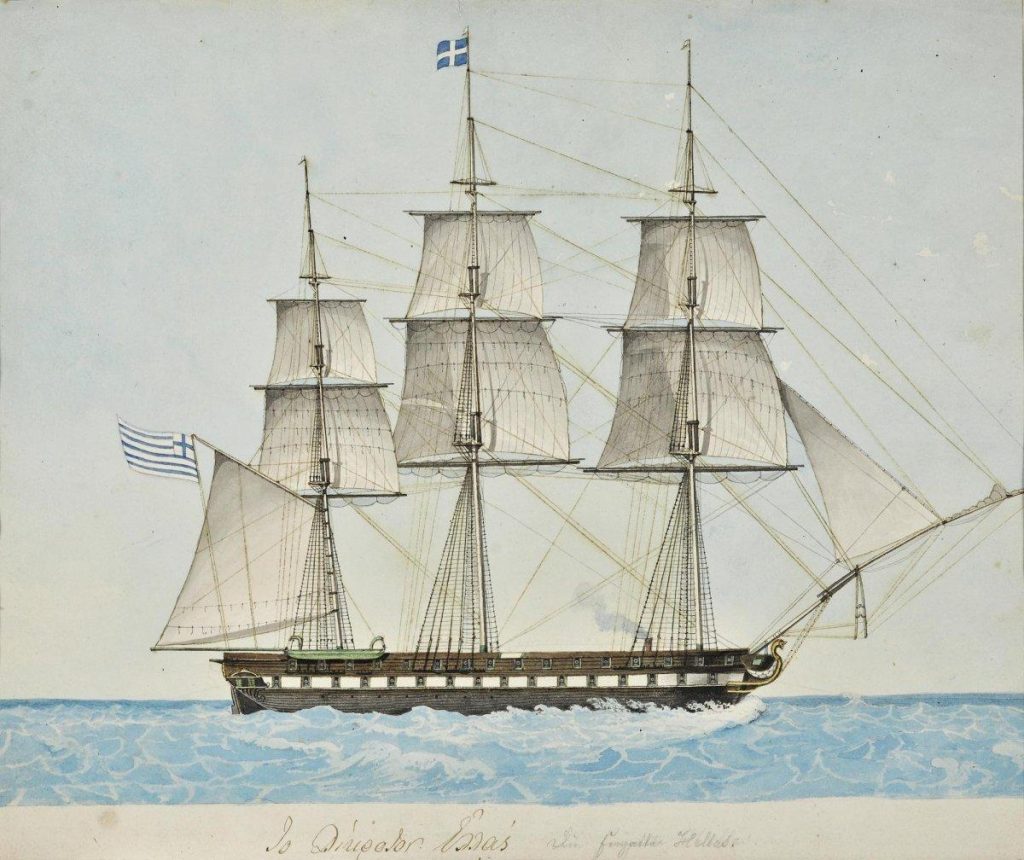
On this day in 1826, the Greek frigate Hellas arrived in Nafplio, becoming the first flagship of the Greek revolutionary navy. During the Greek War of Independence against the Ottoman Empire, representatives of the provisional Greek government arranged for the construction of two frigates in New York in 1825. The ships were named Hope (later renamed Hellas) and Liberator. However, soaring construction costs and financial disputes left the Greek government unable to pay for both vessels. Following arbitration, the Liberator was sold to the U.S. Navy, and the proceeds helped finance the completion and delivery of the Hope to Greece. The frigate became one of the most powerful warships in the Greek fleet, but its service came to a tragic end just five years later. On August 1, 1831, Admiral Andreas Miaoulis set fire to the Hellas at the naval base on Poros amid a rebellion against Governor Ioannis Kapodistrias. The destruction of the flagship was a devastating blow to the fledgling Greek navy. Kapodistrias himself was assassinated less than two months later, on October 9, 1831.
NOVEMBER 27TH:
On this day in 2012, Eurozone finance ministers and the International Monetary Fund (IMF) reached a landmark agreement on measures to reduce Greece’s debt burden and pave the way for the release of €43.7 billion in bailout funds. The deal, reached after approximately 12 hours of negotiations, came amid Greece’s prolonged financial crisis and mounting concerns over the sustainability of its national debt. The measures included extending loan repayment periods, reducing interest rates, deferring interest payments, and introducing a government bond buyback program. The agreement also gave Greece an additional two years to meet certain fiscal targets. Intended to put the country’s debt on a more sustainable path. The deal represented a significant step in efforts to stabilize the Greek economy, restore investor confidence, and safeguard the stability of the Eurozone.
Story via the original publisher. Read the original article