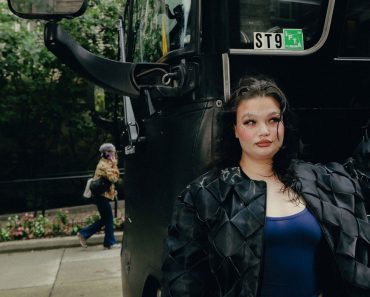

On her first Australian tour, and perhaps her furthest journey from home yet, Nefeli Fasouli has no intention of pulling out a map and ticking off the sights.
The young musician, one of the most captivating voices on the contemporary Greek music scene, has a different reason to look forward to Athens After Dark, presented by Greek Fringe in Melbourne and Sydney on 14 and 21 November respectively.
What interests her most is the opportunity to meet face-to-face with Greeks who have put down roots on the other side of the world.
“What I’m most excited about is seeing the audience, meeting the people. I want to discover where that connection with memory and with Greece stands today. What are people like? What do they listen to? What do they talk about? Where do the younger generations, who are the people I’m speaking to through my music, stand? How do they navigate that sense of memory and heritage?
“I think that’s what this journey will be for me. It will also change the way I see everyday life back in Athens,” she told tells Neos Kosmos from the Greek capital, where every Saturday she gets the crowd going with a repertoire that covers just about everything.
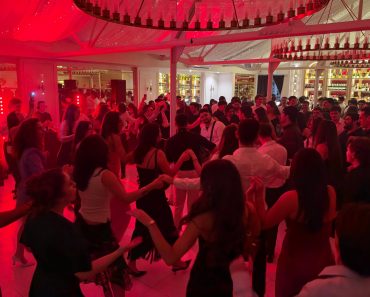
In Athens After Dark, Fasouli invites audiences to a nocturnal adventure in contemporary Athens, where you never know what comes next and where dawn will find you. Presented as an intimate concert, the shows are designed for audiences to move, dance and enjoy a genuine modern Greek music experience, characteristic of an emerging musical movement that she is helping shape in the vibrant Athenian nightlife.
“What I set out to do in Athens was to shift the audience’s attention beyond bouzoukia venues and clubs, and challenge the perception that entechno music is something you sit down and listen to, usually in a melancholic mood; while if you want to dance and let loose, you have to go to a bouzoukia venue.”
In an effort to reach a younger audience that has begun to tire of these stereotypes, she created a musical project in Athens that brings all these elements together.
“You’ll hear ballads, but you’ll also hear something really up-tempo. You’ll hear old laiko songs revisited with a very contemporary sound, and there’s no way you won’t have a good time.”
At first, many asked her: “Why are you mixing them? You must either do one or the other.”
But, as she points out, “Now everyone comes along every Saturday and the place goes wild. We dance, we have an amazing time, and that’s exactly what I want to bring to Australia.”
No Borders, No labels
Her desire to break down barriers and blend different musical worlds extends beyond the Athens stage. It has become a defining part of her artistic identity.
Equally at home performing at an entechno or laiko venue, a jazz festival or a rock club, Nefeli Fasouli moves effortlessly between different musical settings.
“I’m drawn to the new, to something I haven’t heard before. I’m afraid of following the beaten track and releasing, for example, a laiko song that sounds like all the others… with the classic bouzouki. I feel that, even as a child, I wanted to be different and to be known for bringing something new into the world. That has always been my starting point.”
What also fascinates her about the direction her career is taking is the opportunity to connect more directly with the world beyond. Her audience is no longer limited to Greek listeners, but now includes people in Europe, the United States and Australia.
“I will come to Australia and play with Greek-Australian musicians, as well as artists of other ethnicities. I understand that our music is becoming more and more global.”
Her time in New York as a Fulbright scholar, where she furthered her studies in jazz, proved pivotal in shaping her understanding of music.
“Seeing so many different cultures coexist in the same block and hearing all these musical combinations every day was an incredible education,” she says.
In many countries, from Turkey and the Mediterranean coast to Morocco, young musicians are drawing from local traditions and folk music, blending them with rock, electronic and other contemporary sounds. Her exposure to this international movement encouraged her to further develop her own artistic direction.
“I believe language has been a barrier to Greek music becoming popular around the world. But by incorporating this global sound, I feel that I’m suddenly reaching a much wider audience, and that really excites me.”
It also allows her to convey something she often struggles to explain to non-Greek people: this connection we have with our music and culture.
“Like the need to sing a song at a gathering, around a table. The fact that Friday or Saturday night comes around and there’s no way we won’t ask ourselves, ‘Where are we going tonight to listen to some music?’ It’s such an integral part of our culture that sometimes I wonder how to explain it to someone who isn’t Greek in a way that they can truly understand. I feel that, at least through sound, what we do has acquired a universal language.”

Songs that start from within
The stories Fasouli chooses to sing about usually start from her own experiences, questions, and inner searches.
The versatile vocalist—whose career took off six years ago with the release of her debut album, O Kosmos Sou [Your World], featuring songs by Fivos Delivorias—admits that every song she chooses to perform must resonate deeply with her own inner world.
“What is weighing on you right now? What is it that you need to resolve within yourself so you don’t carry it around as a grievance?” These are the questions she asks herself.
It is a process that, she says, requires absolute honesty, a clear look at oneself, and no evasions.
This is how Pyr, Gyni kai Thalassa [Fire, Woman, and Sea] was born— a song that quickly won over audiences and found its place in her live repertoire.
“I felt it was something I first had to resolve myself, drawing on what I’ve experienced in life, before sharing it with others. I think I always start with myself: what bothers me, what I want to resolve, and then I try to turn it into something collective.”
The story behind the song began with a film pitch.
A friend of hers, who was directing a film made entirely by women, asked her to write a song for the final scene.
The protagonist, fed up with partners who disrespect her and belittle her work, finally reaches breaking point and explodes. She kicks the man out of the house and starts throwing his laundry off the balcony.
“She throws his singlets, his T-shirts… it’s an absolutely hilarious scene. I watched it and immediately thought, ‘Now this has to be a laiko anthem, There’s no other way,’” she recalls.
“And that’s how Pyr, Gyni kai Thalassa (Fire, Woman and Sea) came about. It came to me so naturally, it was kind of scary,” she laughs.
“It fitted beautifully into my live set, and the audience immediately got into the spirit, which tells me they found something of themselves in the song.”
Lessons of the stage and a wonderful mentor
Today, Nefeli Fasouli appears completely at ease on stage and in synch with her audience. But the early days were not without their challenges.
As a child, she was eager to sing at school concerts, always vying for the solo, and by the age of three or four, she was already declaring with certainty that she wanted to be a singer.
“Just as things were starting to go really well and I’d reached that point where you think, ‘Now is my moment to shine’, I somehow froze,” she recalls, describing the first two to three years after the release of her debut album, O Kosmos Sou.
As her name became increasingly familiar, she found herself grappling with intense stage anxiety.
“I was shocked by how many people were starting to know who I was, and I became really scared. I wondered whether I’d be able to live up to their expectations. I experienced a strange kind of stage fright,” she says.
A pivotal influence on her journey was Fivos Delivorias, with whom she worked for five years that proved formative in her artistic development.
As she explains, their relationship went far beyond a simple professional collaboration. He became a mentor, opening up new artistic horizons for her. Through him, she discovered films, explored new music and encountered influences that played a defining role in shaping her aesthetic sensibility and artistic identity.
“He has been so much more than a collaborator, almost a mentor in my life, and I’m deeply grateful to him. He gave me the most wonderful foundations to stand on my own in the music world and pursue my own creative path,” she says.
When she opened up to him about the panic she felt on stage, he helped her see it from a different perspective. He explained that there was nothing wrong with being afraid. On the contrary, her fear showed that she cared, reflecting a desire to create something meaningful and lasting.
“It seems you want to build something that will last, that will stand the test of time,” he told her.
This phrase seems to sum up Fasouli’s approach to music and her relationship with her audience.
Ultimately, it is the need to create something genuine, something that comes from within, that gives her the strength to stand on stage and connect meaningfully with the people listening to her.
“When you believe in the songs you sing, word for word, it becomes much easier to stand on stage in front of people who are looking you in the eye and be truly present, without losing that connection with them,” she says.
Fasouli experienced one of the most powerful moments of this connection over the summer, at her biggest concert in Athens to date.
As she often does, she invited the audience to sing along to the chorus of O Kosmos Sou at the end of the night.
“I heard thousands of people singing it, and that was the first time I broke down; my eyes filled with tears. Because it was so much bigger than anything I could ever have imagined. The way so many voices and so many energies came together. I felt incredibly grateful, and I don’t think I’ll ever forget it.”

From the violin to law
Behind her artistic freedom and desire to experiment lies a journey of perseverance, discipline and a lot of hard work.
Nefeli Fasouli was just six years old when she took her first steps in music, choosing the violin which had captivated her, when she heard her grandfather play.
“My grandfather was a remarkable man, worldly, who read incessantly. He had picked up the violin and taught himself to play. I watched him mesmerised, and I remember thinking what an incredible instrument the violin was,” she recalls.
She admits, however, that it is a very difficult instrument for children to learn.
The perseverance that defines her also came into play during the two years she spent studying to pass her exams for Law School.
“That experience shaped me because I learnt that if I want to achieve something, I have to work at it for a long time. It was a somewhat traumatic experience — the kind we go through here in Greece when we sit the national university entrance exams — but it helped shape who I am. Law is also a very interesting field because it deals directly with people’s lives and their everyday experiences.”
Her studies opened a different window onto the world. They brought her closer to understanding human relationships, decisions, conflicts, and the small everyday stories that make up a life.
“Studying law taught me to appreciate the simple things. That’s where the secret lies: in everyday life, in the world of ordinary people. People are defined by simple things — their love for their families, how they break up, how they find their way back to each other. There’s a very strong anthropological element to all of this, and I think that’s where I found the direction I’m following today.”
Perhaps it is this very curiosity about people that makes her upcoming trip to Australia feel more than just another tour.
It may be the first time Nefeli Fasouli is travelling to Australia, but the emotion with which she prepares for this experience feels less like a discovery and more like a reunion.
“In Greece, we all have relatives in the Diaspora. I grew up hearing their names at the dinner table at home and in my mind they were always like these very distant relatives living in Australia, so far away. They seemed exotic and mysterious to me, because I met them only once in my life, not a second time.”
That is why, to her, this trip feels like a reunion.
“Even if I don’t know them personally, it’s as though we’ve known each other for a long time and we have so much to catch up on. Because, really, I think that’s how we in Greece feel about people in the Diaspora: like they are our long-lost relatives.”
Athens After Dark with Nefeli Fasouli is presented by Greek Fringe, in Melbourne on November 14 and in Sydney on November 21, with the support of the Hellenic Museum, the Greek Orthodox Community of NSW, and AHEPA.
*For more information visit Neos Kosmos’ Greek Guide.