On the old boxes, there were Greek titles such as, “Hasapikos Politikos,” (Hasapiko from Istanbul) “Den me xereis, den se xero” (You don’t know me, I don’t know you), and “Ta oula sou” (Everything about you). Their contents, however, were not vinyl records, but perforated paper rolls that allowed mechanical pianos to play music without the need for someone to press the keys. Meletis Pouliopoulos, a Greek American historian, archivist, and independent scholar, had already dedicated decades to researching Greek music when Christos Pantazelos, an instrument maker based in Massachusetts, called him to tell him about a collection of such Greek musical rolls.
In the autumn of 2015, Pouliopoulos traveled to Buffalo, New York, where he spent three days recording a total of 42 rolls. The subsequent research uncovered, among other things, a 1923 catalog of Greek songs that had been released in this unusual format.
This was neither the first nor the last time that an investigation led Pouliopoulos to an unknown facet of Greek musical history. His involvement had begun much earlier, stemming from something more personal: an attempt to rediscover the music he had listened to while growing up in the United States. “I had realized many years ago that the music I grew up with was no longer available, and that many beautiful traditions were disappearing,” he tells Kathimerini. “When I tried to document this music, I found myself faced with more questions than answers.”
The grandson of Greek immigrants from villages near Kalamata and Thebes, he grew up in Manchester, New Hampshire. At home, his family spoke Greek, listened to Greek radio broadcasts, and took part in community events. He went on to have a long international career, during which he never stopped searching for old records and information about the people who had recorded them. In 2006, he officially founded Greek Cultural Resources, a cultural nonprofit based in New Hampshire.

Initially, he was primarily interested in recordings. Soon, however, he realized that a record label did not always indicate who was playing, which orchestra they belonged to, or where they performed. He began searching for record company catalogs, sheet music, performance programs, and advertisements. “As a researcher, I sought out primary source materials, only to discover that Greek American newspapers and books had either not survived or were simply unavailable,” he explains. “I found that traditional libraries had overlooked ephemeral materials, such as record catalogs, performance programs, and announcements, as well as Greek American sheet music.” Consequently, his archive expanded well beyond his original collection of records.
Today, it encompasses thousands of commercial and independent recordings, hundreds of field recordings of traditional music, archives from four Greek American radio stations, sheet music, and original manuscripts dating back as far as the 1930s. The collection also includes old newspapers, photographs, home movies, and handwritten notes regarding the recordings, along with hundreds of cassette tapes. However, his work is not limited to the collections he assembles himself. He often steps in to help families and institutions find a suitable home for archives that are at risk of being scattered or lost. One of the most significant instances of this involved the collection of ethnomusicologist Sotirios (Sam) Chianis, one of the foremost authorities on Greek folk music who, beginning in the late 1950s, traveled to Greek villages to record songs and musical traditions that had often never made it into commercial recordings.
232 crates of material
Chianis was among those researchers who sought out Greek traditional music in the very places where it was still being performed: in villages, at local festivals, and within local communities. He would meet with singers and instrumentalists, record them, take notes, and photograph the people he encountered. Along with the audio recordings, he amassed journals, interviews, and musical instruments. “Sam was one of the first ethnomusicologists in the US and had conducted extensive fieldwork in Greece,” says Pouliopoulos. “He recorded and studied folk traditions throughout the country, many of which have since vanished. His recordings and interviews were accompanied by written journals and photographs.”
The two men knew each other personally; Pouliopoulos would visit him often to discuss his research and examine the material he had collected. “Before his passing, I had cataloged over 300 recordings he had made, as well as 175 musical instruments he had collected and studied from all over the world.” Following Chianis’ death, his family sought Pouliopoulos’ assistance in preserving the collection.

The material comprised 232 crates in total. Pouliopoulos facilitated the transfer of the recordings, books, and research archive to the Archives of Traditional Music at Indiana University. The 175 musical instruments were acquired by the University of Athens, with the contribution of Vasiliki Chrysanthopoulou, assistant professor in folklore studies and director of the Folklore Museum and Archives in the Department of Philology. The traditional costumes and textiles found a home at the Lykeion ton Ellinidon (Lyceum of Greek Women) in Boston. Digital copies of some of the recordings are also held by Greek Cultural Resources.
Panos Liaropoulos, composer and professor of composition at Berklee College of Music in Boston, recently sought out these copies when he visited Pouliopoulos, having become interested in Chianis’ field recordings from Amorgos. “Sam was the only person to have recorded the musical traditions of the island’s northern region – music that has since been lost,” says Pouliopoulos. Liaropoulos arranged for some of these recordings to be included in a small public archive on Amorgos.
In the classified ads
Chianis’ recordings were particularly valuable due to the information that accompanied them – who was singing, where, and under what circumstances. Pouliopoulos encountered this same need, to understand the people and the era behind the music, during his own research. “It was important for me to grasp the historical context of the music. That is why I sought out photographs, interviews with artists, recordings of live performances, and Greek American radio and television programs,” he says. “I realized that all these pieces of evidence were part of a larger, cohesive picture.”
Newspapers from the Greek diaspora also proved to be a significant source of information. In Boston’s Hellenic Chronicle, for instance, advertisements from the 1970s for Greek orchestras, entertainment venues, and community dances now serve as invaluable records of musicians and bands that might otherwise have left no other trace. However, Greek American newspapers did more than just document community activities. Their pages also featured news from Greece, literary works, and features on theater and the arts. Thus, the printed materials that Pouliopoulos began collecting while seeking information about musicians proved valuable to researchers in other fields as well.
A case in point is that of Peter Jeffreys, a professor of English at Suffolk University in Boston and a scholar of Greek poet CP Cavafy, who made an unexpected discovery during a visit to the archive. “One day, Peter came by and was leafing through a special edition of the New York-based National Herald – an anniversary volume marking the newspaper’s first 10 years, from 1915 to 1925,” recounts Pouliopoulos. It was there that the researcher discovered two poems by Cavafy that he had not encountered before. The volume had been published in April 1925. The poems were “Desires” (Epithimies in Greek) and “An Old Man” (Enas Geros); the latter appearing under the title “The Contempt for Wretched Old Age” (Athlion Girateion i Kataphronia) and lacking its first stanza. This find offered an intriguing piece of evidence regarding the presence of the Alexandrian poet in the Greek American press during the interwar period. The volume was subsequently acquired by the Onassis Foundation for the Cavafy Archive in Athens.

Pouliopoulos had also studied this same publication from a different perspective. “The volume contains many pages dedicated to the arts and literature. In it, I found significant information about the first Greek opera singers to arrive in America, as well as about artists associated with the Greek opera scene of that era,” he explains. “If someone were to ask me today what the most important part of the archive is, beyond the music itself, I would say it is the newspapers and other periodical publications.”
Greek on American radio
Beyond the press, Greek-language radio broadcasts also played a significant role in the daily lives of Greek communities. For families living far from major centers of the Greek diaspora, in particular, the radio served as a vital link to their language and current events. Among the archives he has collected, Pouliopoulos highlights one such magnetic tape dating back to 1968. “Greek American radio broadcasts are treasures, as they serve as snapshots of a specific era,” he says. “Last year, a researcher reached out to me; he was studying how Greek American media outlets reacted to the dictatorship in Greece. I was able to provide him with a significant broadcast from 1968, which I had received from John Metaxas in New York. His father had recorded the transmission while it was airing on the radio.”
Long before the radio broadcasts of the 1960s and 1970s, the everyday lives of Greek immigrants had also found a place in the world of recorded music. In addition to songs and instrumental music, there were also comic recordings that satirized the difficulties of adjusting to a new homeland. One such example is “Karagiozis on the Telephone,” recorded in Chicago around 1930 by shadow-theater performer Haris Patrinos for the Columbia label. This familiar character from Greek shadow theater made his way into the recorded repertoire of the Greek diaspora, drawing his humor from the experiences of immigrants. “Karagiozis traditions and early comic recordings often satirized people struggling to adapt to life in America,” explains Pouliopoulos. “They depicted challenges with the language and American customs, while also showing Greeks engaging in self-deprecating humor.”

An apartment of artifacts
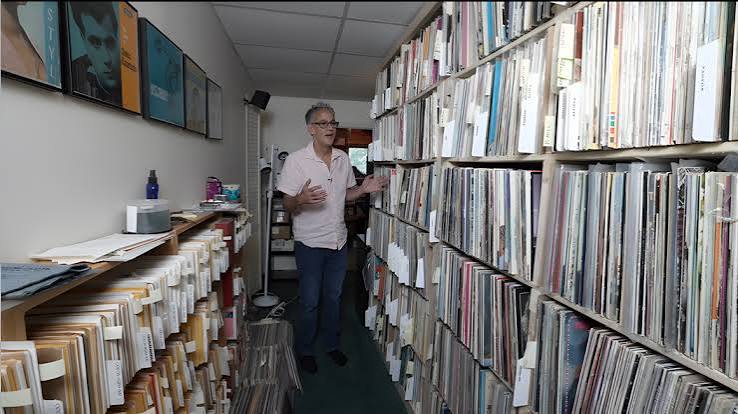
Today, Greek Cultural Resources is housed in Pouliopoulos’ apartment in New Hampshire. The rooms are filled with old records, magnetic tapes, books, and digitization equipment. Space has become so limited that, at times, he is forced to decline new collections, seeking out other organizations that might be able to take them in. Beyond the lack of space, securing the necessary resources remains a significant challenge. As the historian points out, the continuation of this work relies heavily on the support of individuals and donors; support that enables Greek Cultural Resources to preserve, document, and digitize its collections, making them accessible to future generations.
“We can only continue with the public’s support,” he says.
Excerpt from ‘The Kampana Radio Hour,’ WEVD-FM, New York, 1968.
Story via the original publisher. Read the original article