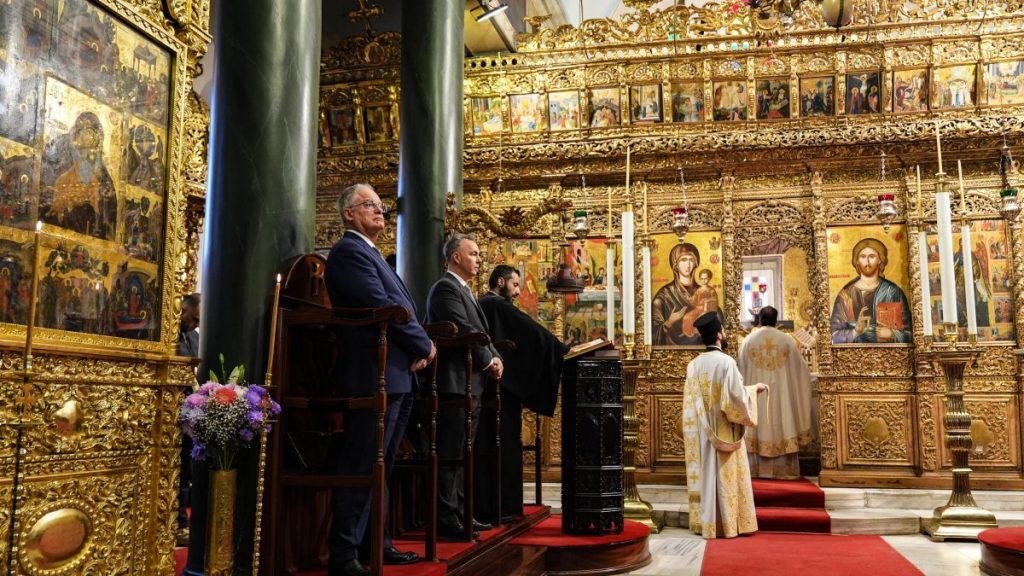
On the second day of his inaugural visit to Türkiye, where he met President Recep Tayyip Erdoğan, Greek President Konstantinos Tasoulas paid a visit to the Heybeliada, or Halki, seminary, a key Orthodox institution whose reopening has been a source of dispute for years.
The visit was literally off to a rocky start as storms battered the coasts of Istanbul before the Greek delegation on Sunday took a boat to Heybeliada, one of the Princes’ Islands off the coast of the city where Erdoğan hosted the Greek counterpart for a brief but optimistic meeting. Tasoulas first visited Aya Triada monastery located within the complex also housing the seminary, in the company of clerics from the Fener Greek Orthodox Patriarchate in Istanbul, whose patriarch Bartholomew hosted Tasoulas on Saturday. Tasoulas and the Greek delegation watched a religious service and were presented gifts by the monastery officials.
The delegation then walked through the seminary’s renovated parts and attended a lunch there.
The seminary opened in the mid-19th century and was the main theological school for the Eastern Orthodox Church until it was closed under a Turkish law in 1971. The school has remained closed for decades despite efforts by the Fener Greek Orthodox Patriarchate, whose patriarch counts millions across the world as followers.
What brought about its closure was a 1971 court ruling that all private religious educational institutions must come under state control, a decision rejected by the patriarchate as it wanted to preserve the seminary’s independence. But after years of closure, the patriarchate has agreed to accept a formula that would let the seminary reopen, operating under Turkish oversight.
Renewed interest in the site was sparked in 2024 when Education Minister Yusuf Tekin visited and spoke of the importance of preserving the building’s original character in any renovation.
The issue of reopening was at times linked to reciprocal steps by Greece to expand the rights of the Turkish minority in Western Thrace, which has been deprived of picking their own muftis but optimism is in the air nowadays as Ankara and Athens look to resolve their tensions despite antagonistic moves by Greece. Indeed, Tasoulas’ visit was first by a Greek president in almost a decade and signals that the hope remains for advancing relations despite recent tensions over the Aegean Sea.
Erdoğan told Tasoulas on Saturday that Türkiye and Greece have significant potential for cooperation in all areas, stressing Ankara’s efforts to advance the positive agenda between the two countries, according to a statement by the Turkish Presidency’s Communications Directorate.
During the meeting, Erdoğan emphasized the importance of addressing minority issues, which are part of the two countries’ shared heritage, primarily from a humanitarian perspective.
He said Türkiye wanted Greece to reciprocate its constructive approach to minority issues, adding that such an attitude would contribute to the positive course of bilateral relations.
Erdoğan also stressed that Türkiye had no hesitation about making the Aegean a sea of peace, saying the Aegean and Eastern Mediterranean should become regions of stability and prosperity, according to the directorate.
Yet, Greece apparently is not ready for steps toward peace. Around the same time as Erdoğan’s statements, Greek media outlets reported that Israel, arch foe of Türkiye in the region, began delivery of weapons systems to Greece. Among them SPICE-1000 and SPICE-2000 precision guidance kits and Rampage air-to-surface ballistic missiles. The precision kits will be employed by F-16 fighter jets. News reports stated that the use of SPICE-1000 and SPICE-2000 precision-guided munitions kits on F-16 fighter jets would enable standoff attacks from outside the range of enemy air defense systems. The reports indicated that these weapons have a range of up to 60 kilometers (37.28 miles).
The reports also emphasized that SPICE-1000 and SPICE-2000 munitions were necessary for Greek fighter jets to survive against Türkiye’s S-400 air defense systems, as well as its indigenous HISAR and SIPER air defense systems. They argued that the weapons’ extended range could help protect both pilots and aircraft. The reports further claimed that Rampage-type ballistic missiles, with their long-range and supersonic capabilities, could penetrate dense air defense networks. Thanks to their high speed in reaching targets, these missiles were described as suitable for striking targets such as radar installations, command centres, airfields and ammunition depots.
Türkiye and Greece continue to navigate longstanding disagreements over maritime boundaries, territorial waters, continental shelves, exclusive economic zones, airspace and energy exploration rights in the Aegean and Eastern Mediterranean.
The status of several Aegean islands and the unresolved Cyprus issue also remain major sources of tension between the NATO allies, whose relations have periodically deteriorated despite repeated diplomatic efforts to maintain dialogue.
Türkiye has advanced its Blue Homeland doctrine, which outlines its maritime claims and interests in the Black Sea, Aegean, Mediterranean and Marmara seas.
The issue has drawn renewed attention following Ankara’s November 2026 NAVTEX notices concerning research activities in areas it claims as part of its continental shelf.
The notices were linked to tensions surrounding the planned Great Sea Interconnector, an electricity cable project intended to connect Crete and Cyprus. The project has been a source of disagreement between Ankara and Athens.
Turkish Foreign Minister Hakan Fidan and his Greek counterpart George Gerapetritis have also maintained diplomatic contacts in the period leading up to the presidential meeting, as both governments seek to prevent disagreements from escalating.

Story via the original publisher. Read the original article