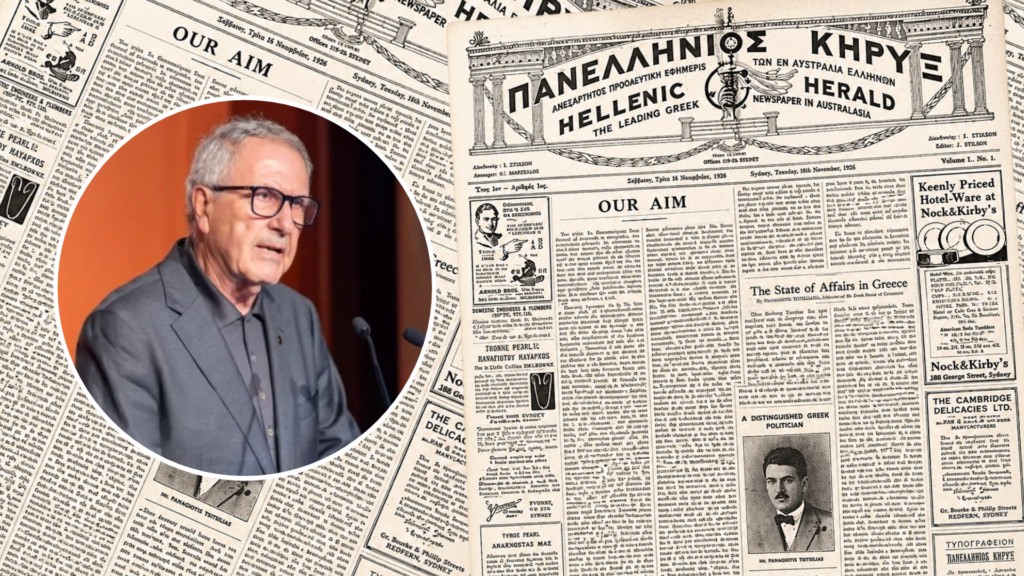
For one hundred years, The Greek Herald has documented the history, struggles, achievements and transformation of Australian Hellenism. Since its establishment in November 1926, the newspaper has served not only as a source of information, but as a guardian of collective memory, a defender of Greek identity and a witness to the evolution of one of Australia’s most enduring migrant communities.
Its pages reveal the remarkable journey of Greek Australians, from a relatively small migrant population during the interwar years to a flourishing community of hundreds of thousands, whose contributions have shaped the social, cultural, economic and political life of Australia.
The history of The Greek Herald is, in many respects, inseparable from the history of Australian Hellenism itself.
As the newspaper celebrates its centenary in 2026, its extensive archives provide an opportunity to revisit the events, personalities and institutions that shaped its first century.

The foundations of a historic newspaper
The newspaper, originally established as the Panhellenic Herald, was founded in November 1926 by George Marcellos and John Stilson, against the background of the political divisions that had characterised Greece during the period of the National Schism.
Its establishment was associated with the political influence of Eleftherios Venizelos and the Liberal movement, at a time when the pro-monarchist newspaper Ethniko Vima was already circulating in Australia.
The ideological divisions between Venizelists and royalists had followed Greek migrants abroad, influencing the establishment of newspapers and community institutions across the diaspora.
Similar divisions had emerged in the United States, where the pro-monarchist Atlantis, established in 1894, was later challenged by the Venizelist Ethnikos Kirix, founded in New York in 1915.
In Australia, however, the divisions within organised Hellenism were not exclusively political. Ecclesiastical disputes, community rivalries and questions of religious authority frequently occupied the attention of Greek migrants and the pages of their newspapers.
These developments formed part of the complex environment in which The Greek Herald began its historic journey, as explored in the newspaper’s first-decade historical retrospective covering 1926–1936.

A century of documenting Australian Hellenism
The newspaper’s archives provide an extraordinary record of the Greek Australian experience.
From the approximately 16,000 Greeks living in Australia during the interwar period to the hundreds of thousands who arrived following the Second World War, The Greek Herald documented the community’s changing circumstances, aspirations and achievements.
Its reporting followed Greek migrants from factories, farms, railway construction sites, sugarcane plantations and mines into small businesses, commerce, industry, education and the professions.

It also recorded the discrimination and xenophobia that confronted early Greek settlers.
The newspaper’s pages reveal incidents of hostility towards Greek, Italian and other migrant communities, discriminatory attitudes in political life and restrictions affecting economic opportunities.
Journalists and editors, including the late Alexandros Grivas, challenged such attitudes and advocated for the recognition and advancement of Greek Australians.
The newspaper’s centenary exploration of lesser-known stories from its archives reveals some of the personalities, controversies and remarkable events that shaped its history.
Over time, the newspaper also documented the changing relationship between Greek migrants and wider Australian society, including the bonds strengthened through the shared experiences of the First and Second World Wars.
The battles fought in Greece and Crete, the contribution of Lemnos during the Gallipoli campaign and the sacrifices of Australian servicemen became enduring elements of the relationship between the two nations.
These experiences are reflected in the newspaper’s second-decade retrospective, covering 1937–1946, which examines its wartime reporting and the transformation of Greek Australian community life.

The growth of Greek Australian communities
The Greek Herald’s historical record also illuminates the development of organised Hellenism.
The establishment of Greek Orthodox churches and the support of clergy were among the earliest priorities of migrant communities.
In subsequent decades, greater attention was directed towards Greek-language education, cultural organisations, sporting activities, theatre, welfare and community solidarity.

Greek associations and regional brotherhoods became important institutions, although local rivalries and divisions sometimes complicated efforts to establish a unified community identity.
The newspaper documented these developments while encouraging greater cooperation and collective advancement.
It also recorded the economic transformation of Greek Australians, from the familiar cafés, milk bars and restaurants of the early migrant generations to expanding involvement in property, construction, commerce, energy and professional life.
Education became another defining achievement.
Greek Australians increasingly entered universities and the professions, while Greek-language schools and, later, independent day schools played an important role in preserving cultural identity.
The community’s political participation also expanded, with Greek Australians entering local, state and federal politics and eventually assuming ministerial and other senior public offices.
A newspaper reaching across Australia
One of The Greek Herald’s defining achievements was its extensive network of journalists and correspondents.
Unlike publications concentrated exclusively in major cities, the newspaper maintained connections with Greek communities throughout Australia’s vast interior.
Correspondents reported from regional towns, rural settlements and emerging migrant communities, recording social gatherings, cultural activities, sporting events, professional achievements and important developments in local community life.

Through these reports, the newspaper preserved histories that might otherwise have disappeared.
Its publishers and journalists also travelled extensively, establishing relationships with readers, appointing correspondents and strengthening the newspaper’s national presence.
The Greek Herald became more than a publication. It functioned as a meeting point for Australian Hellenism, connecting communities separated by enormous geographical distances.
The importance of this relationship is also reflected in the memories of readers and former contributors collected for the newspaper’s centenary.


Theodore Skalkos and a new era of ethnic media
A particularly significant chapter in the newspaper’s history emerged under Theodore Skalkos, whose contribution extended far beyond the Greek-language press.
Skalkos introduced technological innovations that transformed newspaper production, including the adoption of monotonic Greek typography, the transition from traditional typesetting to phototypesetting, and the use of modern communications technology.

He established newspaper offices in Greece, developed relationships with English-language publications and expanded opportunities for Greek-language journalism within Australia’s broader media landscape.
His activities also extended into radio and television, contributing to the development of Greek-language broadcasting with national reach and the introduction of Greek television programming to Australian audiences.
At the height of his publishing activities, Skalkos was responsible for the production of more than twenty ethnic newspapers, extending his involvement into Serbian, Spanish and Arabic-language media.


He also established Ellinis, which became one of the longest-running social magazines of the Greek diaspora.
His extraordinary career and contributions to ethnic media are explored in The Greek Herald’s centenary tribute to the publisher who transformed Australia’s ethnic press.
For approximately half of The Greek Herald’s century-long history, Theodore Skalkos played a defining role in its ownership, modernisation and development, helping establish new standards for ethnic media in Australia.

Preserving identity while encouraging integration
Throughout its history, The Greek Herald sought to balance the preservation of Greek identity with the practical demands of life in Australia.
Its editors encouraged migrants to learn English, participate in the wider economy, pursue education and establish themselves beyond the traditional boundaries of their communities.
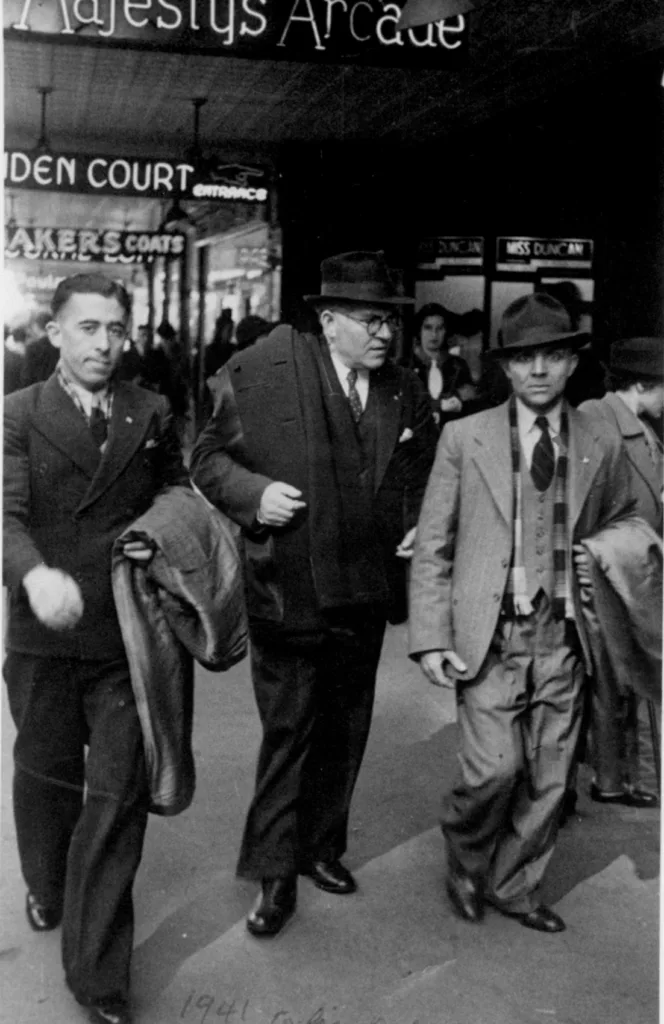
Alexandros Grivas, in particular, repeatedly urged Greek Australians to broaden their professional and economic ambitions, moving beyond small businesses and pursuing opportunities in agriculture, industry, research and public life.
At the same time, the newspaper defended the Greek language, Orthodox faith, cultural traditions and the historical consciousness of the community.
This dual responsibility — preserving cultural heritage while encouraging participation in Australian society — became one of the newspaper’s enduring characteristics.
As the publication entered its tenth decade, it continued adapting to changing media technologies and audiences, a transformation documented in The Greek Herald’s historical retrospective of 2017–2026.
The importance of maintaining that connection across generations was also reflected in young Greek Australians’ reflections on the newspaper’s next century.
A century of collective memory
The Greek Herald’s historical significance extends beyond the events it reported.
Its pages preserve the experiences of generations of Greek Australians: their struggles against discrimination, their economic and educational advancement, their political participation, their community institutions and their contributions to the development of modern Australia.
The newspaper has also helped preserve the connections between Greece and Australia, documenting the shared historical experiences and cultural relationships that continue to bind the two countries.
This contribution was formally recognised during The Greek Herald’s centenary celebration at NSW Parliament House in May 2026, where Professor Tamis reflected on the newspaper’s historical significance and its contribution to Australian Hellenism.

After one hundred years of uninterrupted publication, The Greek Herald remains an important custodian of Australian Hellenism’s collective memory.
Its history demonstrates how a migrant newspaper can contribute to social change, cultural continuity, bilingualism, community participation and the preservation of historical identity.
Through its reporting, advocacy and commitment to the Greek language, The Greek Herald has helped generations of migrants and their descendants maintain a connection with their heritage while establishing their place within Australian society.
Its centenary is therefore not simply a milestone in the history of a newspaper. It is also an opportunity to recognise the extraordinary journey of Australian Hellenism over the past century.
Professor Anastasios M. Tamis is preparing the historical study Hellenic Herald: The Centennial Voice of Hellenism, expected to be published in 2027. Drawing on extensive archival research, the study examines the newspaper’s century-long contribution to the history and development of Australian Hellenism.
This article has been adapted into English from Professor Tamis’ original Greek-language centenary contribution.

Story via the original publisher. Read the original article