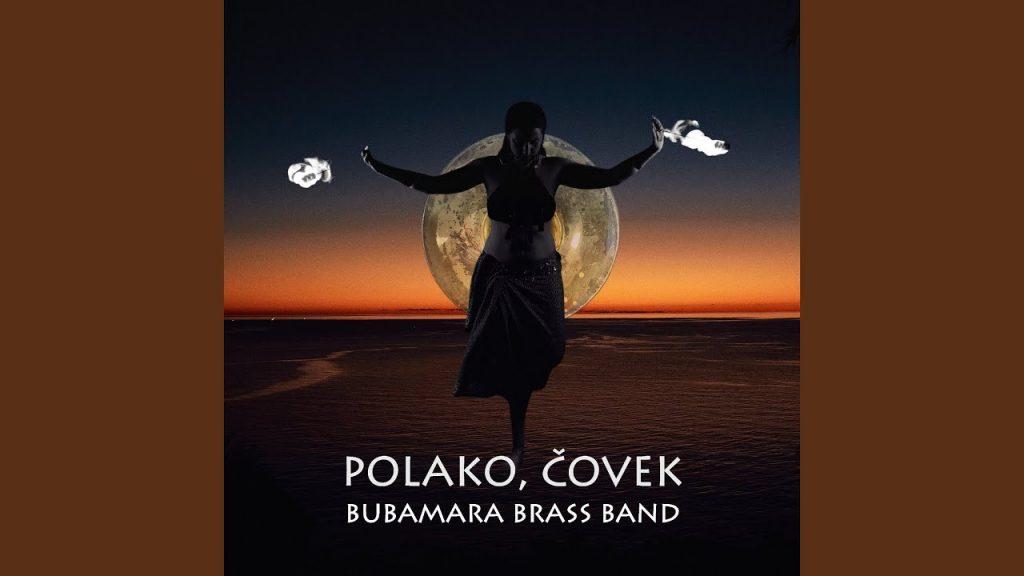
Balkan brass travels a long way on “Polako Čovek”. Aleksandar Kashtanov founded Bubamara Brass Band in Moscow in 2005, gave this tune a Serbian name meaning roughly “slowly, man”, and now leads the orchestra from its base in Georgia. On the track he builds the horn line almost single-handed, layering his own trumpet, flugelhorn and alto and soprano saxophones, while Pavel Axenov’s trombone, Iliya Lipatov’s drums and Nastena Bad’ina’s choir vocals fill out the sound. Kashtanov wrote the words and music as well, then produced, mixed and mastered the track himself.
The song gives its name to Polako Čovek, the band’s new album, released on 9 October. Kashtanov calls it “an incredibly powerful album, a soulful soundtrack to my life”. Alongside his originals, the record carries the Greek song “S’Agapo” and the Turkish “Mihriban”. Several of the new compositions take their names from the band’s adopted home: “Gamarjoba” is the Georgian hello and “Pkhali Dance” is named after a Georgian vegetable and walnut dish, while “Yalda Night” looks further east to the Persian midwinter festival.
Kashtanov came to Balkan brass by a winding road.
He graduated from the Moscow Engineering Physics Institute, played flute in the orchestra of jazz bandleader Yuri Chugunov and led Vodovorot, a group playing Balkan music in Moscow’s clubs, on guitar before starting the band, inspired by the films of Emir Kusturica. He named it after Bubamara, the heroine of Kusturica’s 1998 film Black Cat, White Cat; the word is Serbian for ladybird. The orchestra plays Serbian, Romanian and Roma brass tunes alongside his own, with tribal-style dancers playing finger cymbals in its live shows, and has taken that show to the Usadba Jazz festival and the Kinotavr film festival in Russia, as well as to Turkey, Kazakhstan and Montenegro.
Listen to “Polako Čovek” HERE
Story via the original publisher. Read the original article