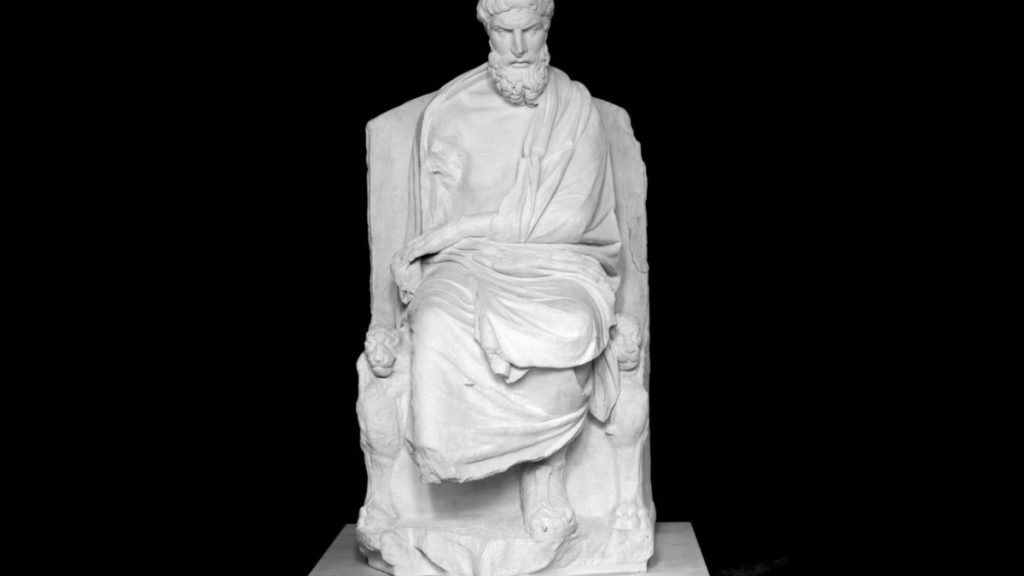
Few philosophical maxims capture the essence of personal accountability as sharply as Epicurus’s enduring observation: “It is folly for a man to pray to the gods for that which he has the power to obtain by himself.”
Widely circulated in modern quotation anthologies, the line traces its roots to Vatican Saying 65, part of a collection of Epicurean aphorisms preserved in a medieval manuscript and rediscovered in the late nineteenth century.
Giannis Antetokounmpo hits Greece teammate on the head in unexpected moment caught on video
Rather than encouraging cynicism or despair, the statement was designed to liberate ordinary people from superstition, passivity, and misplaced anxiety.
Born in 341 BCE on the Aegean island of Samos to Athenian parents, Epicurus spent his early years studying rival philosophical traditions before establishing his own school in Athens around 306 BCE.
Located just outside the city walls and known simply as The Garden, his community broke sharply with the elitism of Plato’s Academy and Aristotle’s Lyceum. Epicurus welcomed women, enslaved people, and citizens from every social class, creating an egalitarian sanctuary devoted to rational inquiry, mutual support, and peace of mind.
To understand why Epicurus dismissed petitionary prayer, one must examine his distinctive view of the divine. Contrary to centuries of caricature, Epicurus was not an atheist; in his surviving Letter to Menoeceus, he explicitly affirmed that the gods exist.
However, he rejected the popular Greek theology that depicted deities as jealous, wrathful rulers who rewarded rituals and punished human missteps.
In his Principal Doctrines, Epicurus argued that a truly blessed and immortal being neither experiences trouble nor inflicts trouble on others, remaining wholly untouched by anger or favoritism.
Because the gods exist in undisturbed serenity rather than managing earthly affairs, begging them for wealth, courage, or discipline is a wasted effort that distracts individuals from taking constructive action themselves.
Self-sufficiency, tranquility, and why Epicureanism is still misunderstood
In modern English, the word “epicurean” is routinely associated with gourmet dining and sensory indulgence, yet that reputation turns the philosopher’s actual teachings upside down.
Epicurus lived on simple fare, primarily water, barley bread, and occasional cheese, and taught that lasting happiness depends on aponia (the absence of physical pain) and ataraxia (an untroubled, tranquil mind). Chasing extravagant luxuries or public acclaim, he warned, traps people in endless cycles of craving and disappointment.
At the center of Epicurus’s ethical framework sits autarkeia, or self-sufficiency—the ability to meet natural, necessary desires without depending on luck or external validation. As he noted in Vatican Saying 77, “the greatest benefit of self-sufficiency is freedom.”
Later followers distilled his therapeutic philosophy into the Tetrapharmakos, or four-part cure: do not fear the gods, do not worry about death, recognize that what is genuinely good is easy to obtain, and remember that what is painful is endurable.
Viewed alongside those principles, Epicurus’s warning against praying for what lies within human reach becomes a blueprint for daily resilience.
When people outsource responsibility for their character, habits, or relationships to fate or divine intervention, they surrender the very agency needed to improve their lives.
Epicurus maintained that wisdom, moderation, and deep friendship, which he prized as the greatest safeguard of lifelong happiness, are cultivated through deliberate human choice.
Even after his death in Athens in 270 BCE, that empowering message resonated across centuries, inspiring the Roman poet Lucretius and later shaping Enlightenment thinkers such as John Locke and Thomas Jefferson.
In an era still dominated by distraction and external pressures, Epicurus’s advice remains disarmingly clear: stop waiting for rescue when the tools for a tranquil life are already in your hands.
Story via the original publisher. Read the original article