It is a fascinating phenomenon that Traditional Greek folk dance is more popular with Europeans than the average Athenian.
If you go into Facebook there are websites that list seminars and workshops of Greek dance seminars all over Greece and Europe.
During the European summer, these events take place all over Greece, and are mainly attended by Europeans, from France, Germany, Belgium, as well as Israelis and Americans. July and August is the peak period, which makes sense as it is the European summer and holiday period.
In winter the Greek dance teachers are found running workshops in Germany, France, Belgium and other European countries.
But why this popularity for Traditional Greek dance!
I have attended a number of such seminars in July and August over the years.
The first on the island of Ikaria, then in Prespa, Macedonia and recently in the village of Vitsa, Epirus.
These seminars follow a pattern, which consists of dance classes during the day and trips to festivals, and panyiria in the evenings.
Everything is catered for, as the cost covers accommodation, food and buses to the panagyria.
So from a holiday perspective the seminars are quite attractive.
Greek folk dance is inclusive. If you are single, or in a group, or a family, everything is catered for. Everyone is welcomed into the circle, and with changing demographics in Western culture, with a growing number of single individuals this is a holiday where an individual can turn up and be a participant and part of the group.
But why the European enthusiasm for spending one’s holidays dancing around in a circle in 35 degrees heat!
It seems that holding hands and dancing in a circle provides a human connection, a sense of belonging. Even a spiritual feeling of everyone in the circle being one and connected.
Certainly, there is a feeling of unity and common purpose around the music and dance,
Plus, the fun and enjoyment of the panayria in the various villages that those attending are taken to.
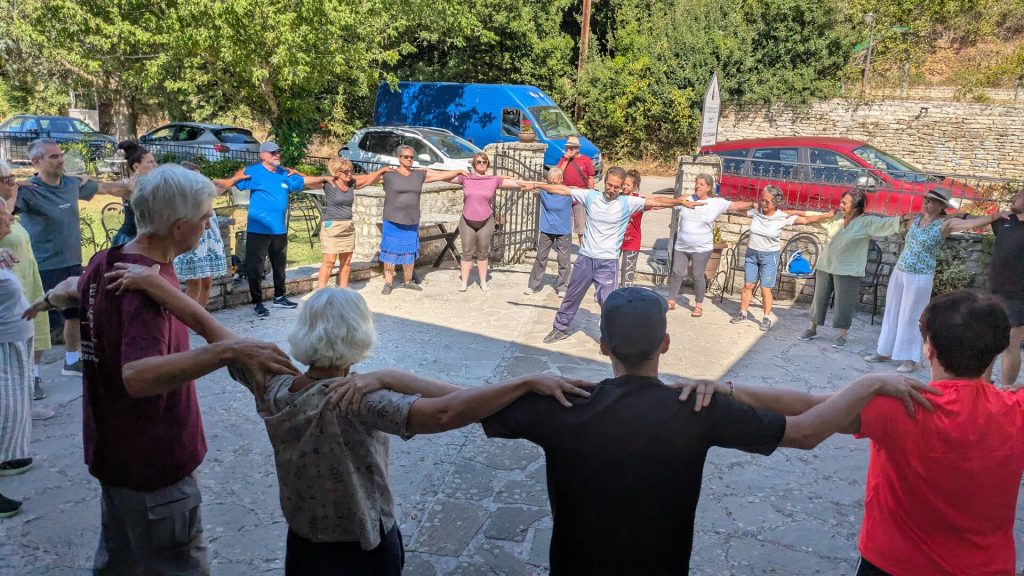
This year I went to the village of Vitsa, Epirus for a 10 day seminar. Vitsa is about half an hour out of Ioannina in the spectacular countryside of mountains and valleys. The region is a drawcard for Europeans who like to trek, swim in rivers and immerse themselves in nature in the wilds of Epirus.
During this year’s seminar, people came from various villages to teach us the dances from their villages and to talk about the traditions around the dances. Musicians also came and played with traditional instruments, for us to dance to.
In the past If villages didn’t have musicians then the villagers sang songs to dance to,, and so, Polyphonic singers sang for us one night.
We were shown traditional costumes from Serras, Pontian, Slavic, Cappadocian villages, and told about their traditions.

The songs from traditional Greek dances provide us with an oral history of the lives and traditions of the past.
The dances evolved to explain historical events, to prepare for war, to celebrate religious and social events. Songs about tragedies were danced to as well as happy events such as weddings. The clothes also had to be appropriate to the dance story. The songs told the story, and the dance supported the songs.
Local traditions and strict codes of behaviour were reflected in the dance, such as who led the dance and with whom one danced.
In some areas, one might only dance with one’s family, and single men and women could not touch each other, so the handkerchief was used, so the dances tell the stories of the villages and regions they come from. Christenings, weddings, funerals and wars. The coming of the seasons, and the hardships of everyday life. The traditional Greek dances and songs are a window into the past.
Giorgos Kapsalia rang the 10th Epirus dance seminar this year in the village of Vitsa Zagori in Epirus, with people from many countries attending’
The participants are interested in each other’s cultures and want to dance, eat, and simply be content being part of the group.
Many of the participants knew each other because year after year they go to the same seminar or to a seminar in another part of Greece.
The teachers of the seminars often come from families immersed in their local region and its dances.
Yiannis Konstantinou in Lemos, Prespes has been running the Balkan dance seminars for thirty years, and when I attended his seminar a couple of years ago, we were taken to Albania and North Macedonia to experience traditional dances and music.
The Ikaria Dance Festival held in August is prominent and a few years ago, a video of Olga Black from Melbourne, in her nineties who was at the Ikaria Festival, was filmed doing a zebekiko which went viral on the internet, and can be found on Youtube. It was also a news item on Greek TV. Incidentally Olga is now ninety six and goes to Chris Konstantinides dance class in Oakleigh every week. And recently was interviewed by Neos Kosmos and by AlphaTV from Greece.
In Australia many in the Greek communities bemoan the fact that many Greek Australians are not well versed in the Greek language, and thus are missing out on learning about Greek culture.
I suggest that through traditional Greek dance one can learn much about everyday life in Greece in the past. Greek dance gives us a window into the life of Greeks in villages. Through dance we can learn about the mores, the norms and code of behavior of the past, in villages and small towns.
This also gives us a context for the disconnect of our families when confronted with an alien Australian culture, on their arrival on Australian shores.
But above all this, it’s fun, as you get to meet participants from different countries, go to panayiria, eat genuine Greek food and dance night and day.
Story via the original publisher. Read the original article